Regulation 18 Draft Local Plan 2025 Online Version and Consultation
Other elements in this consultation
Chapter 6: Moving Torbay - Sustainable travel and inclusive access View representations

Strategic Policy TAS: Integrated transport vision, transport hierarchy and strategic connectivity View representations
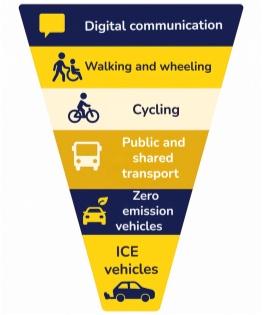
Transport Vision and Hierarchy
All new development shall contribute to the achievement of the Transport Vision:
To provide integrated, accessible, and inclusive transport for everyone, in line with the transport hierarchy, that facilitates growth and supports reaching net zero carbon.
This is expected to be achieved through development that is led by the transport hierarchy, with effective digital communication to facilitate work and leisure activities, connected to the existing transport network across all layers of the transport hierarchy, improving travel choice and delivering benefits to the health and wellbeing of those within the proposed development and those around and/or interacting with it. Improvements to the transport network to deliver these connections may be required to provide integration, accessibility, and inclusivity.
Strategic Improvements
The council will support improvements to the strategic transport system that enhance the connections between the three towns, between Torbay and the rest of the sub-region, and between Torbay and national or international markets. The council expects new development to support this directly where applicable or will seek to facilitate delivery of these schemes through the safeguarding of land and/or contributions from development.
Proposals set out within the Devon and Torbay Local Transport Plan will be supported subject to other Local Plan Policies.
Community and Corporate Plan – Community and Place
Explanation
6.1 By improving transport connectivity and sustainability it will help deliver the transport infrastructure that is needed for our people and our place, underpinned by the need for resilience and safety on the network.
6.2 Transport has a significant impact on our local environment, and it is therefore important to keep people and businesses connected whilst also improving air quality, enhancing our natural environment and reducing emissions. To do this we will ensure all aspects of the transport hierarchy are considered appropriately.
6.3 How we travel is changing, with increased use of online access influencing how we shop, work and access services. As our climate and the way people travel changes, we need to adapt our transport system to ensure infrastructure remains resilient and will support our needs now and in future through choice.
6.4 The transport hierarchy ensures that as much emphasis as possible is given to the most sustainable modes of transport, but also to ensuring there is a choice of transport options for all.
6.5 To deliver the Local Plan's aspirations and objectives, improvements are needed to ensure the Strategic Transport Network across all modes is fit for purpose and accessible, in order to ensure free movement around the Bay and to the wider sub region and beyond. This is vital to delivering economic prosperity and also to support new development.
6.6 Proposals such as junction improvements, a new railway station, mobility hubs and new cycle routes will contribute directly to ensuring the success of the Strategic Delivery policies.
6.7 The Major Road Network is nationally defined and multi-modal improvements to it will be critical in ensuring the economic growth and delivery of future development in all areas of Torbay.
Walking, Wheeling and Cycling Network
6.8 Torbay's Local Cycling and Walking Infrastructure Plan identifies Bay Trails and supporting/connective walking and cycling infrastructure across Torbay, as well as enhancement and protection of the South West Coast Path and King Charles III England Coast Path.
6.9 Development will be expected to deliver local enhancements to walking, wheeling and cycling infrastructure to ensure effective integration with facilities and public transport services. Major development, and all development in growth areas will be expected to provide connectivity through and around the development proposal, providing key links for access to services, commuting and leisure.
Local Public Transport Services
6.10 Improvements to the bus and public transport networks and infrastructure to provide a step change in quality, accessibility and integration with other forms of transport.
Mobility Hubs
6.11 Development of multi-modal mobility hubs in key locations help to support connectivity to the transport network and increase travel choices. Individual hubs may provide different facilities appropriate to the location, but all major development must consider opportunities within the proposals, and those in growth areas must provide suitable facilities. These locations will increase travel choice opportunities for residents, visitors, and commuters. Sites suitable for more significant and/or bespoke facilities include (but are not limited to):
-
Paignton Transport Gateway, bringing together investment in the railway station, bus station, car parking and public realm
-
the former Park and Ride site at Churston, Brixham,
-
the site adjacent to Gallows Gate. Torquay.
Electric Vehicle Infrastructure
6.12 Electric vehicle infrastructure will not be considered in isolation and will feature across strategic and non-strategic investments in the transport network.
6.13 The ongoing delivery of on and off-street public charging infrastructure will be supplemented by new development requirements for associated provision.
Rail Network
6.14 New railway station within the Torquay Gateway, Edginswell, to support residential growth, employment sites, and critical health facilities.
6.15 Upgrades to existing stations to provide enhanced accessibility and other facilities to ensure everyone can access rail services within Torbay and supporting rail patronage to grow.
6.16 Development of proposals to extend the railway line to, and with a new station at, Goodrington Sands and continued maintenance and enhancement of the rail network serving the Bay, supporting the future needs.
6.17 Minimising the impact of development upon level crossings, and where necessary seeking developer contributions to help fund improvements to, or consider alterations to the operation of, level crossings, where these are required as a result of development.
Highway Network
6.18 Multi-modal enhancement of the Major Road Network, including the critical junctions and improving the flow of traffic, to ensure reliable connectivity within, to and from Torbay.
6.19 On-line multi-modal improvements, resilience, and traffic management schemes where necessary to protect and enhance critical route infrastructure.
6.20 The A385 Totnes Road (Torbay/South Hams border to Tweenaway Cross) remains a well used and important connection that is also proposed to accommodate significant new development. We will ensure better connectivity on that corridor across all modes. A comprehensive solution to transport issues is needed to enable the longer term development in Collaton St Mary (SDP4), and development contributions are expected to help fund these strategic improvements.
Policy TA1: Reducing the impact of transport and promoting sustainable travel View representations
Proposals shall support principles set out in Policy TAS and accord with the design code or supplementary planning document to support high quality, safe and accessible places.
To assess and mitigate the impact of development and to promote sustainable travel choices, the following information will be required to support planning applications:
A Transport Assessment and Travel Plan: where the proposed development is likely to have significant transport and related environmental impact (in accordance with Department for Transport guidance); or
A Transport Statement: where the development has relatively minor transport implications (in accordance with Department for Transport guidance).
Where there is an existing Travel Plan but only minor transport implications are expected, an update to the Travel Plan may still be necessary.
School Travel Plans (or updates) are required where provision for 30 or more extra pupils is planned. A Transport Assessment is required for proposals generating over 30 trips during the morning peak period of 8-9:30am.
The visual impact of transport infrastructure (including signage) within the street scene should be kept to a minimum, to avoid proliferation of unnecessary clutter or harm to amenity and the historic features.
New development must contribute to improved accessibility and a healthy living environment.
Community and Corporate Plan – Community and People
Explanation
6.21 An effective and efficient transport network is vital for people's lives and livelihoods.
6.22 A reliable, sustainable, safe and connected transport system can help improve the quality of life for residents and create a fairer and healthier society. It supports economic growth and productivity and enables more equitable access to jobs, education and services. It provides opportunities for physical activity, social interaction and access to the beautiful coast and countryside.
6.23 It is necessary to appropriately and proportionately assess the impact of development to ensure it is contributing and not adversely impacting or stifling economic growth within Torbay. Transport Assessment (for larger development) and Transport Statements (for more minor development) are key ways to assess this.
Policy TA2: Effective and inclusive transport system View representations
Where developments generate new or additional journeys, it may be necessary to seek financial contributions towards enhanced transport infrastructure or service provision.
Any new development that affects transport-especially if it leads to more journeys, increases demand for public transport, or reduces car parking-will be expected to contribute towards mitigating its impact and supporting improved transportation. This includes:
- Supporting stronger public transport services along Key Corridors,
- Better integration with other travel options,
- Supporting a safer unified bus network and transport links.
- Developments, particularly where related to town centres and harbour areas, shall also consider measures to enhance accessibility and use of taxi and ferry services.
It is important that future development makes an appropriate contribution to delivering across these areas to ensure an effective transport system. Proposals should encouraging sustainable modes of transport.
An effective transport system will be achieved through:
- Focusing development in locations that are accessible and safely connected by foot, cycle and other wheeled users, public transport, as well as by private vehicles to essential, everyday facilities and supported by opportunities for digital communication and remote working to reduce the need to travel.
- Where not already suitably located, improvements shall be sought to ensure users of the new development shall be able to more easily access everyday facilities safely in accordance with the transport hierarchy.
- Ensuring that the full extent of the transport hierarchy is provided for as an integral part of all developments, in a safe accessible way that minimises conflict between users.
- Improving road safety reflecting the hierarchy for all users and equality of access for all.
- Maximise the opportunities for sustainable transport of freight in addition to the high level of choice for employees and visitors.
- Appropriate provision of facilities for disabled persons, such as suitable levels, signage, facilities and parking bays must be included within all development.
Community and Corporate Plan – Community and People
Explanation
6.24 The council is delivering a sustainable, accessible, integrated and high-quality transportation system which enables travel choice for everyone and promotes Torbay's economic competitiveness, whilst reducing the need to travel and its environmental impact. It is expected that all new development will contribute towards this.
6.25 Improvements to transport will support Torbay to be healthy, happy and prosperous. These include a focus on improvements to help regenerate the town centres and improving travel choices throughout Torbay.
6.26 Major investment in Edginswell railway station is proposed. Bus improvements including zero emission buses, longer operating hours, faster services, more accessible infrastructure and better bus stop facilities will be supported. Improvements to walking, wheeling and cycling facilities and roll out of shared mobility will further enhance transport choice and make sustainable travel easier and more attractive for residents and visitors across Torbay and beyond.
Policy TA3: Development layout, access and connectivity standards View representations
Delivering suitable layouts
Layouts will provide and connect to a network of footpaths, cycle routes, green infrastructure and public transport, identified in the Torbay Green Infrastructure Delivery Plan, Local Cycling and Walking Infrastructure Plan (LCWIP), Bus Service Improvement Plan etc.,
Multi-modal travel links to, from and through new development will be provided for, or secured in perpetuity, along with links to potential future development surrounding the site.
Major development, and all development in growth areas, will be expected to provide unfettered connectivity through and around the development proposal, providing key links for access to services, commuting and leisure.
All development shall provide safe turning/manoeuvring and stopping areas for vehicles within the site, including deliveries.
Measures for emergency service vehicles, waste collection vehicles and public transport vehicles to access and service the site, as necessary and appropriate, in a way that would not disrupt the service they provide must be included within proposals.
As a minimum, estate roads serving major development will be constructed, completed and maintained to the council's approved highway standards, meet highway safety standards and be appropriately available for use by the occupants, and other users of the development.
The Local Highway Authority will seek to adopt residential estate roads via Section 38 of the Highways Act 1980 as a default position. All estate roads serving minor and major development (commercial or residential) will be required to have a Private Management and Maintenance Plan confirming funding, management and maintenance regimes for the lifetime of the development, if a S38 Agreement as not been entered into. Ransom strips at the edge of sites will be resisted.
Accessing the highway network
Schemes which require new access (vehicular, pedestrian or cycle) to/from the highway network will be supported where they:
- Are essential to access the schemes and can demonstrate significant environmental, safety or economic benefits;
- Provide access for all modes to a safe standard, that minimising conflicts between modes and users;
- Maintain an acceptable network capacity or provide suitable mitigation for any negative impact on capacity; and
- Enhance and contain high quality provision for sustainable modes of transport, proportional to the scale and type of development, prioritised in accordance with the Transport Hierarchy
New access points will not be permitted where there is an unacceptable impact on road safety, or severe impact on the highway operation.
Community and Corporate Plan – Community and Place
Explanation
6.27 It is an important principle that new development should integrate with the surrounding area in terms of its connectivity and should be accessible by a wide range of means to provide choice for residents/users.
6.28 Safe, free flowing and well maintained vehicular access throughout development is a vital element of a high quality development.
6.29 Development proposals that require new access provision for any mode will be permitted where the proposal does not create a safety concern for any user, significantly reduce capacity on the road network or impose delays to essential services. Ransom strips that impede later stages of development can create serious obstacles to site master planning and the creation of permeable layouts, and must be avoided.
Policy TA4: Parking and shared transport provision View representations
Parking should be provided in accordance with the council's minimum parking standards detailed set out below and in accompanying guidance (to be developed) .
In new development, appropriate levels and standards of parking will be incorporated for all users, including cycles, vehicles, electric charging, deliveries, disabled and visitors, that is well-designed, integrates with other public space uses and does not dominate the built environment.
The loss of existing parking provision for any mode, will be a material consideration in planning applications and must not result in the net loss of parking provision to below the standards. Additional development shall provide parking sufficient for the proposal which may exceed the existing.
Shared Transport/Car Club
For all residential developments over 100 units, allocated parking capacity with safe and efficient access to/from new homes and the public highway for shared cycle provision (at 1 space per 20 homes ratio) and shared car provision (at a ratio of 1 space per 100 homes) will be required.
For all residential, leisure and employment uses, appropriate contributions towards this provision of shared transport is expected to be necessary.
Provision of these should not be considered as a substitute for parking requirements unless otherwise agreed through an appropriate Transport Assessment/Statement and Travel Plan.
In applying site specific parking requirements, the council will seek to minimise the scope for community conflict and anti-social behaviour and will give significant weight to the achieving community safety.
Table 13: In Principle Minimum Parking Standards:
|
Cycle Parking |
Dedicated cycle parking is required within all new development. This can be either through internal storage as part of a non-habitable room, or within a garage, or a purpose-built cycle store. All cycle parking and any associated access routes must be well-illuminated with good natural surveillance to deter theft and engender a feeling of personal security. All cycle parking must be designed for the exclusive use of cycles and maintained in perpetuity. Whether cycle storage is provided within a standalone store or in an internal area of a building, it should be conveniently located with level access and users should not have to negotiate more than one door with their cycle (with a minimum width of 1.2m). Where rear storage is provided an accessway is expected to be designed in from the beginning (eliminating the need for cycles to traverse inside the property from rear to front (and vice versa). Provision for safe electrical charging should be made. Note: Cycle storage identified in habitable rooms, general storage areas, bin stores, circulation areas, or on balconies will not be considered acceptable. Residential use: 1 to 2 bedroom apartments: 1 space per apartment. 3+ bedroom apartments: 2 spaces per apartment. Houses: A minimum of 2 spaces per dwelling Houses in multiple occupation: 1 space per letting bedroom |
|
Provision for scooters (foot propelled) and powered two-wheeled vehicles including motorcycles. |
Secure and safe provision for scooters (foot propelled) and powered two-wheeled vehicles including motorcycles. Major developments based on at least 5% of the maximum total car parking standard. Minor developments provision provided on a case by case basis. |
|
Provision for mobility scooters: |
New development that is likely to cater for those making use of a mobility scooter, such as age restricted housing and extra care units, will be expected to make provision for storage areas and dedicated charging points on the ground floor and must form an integral element of the design of the development. |
|
Electric Vehicle Charging provision: |
Proposals for houses with at least one designated parking space within the curtilage of its own plot must ensure the installation of at least one active EV charging point. Conversions and change of use applications will be agreed with the LPA on a case by case basis. An expected ratio of 20% 'active EVC' is expected on minor residential development and 50% on major residential development. Commercial development should provide 30%. The EVCI charge requirements increase in line with the number and intensity of usage. |
|
Disabled parking requirements: |
Residential units: 1 space per wheelchair accessible unit plus provision for non-ambulant visitors. |
|
Parking for People with Young Children and specialist parking |
Provision for child and parent or specialist parking for development where appropriate. |
|
Shared Transport /Car Club |
Residential developments over 100 units, allocated parking capacity with safe and efficient access to/from new homes and the public highway for shared cycle provision (at 1 space per 20 homes ratio) and shared car provision (at a ratio of 1 space per 100 homes) will be required. All residential, leisure and employment uses: appropriate contributions towards provision of shared transport where assessed to be necessary. |
|
Car parking provision: |
All development should provide an appropriate level of car parking spaces per unit for occupants, staff and visitors to avoid overspill on-street parking. Specific requirements for other uses will be set out in supporting Supplementary Planning Document (SPD). Where no specific provision is defined, parking should be provided in accordance with a reasoned and site specific prediction of demand, which will need to be set out within the planning application documentation. General Minimum Parking Standard: 2 spaces per house: not to include garages unless additional on-curtilage parking is provided. 1.5 spaces per apartment Additional parking provision within the curtilage will be required for larger residential accommodation (3-4 bedrooms plus). Parking provision must include additional provision for visitors, appropriate to the nature and scale of the development. HMOs should provide 0.25 car parking spaces per bedroom (when calculating parking provision, fractions of spaces should be rounded to the nearest whole number. Town Centre and Accessible Locations Designated town centres: A reduced level of parking will be agreed up to zero car parking. Where below standard parking cannot be provided, additional sustainable transport measures will be sought if they can adequately off-set parking demand for the lifetime of the development. Reduced parking provision must be robustly justified in an appropriate Transport Assessment/Statement and Travel Plan. The active travel measures and improvements will be sought as a site deliverability matter where parking is below the general minimum parking standard. Accessible locations outside designated town centres: (e.g. within 400m footpath access of a national network rail train station or bus stop served by a minimum of 20-minute services): A reduced level of parking will be agreed with a minimum of 1 parking space per dwelling plus 0.5 spaces per dwelling for visitors. Where standard parking cannot be provided, additional sustainable transport measures will be sought if they can adequately off-set parking demand for the lifetime of the development. Reduced parking provision must be robustly justified in an appropriate Transport Assessment/Statement and Travel Plan. The active travel measures and improvements will be sought as a site deliverability matter where parking is below the general minimum parking standard. |
Community and Corporate Plan – Community and Place
Explanation
6.30 Parking standards need to reflect a balance between ensuring that the levels of car parking generated by any type of development are met on-site (and therefore overspill and the proliferation of on-street parking and conflict over parking is limited) with the need to ensure that the consideration of sustainable transport is fully embedded into the design for new developments. The Local Plan recognises that many people will own motor vehicles and seeks to provide alternatives to car use rather than seeking to restrict ownership. The Plan therefore requires residential development to provide adequate on-site parking where possible, but these requirements should not dominate the site's appearance and should be useable. In broad terms, the provision of adequate and appropriate residential parking should be safe, convenient and discrete so that vehicles do not obstruct the highway or dominate the street scene. Torbay Council will take a site specific approach taking these considerations into account.
6.31 Reduced parking requirements may be permissible in town centres and active travel/sustainable transport corridors, subject to active travel measures and improvements which will be sought as a site deliverability matter where parking is below standard. For all residential, leisure and employment uses, appropriate contributions towards this provision of shared transport is expected to be necessary. Additional guidance (SPD) will set out further details on the nature and scale of development parking provision
6.32 Changes of use will be particularly scrutinised to ensure they do not result in localised parking problems or harm an area's character, undermine economic viability or lead to community conflict. Levels of car parking provision should also take into account peak and seasonal effects, particularly the additional tourist demand during summer months. High traffic generating uses, particularly out of town developments requiring a Travel Plan, will need to examine how parking provision can affect the way people choose to travel.
6.33 The layout and design of car parks should reflect the scale and character of the area; they should be accessible and safe, with careful consideration given to the pattern and scale of buildings and open spaces in the vicinity. They should positively contribute to the urban environment with appropriate hard and soft landscaping, surface materials and street furniture.
Have your say on Chapter 6