Regulation 18 Draft Local Plan 2025 Online Version and Consultation
Other elements in this consultation
Chapter 12: Responsible resource use - Waste and Minerals View representations
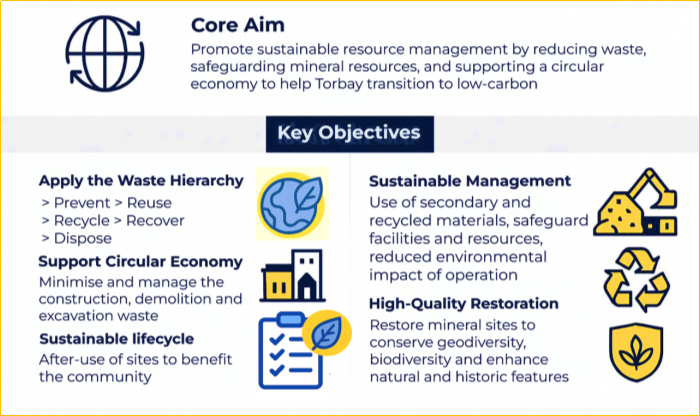
Strategic Policy WS: Waste spatial strategy View representations
Development should minimise the production of waste and increase its reuse and promote the movement of waste up the Waste Hierarchy.
Waste management facilities that can provide an increase recycling, treatment and reprocessing of waste to ensure sufficient capacity exists for the sustainable management of Torbay's waste will be supported.
Waste management sites should be restored at the earliest opportunity to the highest possible standard to sustainable after-uses that benefit the community economically, socially and environmentally.
Where possible, after-uses should conserve and improve local landscape character and provide opportunities for biodiversity.
Community and Corporate Plan – Creating a Sustainable Future
Explanation
12.1 As a Waste Planning Authority (WPA) and Waste Collection Authority (WCA) the council needs to maximise the 'value' of resources that we manage from households, in terms of realising the social, environmental and economic opportunities. As a Waste Disposal Authority (WDA) we also need to assess current and future infrastructure operational requirements which will also help to meet the Waste Hierarchy and government targets.
Policy W1: Waste hierarchy and sustainable waste management View representations
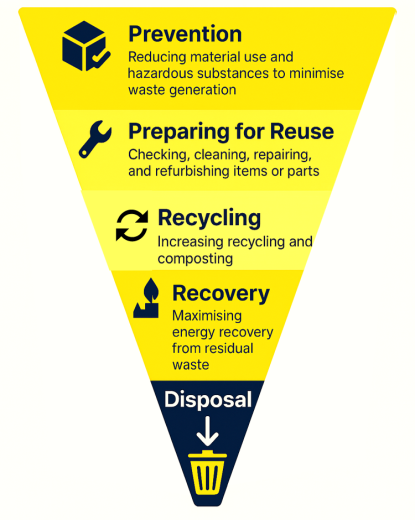
All development should seek to minimise the generation of waste, having regard to the waste hierarchy[20]:
- Prevention: Using less material in design, manufacture and re-use. Using less hazardous material and other measures to minimise waste generation.
- Preparing for Reuse: Checking, cleaning, repairing, refurbishing, whole items or spare parts
- Recycling Increase recycling and composting through the kerbside collection regime and ensuring adequate existing recycling facilities in Torbay as well as the improvement or development of new facilities where appropriate. Explore opportunities for storage, re-use and collection facilities. Provision of waste audit statements demonstrating accordance with the waste hierarchy for major developments.
- Recovery: Maximise the recovery of residual waste, through a partnership approach with other Devon Authorities for the use of the site in Plymouth for 'energy from waste recovery'.
- Disposal: Minimise the amount of residual waste which is disposed of and minimise the exporting of waste for disposal to Devon.
Development proposals will be expected to provide a scheme of sustainable waste management, proportionate to the scale and nature of the proposal. As a minimum, all developments should make provision for appropriate storage, recycling, treatment and removal of waste likely to be generated. Residential units should be provided with adequate space within the curtilage for waste and accessible kerbside recycling bins and boxes as a site acceptability matter. Planning contributions may be required to enable the provision of additional waste management facilities or equipment where these are needed to support development.
Community and Corporate Plan – Creating a Sustainable Future
Explanation
12.2 The government has introduced legal requirements to drive waste up the hierarchy including the following:
-
plans must be in place detailing measures to ensure 65 per cent of municipal waste, including household waste and household like waste from commercial and industrial sources, is recycled by 2035.
-
the volume of residual waste per person which is not reused or recycled must be halved by 2042 from 2019 levels.
-
by 2050, avoidable waste must be eliminated by recycling or reusing any waste which possibly can be reused or recycled.
12.3 The Local Plan therefore seeks to influence/reduce waste arising from all forms of development. In accordance with the Waste Hierarchy, the Plan gives priority to planning for waste management developments that prepare waste for re-use or recycling.
Policy W2: Waste reduction and waste audit for major and significant waste generating developments View representations
All new development must be designed in accordance with "circular economy" principles to minimise the production of construction, demolition and excavation waste and manage any such waste arising during the development in accordance with Policy W1 and accord with the Principles of the Circular Economy to:
- retain and repurpose existing structures where possible retain and repurpose existing structures where possible;
- allow for ease of redevelopment and refurbishment; and,
- maximise sustainable construction methods which include the use of recycled and recyclable materials and techniques which minimise waste and allow for ease of deconstruction and reuse of building components.
Major Development proposals which are likely to generate significant volumes of waste must include a Waste Audit and Five Year Waste Management Plan setting out how waste generation will be reduced during the construction and operation of the development. This will include provision of appropriate on-site facilities for storage, re-use, recycling (composting where appropriate) and collection of waste. Schemes should include measures to:
- Prevent and minimise, re-use and recycle waste (including composting where appropriate);
- Minimise the use of raw materials;
- Minimise the pollution potential of unavoidable waste;
- Seek alternative modes of transport (to the use of roads) to move waste;
- Make provision for the storage and collection of recyclables and waste. Planning contributions for off-site waste management facilities may also be required; and
- Dispose of unavoidable waste in an environmentally acceptable manner;
The audit should be proportionate to the scale of the proposal, number of visitors and likely waste (including operational waste) generation.
Proposals for waste disposal sites must incorporate a satisfactory scheme for the reclamation of the site to an appropriate after-use, progressively wherever possible, and at the earliest possible opportunity, and progressively during site operation where possible. Adequate contingency measures should be included to manage any systems failures.
All relevant proposals should be accompanied by a recycling and waste management strategy which considers the above matters and demonstrates the ability to meet local authority waste management targets where applicable.
Community and Corporate Plan – Creating a Sustainable Future
Explanation
12.4 Policy W2 requires a Waste Audit to be carried out to assess and manage the impact of major development and uses that can be reasonably expected to generate significant levels of waste.
12.5 The Waste Audit should demonstrate that waste will be minimised as far as possible in both construction and operational phases and managed in an appropriate manner in accordance with the waste hierarchy. The Waste Audit and Five Year Waste Management Plan should include details relating to the minimisation of the use of raw materials, the nature and volumes of waste generated and how waste has been minimised and segregated (i.e. sorting, storage, recovery and recycling facilities). Other measures should also be included to manage waste that cannot be incorporated within the new development, or that arises once it is operational. For residential and commercial development the provision of reduction and/or recycling infrastructure should be identified and support for community composting schemes demonstrated where appropriate. Before granting planning permission, additional waste management measures may also be required to ensure movement up the waste hierarchy.
Strategic Policy W3: Safeguarding waste management facilities View representations
Existing, allocated or consented waste management sites (for the re-use, recycling and composting, transfer, treatment, recovery or disposal of waste) will be protected unless no longer required or alternative provision can be made. Development proposals at, or within 250m of, waste management sites that would prevent or prejudice the use of such sites for those purposes will not be permitted unless conflicts can be satisfactorily mitigated.
The continued enhancement and improvement of the Torbay Household Waste Recycling Centre (HWRC) and Waste Transfer Station at Yalberton, Paignton will be supported. The use of Yalberton Tor Quarry for Construction, Demolition and Engineering Waste, or other waste management purposes, will be protected.
Community and Corporate Plan – Creating a Sustainable Future
Explanation
12.6 The Waste Planning Authority must demonstrate sufficient waste management capacity and allocate sufficient provision of waste management sites to meet Torbay's need. A Waste Site Assessment was carried out in 2013, which identified very limited scope for deliverable major new waste management facilities in Torbay.
12.7 The continued enhancement of existing waste management sites including the Torbay HWRC and Waste Transfer Station at Yalberton to accommodate additional facilities will be supported, to ensure sufficient capacity to serve Torbay to 2031. The need for additional local Household Waste Recycling Centres elsewhere in Torbay during the Plan period will be kept under review. The impact of all operations must be minimised and sites restored where appropriate in accordance with Policy W4. Yalberton Tor Quarry has previously operated as a Construction, Demolition and Engineering Waste (CDEW) facility in Torbay. It's future use will need to be assessed against the need for continuing as a CDEW facility or as another waste management facility.
12.8 It is essential that waste management facilities (whether proposed or existing) are safeguarded from any development proposals in close proximity to them which may prevent or prejudice their operation. This Policy should also be applied to waste management sites with planning consent.
Policy W4: Proposals for new waste management facilities View representations
Preference will be given to proposals for (non-hazardous) waste management facilities that are in accordance with the waste hierarchy and located on previously developed land. Individual sites should be well-related to the transport network (including rail and water), to centres of population and sources of waste, and be compatible with neighbouring land uses.
Waste management development will be supported where they would not have an unacceptable impact (including cumulative impact in combination with other existing or permitted development) upon human health, amenity, (including noise levels, odour, air quality, dust, litter, light pollution and vibration) land stability, the quality and quantity of surface waterbodies, groundwater, capacity of existing drainage systems, hydrogeological ) and flood risk and features of, environmental (including landscape, historic and geological environment) and biodiversity importance. Policies for the protection of these features are set out elsewhere in the Plan.
Development of facilities for the management of special types of waste (including clinical or hazardous waste) should serve a defined local need and particular consideration will be given to any health, environmental and amenity impacts.
The immediate and wider impact of facilities on the surrounding environment should be minimised through high quality design solutions, with the use of sympathetic materials and colour schemes, and effective methods of landscaping and screening. Specific site management issues should be carefully addressed including amenity, litter, vermin and birds, the impact of odours, lighting, noise, vibration, hours of operation, access and transport movements.
All proposals for waste management facilities must assess the potential for non-HGV transportation of materials to and from the facilities, principally by rail (or water) and take up these sustainable transport opportunities where available. Proposals should be satisfactory in terms of access where anticipated HGV movements, taking into account cumulative impacts and any mitigation measures proposed (including safety, highway network, air quality). Supporting Transport Statements/Assessments should demonstrate sufficient parking, access, routes, safeguarding of other road users and sustainable transport measures.
Where appropriate, provision for restoration and after use will be required.
Community and Corporate Plan – Creating a Sustainable Future
Explanation
12.9 Policy W4 sets out criteria for new waste management facilities. Such proposals must safeguard residential and other amenity and minimise impact on the road network.
12.10 The Local Plan continues to identify Yalberton and Yalberton Tor Quarry for Waste Management purposes. Most waste management facilities are expected to be in this area. It allows consideration of proposals to support the existing material recycling facility (MRF) including provision for waste and recycling collection vehicles. The Plan also seeks to ensure that Yalberton Road is not sterilised from waste related activities by allowing residential development to encroach too close to it e.g. between Berry Acres and Yalberton Road.
Strategic Policy W5: Waste water disposal and infrastructure capacity View representations
New, enhanced or extended waste water treatment facilities will be supported where such proposals aim to improve the quality of discharged water or reduce the environmental impact of the operation of the waste water treatment facility.
Development proposals will be required to demonstrate that the proposal can be delivered and operated without giving rise to unacceptable impacts on water treatment and disposal, or deterioration in the service received by residents and businesses. In considering minor development proposals, the council will have regard to the in-combination impact of such developments and their effect on local capacity or flows.
Proposals for housing developments, particularly on new greenfield sites and Future Growth Areas, will not be supported if South West Water, Natural England or the Environment Agency confirm that:
- Waste water treatment works or other sewerage infrastructure serving these developments have insufficient capacity to accommodate the additional development, without increasing the risk of overflows of untreated sewage into the environment; or
- There would be an increase in the levels of pollutants or spills (see definition below) likely to have an adverse effect on the integrity of the Lyme Bay and Torbay Marine Special Area of Conservation, due to insufficient capacity within the combined sewer system and/or of treatment works; or
- The proposal would otherwise increase the risk of overflows of untreated sewage into the environment.
Appropriate measures to reduce the impact of development on the sewerage system, such as natural or sustainable drainage and water conservation measures, will be required, proportionate to the scale and nature of development.
In addition, development of previously developed land must be in accordance with the hierarchy set out in Policy ER2 to ensure that development schemes do not exacerbate sewer flooding and Combined Sewer Outfall (CSO) spills. This will apply in particular, to development that discharges into Hope's Nose CSO in Torquay.
A Health Impact Assessment will be required for new or extended waste water treatment facilities. Existing facilities (including Brokenbury Quarry) will be protected; new development should not compromise their operational efficiency and environmental impact.
Community and Corporate Plan – Creating a Sustainable Future
Explanation
12.11 Waste water treatment facilities are essential infrastructure, necessary to protect human health and water quality.
12.12 For appropriate new developments, the council will consider the use of natural sewage treatment methods (including reedbeds) and sustainable drainage measures. This will help meet Water Framework Directive objectives, which the council will ensure are not undermined by development.
Strategic Policy MS: Sustainable minerals strategy View representations
Mineral development should contribute to the progression towards a low carbon economy, facilitate the processing and use of secondary and recycled aggregates to become less reliant on land-won construction aggregates and include appropriate adaptation to the effects of climate change. Economic mineral resources will be protected for future generations this including building stone minerals for heritage building products, alongside associated or potential mineral transportation and processing infrastructure.
Mineral sites should be restored to a high standard and the natural and historically sensitive features are conserved and enhanced including features of geodiversity / geological interest in the context of the UNESCO Geopark.
Community and Corporate Plan – Creating a Sustainable Future
Explanation
12.13 The spatial vision outlines an ambition for sustainable resource management for minerals development in the plan area. It seeks to manage mineral safeguarding, extraction and possessing according to the principles of sustainable development.
Policy M1: Minerals extraction and environmental safeguards View representations
The process of identifying, appraising, designing and implementing proposals for new or disused sites for minerals extraction will be subject to the following criteria:
- The need for the mineral, taking account of aggregate landbanks for Devon;
- Likely effects on designated sites of environmental and historic importance, geodiversity or biodiversity;
- Impact on the surface water flow regime and groundwater sources;
- Compatibility with surrounding land uses, including historic character and landscapes, and in particular protected landscapes such as National Landscape;
- Proximity to local communities and the need to maintain and enhance the local landscape character and setting of settlements;
- Proximity to primary end use markets and ease of access by road or alternative transport modes;
- The ability for a site or sites to deliver significant contributions to habitat creation and priority species as well as geodiversity gains where applicable;
- The provision of Pollution Prevention Plans, including a method statement for management of all potentially polluting activities; and
- There are no unacceptable impacts on human health, noise-sensitive properties and aviation safety; unavoidable noise, dust and particle emissions or vibrations should be controlled, mitigated or removed at source.
Extensions to existing/disused sites will be given priority over new sites, subject to environmental acceptability. The cumulative effects of activities and sites will also be considered. Proposals for the extraction of building stone that demonstrate a local need for the mineral (such as the repair of heritage assets) will be supported, subject to the above criteria and other relevant Policy requirements of this Plan. An acceptable programme of progressive working throughout its life, early restoration and after-use should be submitted.
Community and Corporate Plan – Creating a Sustainable Future
Explanation
12.14 The NPPF requires Mineral Planning Authorities (MPAs) to plan for a steady and adequate supply of aggregates. Torbay Council is meeting this requirement by cooperating in the preparation of a Devon Local Aggregate Assessment with the other Mineral Planning Authorities in the County and Region. As part of this work, it has been established that the potential aggregate resources within Torbay are limited to limestone, for which Devon has a landbank equivalent to 50 years.
12.15 Torbay is adequately served by two existing limestone quarries in South Devon (Stoneycombe at Kingskerswell and Linhay Hill at Ashburton), each of which has sufficient reserves to last beyond the Plan period. Consequently, it is not considered necessary for Torbay to make provision for further land-won aggregate resources in the Plan period.
12.16 Limestone aggregate was available from Yalberton Tor Quarry (previously the only active quarry in Torbay) but this site now has planning approval for the operation of recycling aggregates, at which point its extraction permission was revoked.
12.17 The extraction of building stone within the Devon area is very limited and non-existent in Torbay. Previous quarrying at Berry Head in Brixham has had a large impact on the Head's appearance, and significant quarrying here would conflict with the area's landscape and biodiversity designations. However, the Strategic Stone Study (a Devon-wide study identifying the significant stone types used in the past and their potential current sources) indicates that there is a need for a range of building stone which is not available at present. The protection of locally important building stone is addressed in Policy M2 below. Proposals for extraction would be considered in the context of Policy M1.
Policy M2: Maximising the Use of secondary and recycled aggregates View representations
The council will support developments that promote and maximise the use of secondary and recycled aggregates. Sites for the reception, processing and distribution of secondary and recycled aggregates will be supported, subject to meeting other Policy requirements of this Plan, near to the source of raw materials in the following locations:
- Industrial areas and previously developed land;
- Within existing, proposed or suitable former minerals developments; and
- Co-located with existing or proposed waste management facilities.
Proposals should satisfy criteria 2 to 9 in Policy M1. Any new development that might constrain the effective operation of existing facilities will be resisted.
Community and Corporate Plan – Creating a Sustainable Future
Explanation
12.18 In order to secure their long-term conservation and make best use of mineral resources, the NPPF states that MPAs should safeguard the potential for the production of secondary and recycled minerals. Producing recycled aggregate helps to reduce demand for primary aggregates. The council will seek to safeguard existing and any proposed minerals recycling facilities, for the reception and processing of construction and demolition wastes. The main source of alternative aggregates arises from construction, demolition and excavated waste (often referred to as CDE waste). Policies W1, W4 also seek to reduce the amount of raw materials in construction, minimise waste production and to maximise the use of secondary and recycled aggregates.
12.19 Yalberton Tor Quarry has planning approval for the operation of recycling aggregates. Policy TA1 encourages the consideration of alternative modes of transport to move aggregates. The jointly prepared annual Devon-wide Local Aggregate Assessment includes an assessment of all aggregate supply including secondary and recycled sources. Although secondary aggregates (which in Devon are derived from china clay waste and ball clay waste, or potentially incinerator bottom ash) are unlikely to be generated in Torbay, any facility for their processing would be considered in the context of this Policy.
Policy M3: Preserving and safeguarding of limestone resources and key local building stone View representations
The council will seek to safeguard important mineral resources and sites. The use of local building stone in new development and for restoration purposes (particularly of heritage assets) will be encouraged. The redevelopment of buildings constructed in local stone should ensure the re-use or salvage of such material. Any proposal on or in the vicinity of an important mineral resource, including a Mineral Safeguarding Area, should demonstrate that it will not cause unnecessary sterilisation or prejudice the future extraction of important minerals or building stone on these sites.
Community and Corporate Plan – Creating a Sustainable Future
Explanation
12.20 Minerals are a finite resource. The NPPF requires that proven mineral resources should be protected by designation as Mineral Safeguarding and Mineral Consultation Areas to avoid being needlessly sterilised by non-mineral development.
12.21 In order to allow flexibility in demand and ensure long-term supply, Devon County Council (Torbay's neighbouring MPA) has identified the need for safeguarding of aggregate and mineral resources for future generations, some of which lie adjacent to Torbay's boundary. In consultation with Devon County Council and consistent with this approach, Torbay has identified an area of Devonian Limestone as a resource which lies largely in the south of Torbay from the River Dart valley at Galmpton across the northern part of the Brixham Peninsula from Churston to Berry Head.
12.22 A Mineral Safeguarding Area (MSA) is shown on the Policies Map. Its identification has been based on the known location of the resource (British Geological Survey records) but aligned to field boundaries predominantly in the undeveloped area to prevent unnecessary sterilisation of the mineral resource. The MSA does not state the quality of the resource or presume that the resource will be worked, nor does it preclude all development. However, dependent on the scale and location of any proposed development, an assessment may be required of the likely effect on the mineral resource beneath or adjacent to the development site.
12.23 Traditional stone forms a strong element underpinning the character of many of Torbay's individual buildings and conservation areas. The use of local materials, building methods and details helps to enhance local distinctiveness. Imported stone does not often reflect this local distinctiveness and can detract from the stone in older buildings, harming the character of the area. It is therefore necessary to protect key local stone types both now and in the future, for the ongoing maintenance and restoration of some of our most important historic buildings, the preservation and enhancement of conservation areas and the maintenance of local distinctiveness. It is envisaged that access for small-scale, limited extraction for key local stone (to meet a specific need) may be required, subject to environmental and amenity impact.
[20]Waste Management Plan for England
