Regulation 18 Draft Local Plan 2025 Online Version and Consultation
Other elements in this consultation
Chapter 5: Thriving communities - Wellbeing, safety and belonging View representations
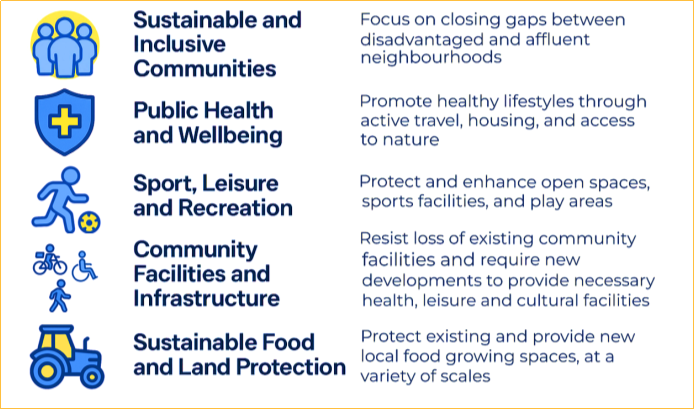
Strategic Policy SCS: Sustainable and inclusive communities strategy View representations
Development will be assessed against its contribution to improving the sustainability of existing and new communities within the Bay, and especially the way in which it closes the gap between the most and least disadvantaged neighbourhoods in Torbay.
Development must help to create cohesive communities within a high quality built and natural environment where people want to live and work.
Proposals that regenerate or lead to the improvement of social, economic or environmental conditions in Torbay, and particularly within deprived areas, will be supported in principle.
Development proposals will be assessed according to whether they achieve the following criteria, insofar as they are relevant and proportionate to the development:
- Meet the needs of and enhance the quality of life of residents;
- Help to close the gap between the most and least disadvantaged people and neighbourhoods in Torbay;
- Help to develop a sense of place and local identity;
- Promote social inclusion, and seek to eliminate exclusion based on access to housing, health, education, recreation or other facilities;
- Help to reduce and prevent crime and the fear of crime whilst designing out opportunities for crime, antisocial behaviour, disorder and community conflict;
- Helps to reduce social isolation by providing communal facilities and opportunities for people to interact.
- Support local food production and consumption;
- Create a well-connected, accessible and safe community;
- Contribute to the success of the local labour market by improving provision of and/or access to jobs and widening the pool of available labour.
- Protect and enhance the local natural and built environment, including where appropriate through planning contributions;
- Deliver development of an improved type, scale, quality, mix and density in relation to its location;
- Contribute towards any additional educational or training needs including the promotion and negotiation of local labour training arrangements, placements and apprenticeship schemes, and by supporting the provision of local employment space, in order to tackle worklessness;
- Enable people to have access to local services to meet their day-to-day needs including open spaces, community halls (or rooms), play areas, leisure and recreation facilities and allotments;
- The maintenance and improvement of strategic health services in Torbay commensurate with the population size and age structure, with a key focus on Torbay Hospital.
- Contribute to health services, policing and other social infrastructure where development would exacerbate shortfalls in provision; and
- Provide a good standard of residential accommodation, by seeking to retain small to medium sized homes (2–4 bedrooms) and resisting change of use of buildings to HMOs and small self-contained dwellings. This applies especially in areas with significant deprivation.
Community and Corporate Plan – Community and Place
Explanation
5.1 The Local Plan focusses development into existing urban areas. It is important that the opportunity that development provides to help shape our urban areas in sustainable and healthy ways which benefits local communities, is achieved. We want our existing urban areas, particularly our town centres, to be places people increasingly aspire to live in.
5.2 Conversely, new out-of-town centre housing should not be car dependent and bereft of local amenities and services.
5.3 Good quality sustainable communities and neighbourhoods should have good access to employment, housing and essential infrastructure such as health and policing. Measures will be supported to safeguard and improve the provision of facilities, such as those for health, education, social interaction, sport, recreation, and transport, as well as services such as crematoria and cemeteries. Contributions will be sought towards the provision by the development of new facilities where levels of demand show this to be necessary (see also Policy IN1).
5.4 Health, well-being and the built environment are inextricably linked. The implications of the proposals upon the health and the well-being of the affected communities must be considered at plan making and planning application stages. Health and well-being is enhanced by attractive, inspiring environments and contact with nature.
5.5 However, the NHS has identified severe shortfalls in primary and secondary health across Torbay. Accordingly, contributions will be sought towards healthcare provision from developments that are likely to increase pressure on health services.
5.6 Planning should create safe and accessible environments where crime and the fear of crime do not undermine quality of life or community cohesion (NPPF paragraph 58 refers). The Police Architectural Liaison Officer (ALO) will provide advice and recommendations on designing out opportunities for crime, disorder, antisocial behaviour and community conflict in the built environment. (See also Policy TC10 Safe and welcoming town centres for all and DE1 Design.) Where the Police identify that development would create additional pressure on services a contribution will be sought towards additional infrastructure.
5.7 Torbay, like many seaside resorts, is characterised by pockets of severe deprivation, which often exist close to more affluent areas. Overall, the 2025 Indices of Multiple Deprivation show that Torbay remains the most deprived local authority area in the South West, with particular concentrations in "inner urban" neighbourhoods in Torquay and Paignton town centres, and some residential estates. Eleven neighbourhoods (lower super output areas comprising about 1500 people) were in the 10% most deprived neighbourhoods in England, which is one more than in the 2019 Indices of Multiple Deprivation. The clearest factors were poor employment and low income. Poor-quality housing much of which is sub-divided apartments in the private rented sector also contributes to the high levels of deprivation.
5.8 The Local Plan identifies "deprived areas" as those within the 20% most deprived Lower Super Output Areas LSOAs in England in the most recent Indices of Deprivation. Please note that the IMD 2025 will be used for the Plan; but this was only published in late October 2025, and the Policies map currently uses the IMD 2019 boundaries.
5.9 The Local Plan will support schemes that deliver a mix of employment, family housing, healthcare, childcare, education and local centre facilities,
5.10 The Local Plan is realistic that such areas are likely to include "lower quartile" housing and are often sustainably located close to shops and other facilities; and can therefore be good locations for affordable housing. However, the council will resist the creation of very small apartments and HMOs where this would make deprivation and associated issues more severe. Conversion of existing buildings should be carried out to a good standard that creates a decent home, rather than simply repurposing commercial accommodation for residential use at minimum cost. This would include, for example, the creation of proper house frontages rather than curtaining over shop front windows (subject to other design and historic environment considerations). The refurbishment and retrofitting of existing properties to secure a better standard of accommodation, improved energy efficiency, renewable energy provision and improved public space will be supported (see also Policies in Chapter 8 of the Plan).
5.11 Because Community Investment Areas are usually within established built up areas, the scope for new greenfield development within them is likely to be relatively limited. In appropriate circumstances developer contributions from other areas may be pooled to support refurbishment, bringing vacant property into use or other environmental improvements in Community Investment Areas. The council are seeking to bring vacant dwellings back into use though its accommodation repurposing programme. This has multiple benefits of regenerating areas, providing affordable housing and building local skills.
5.12 The council will use Local Development Orders, Article 4 Directions and Compulsory Purchase powers to help deliver comprehensive urban renewal schemes and the ambitions of this policy.
Strategic Policy SC1: Public health and wellbeing View representations
Development must contribute to improving the health and wellbeing of the community by reducing health inequalities and helping to deliver the conditions to enable healthy lifestyles and sustainable neighbourhoods. Development which exacerbates factors which worsen living conditions, and therefore harm public health objectives, will not be supported.
Development must have regard to the health needs of the population and have special consideration towards measures which will address reducing health inequalities, including those geographically across the Torbay area and those which are experienced between different population groups.
To achieve these requirements, development must, through its location, design and suitability to local context, maximise its potential to address the place-based determinants of ill-health in the local area, including with strong reference where relevant to:
- Active travel - enabling active mobility through walking, wheeling and cycling
- Housing – delivering diverse house types; affordable housing and accommodation to address local needs; energy efficient homes with good daylight, ventilation and thermal comfort; and comfortable living environments
- Communal and community facilities to reduce social isolation
- Employment – taking opportunity to provide local employment through construction and operation
- Natural environment – reducing exposure to environmental hazards, facilitating access to nature, and participation in physical activity in outdoor settings
- Transport – enabling 'access for all' and the use of public transport
- Healthier food – providing opportunities to produce and increase access to healthier food and decrease exposure to unhealthy food environments
Development proposals should be prepared with special consideration for the identified needs and issues of the local community and neighbourhood where it is located. This means early engagement with the public and local stakeholders, as well as referring to available local evidence which can augment this understanding.
Development which creates an improvement of access and provision to health and care services will be supported.
Developments which offer the potential to give rise to significant health impacts will be required to undertake a systematic assessment of those impacts through mechanisms such as Health Impact Assessment.
Community and Corporate Plan – Community and Place
Explanation
5.13 A 'healthy place' is a good place to grow up, live, work and grow old in. It is a living environment which supports people to live their lives in a state of good physical, mental and social well-being. Healthy places contribute to the prevention of ill health and provide the environmental conditions to support good health.
5.14 Health, well-being and the built environment are inextricably linked. New development has the potential to positively or negatively affect the wider determinants ('the causes of the causes') of health in our neighbourhoods. It is therefore important that the implications of proposed development upon the health and well-being of communities are considered.
5.15 Health indicators for Torbay relating to poor health and premature mortality show a relationship strongly related to demographics and levels of deprivation, including significant levels of health inequality (variation in health and wellbeing across different population groups). In our most affluent areas residents can expect to live almost eight years longer than those in our most deprived communities. There are significant gaps in healthy life expectancy (years in good health) between the most affluent and deprived areas. Torbay's annual Joint Strategic Needs Assessment provides further detail about the specific health needs of the population across Torbay and should be referred to as part of the development of planning applications, particularly when considering Health Impact Assessment.
5.16 Development can contribute to creating healthier communities in a number of ways, for example by providing decent accommodation, reducing the effect of fuel poverty, providing open space and recreation areas, access to healthy food and supporting active travel. Torbay has a significant ageing population, many of whom live alone, and the implementation of Age-Friendly initiatives to promote inclusive, healthy environments and reduce isolation is important. Also, child-friendly design is crucial in helping to enable good health across the life-course.
5.17 All developments should consider how they can promote healthier outcomes. Proposals will be expected to assess their impact on health, proportionate to the scale of development. Health Impact Assessment is one mechanism that can be useful to consider and integrate health within the design of new development. It can be implemented at various scales (for instance comprehensive, rapid or desktop) tailored to the complexity and scale of proposals. Torbay Council provides local planning guidance on methods to help developers assess and evidence how health and wellbeing has been considered and integrated into proposals and will use this information to aid decision making.
5.18 Approaches to delivering healthy places across Torbay need to take account of their context and the community within which it is placed. Our communities are different. There are 16 Community Partnership areas across Torbay, with their own specific needs. Engagement with communities and local stakeholders is essential when considering how new development can contribute to creating healthier places. The local needs of different population groups within local areas must be considered and referred to as part of the evolution of proposals. Development proposals which make genuine efforts to support these needs will be looked upon more favourably.
Strategic Policy SC2: Sport, leisure and recreation for healthy living View representations
Physical activity and access to open spaces is important for health and Well-being. Development should provide access to sport, leisure and recreation facilities according to the additional demand it generates and the capacity, condition and location of existing facilities. Where a need is identified for new facilities, they should be appropriately inclusive and provided in appropriate locations, preferably co-located with existing and other planned sports facilities, where they are accessible for all users (i.e. following the transport hierarchy) including a range and choice of transport and comply with other policies in this Plan, particularly in relation to residential amenity.
An assessment of existing provision of such facilities will be required with development proposals proportionate to their scale, allowing the council to determine whether a contribution is needed towards new facilities or the enhancement of existing provision at least in line with the Fields In Trust open spaces standards1
Major new leisure facilities should be developed on accessible and well-located sites, wherever possible, using available town centre sites as first preference, then edge of town centre sites, district centre locations and existing concentrations of facilities. Any proposal that may lead to likely significant effects on sites protected under European legislation will only be permitted where no adverse effect on the integrity of the site can be shown.
The key sports and recreation facilities and improvements to these facilities will be supported:
- Torquay United Football Grounds and environs.
- Riviera International Conference Centre and environs.
- Sports facilities at Torbay Leisure Centre and associated VeloPark and pitches at Clennon Valley, Paignton;
- Water sports facilities at Torquay, Paignton and Brixham *
- Sports facilities at Churston, Brixham (area of search).*
- Other Sports pitches identified in the Torbay Playing Pitch Strategy (2024), Local Football Facilities Plan (2024) and other evidence base that emerges.*
There will be a presumption against loss of existing open space, sports and recreational buildings and land, including playing fields and formal play spaces, that should not be built on unless:
- An assessment has been undertaken which has clearly shown the open space, buildings or land to be surplus to requirements; or
- The loss resulting from the proposed development would be replaced by equivalent or better provision in terms of quantity and quality in a suitable location; or
- The development is for alternative sports and recreational provision, the benefits of which clearly outweigh the loss.
Planning Contributions will be sought for the long-term maintenance and management of new recreation provision and mitigation where appropriate.
*Sites not shown on the Policies Map
Community and Corporate Plan – Community and People
Explanation
5.19 Torbay has a fantastic environment for sport and recreation, and there are clear links to health, well-being and productivity. Assessments of existing and future sports and recreational need have been undertaken by the council. This evidence base will be updated periodically as required and this Policy should be applied to development
5.20 The Local Plan has an important role in protecting and enhancing existing provision, supporting the development of new facilities and helping to bring forward the ambitions of people, clubs and representative organisations.
5.21 The provision of sports facilities often involves significant investment, and proposed new sites must be capable of sustaining and servicing any development through, for example, adequate car parking, and accommodating appropriate intensification of use, such as floodlighting. Proposals should be in accordance with other Policies in this Plan, for example those relating to countryside and design. Provision of sports, recreation and leisure facilities in more rural areas will need to be sensitively and carefully designed to ensure the facility, and its use, complements and does not unduly harm the character and appearance of the area.
5.22 The availability, within an acceptable safe walking distance, of sport, leisure and recreation facilities is an essential ingredient of a sustainable, healthy community.
5.23 Where proposals result in the loss of open space or recreation facilities, the above Policy and the NPPF require an assessment of their value to be carried out and replacement facilities of equivalent or better quality, quantity or location, to be provided.
Strategic Policy SC3: Education infrastructure and inclusive learning strategy View representations
The Local Plan will support the improvement of existing and provision of new educational facilities to meet identified needs in Torbay. This includes both the expansion of schools to meet identified needs in terms of providing sufficient places and improving the quality of provision; and the construction of new schools to address longer term requirements associated with the delivery of new homes. The ongoing needs of South Devon College will be supported.
Planning Contributions will be sought from development that generates a need for school places or facilities.
The following education facilities are proposed in the Local Plan, subject to master planning and confirmation of need from Children's Services:
- Improved provision of early years facilities within existing schools
- Improved primary school facilities serving the north and west of Torquay including facilities serving Torquay Gateway.
- The provision of an improved Special Education Needs and Disability (SEND) school to consolidate and expand existing provision.
- A new school at Inglewood, Paignton.
- Identification of a site for a ninth secondary school in the Bay, or expansion of existing schools to meet demand for secondary places.
Community and Corporate Plan – Community and People
Explanation
5.24 The NPPF requires local planning authorities to give great weight to the need to create, expand or alter schools, and to work to resolve key planning issues. The Local Plan supports the delivery of the council's capital programme to address current pupil number increases across Torbay. Policy IN1 seeks developer contributions towards infrastructure, including education facilities, where this is needed for development to proceed. Policy E6 deals with Local Training Agreements.
5.25 The Community and Corporate Plan prioritises the provision of safe environments for young people to thrive in and providing opportunities for everyone to raise their skill level. The Plan seeks to establish pathways for all young people, including those with special educational needs and/or disabilities (SEND) and care experienced young people.
5.26 The need for school places will be kept under review by the council's Education Team. The council's 2025 School Place Planning Statement indicates the impact of low birth rates in Torbay (mirroring the national trend) leading to spare capacity of primary places: 28.3% in Torquay, 25.5% in Paignton and 37.7% in Brixham. Closing schools is always a difficult decision and results in the loss of a wider community facility and a local source of good quality employment. It is not currently proposed to close any schools unless better alternative provision is made. This will need to be kept under review. However, there is likely to be a need for school improvements and potentially relocation where existing premises lack modern facilities.
5.27 In terms of secondary schools, there is a high inwards migration at secondary school level (Year 7) due to the pull of Torbay's three selective schools. This creates a capacity pressure on the secondary sector, although it is currently intended to meet this capacity within existing school campuses.
5.28 There is a significant, and growing, demand for Special Educational Needs (SEND) provision and provision is split across several sites. In the short term it is proposed to expand and utilise existing buildings. However, the Local Plan, in partnership with Children's Services and the School Place Planning Team will consider allocating a single site to consolidate and expand SEND provision.
5.29 The Plan is committed to provision of full coverage of education facilities located close to local communities. Where the expansion of a school results in the loss of public open space, Department for Education funding will be sought to identify and improve alternative open space and facilities in line with Policies SC1 and SC2.
Policy SC4: Sustainable food production and land protection View representations
The protection of existing and provision of new local food growing spaces, at a variety of scales, will be supported and expected from new development wherever practicable.
The change of use or redevelopment of allotment sites will not be permitted unless appropriate improved or equivalent alternative publicly available provision is made, or it can be clearly evidenced that there is no demand for the facility.
Development which would result in the detriment to or loss of the best and most versatile agricultural land (Grades 1, 2, or 3a) will only be permitted where there is an overriding need for the development and it is demonstrated by the applicant that it cannot be accommodated on lower grade land. Where development is proposed and there is a choice between sites of different grades, development should take place on land of the lowest grade feasible, subject to other Policies in the Plan. Where development is approved on the best and most versatile agricultural land, the local authority will require a schedule for the reuse of soils to be provided in accordance with an agreed agricultural land assessment.
Residential schemes at all scales should include provision for sustainable food production, proportionate to the scale of development. This should be guided by the provision indicated in Table 6 below. Food growing opportunities will also be sought from non-residential development on a case-by-case basis.
Food production features may include edible landscaping (hedgerows, trees, vertical growing), public amenity space (communal gardens, orchards, allotments, roof gardens, atriums/courtyards) and/or private amenity space (balconies, gardens). On larger development sites the specific provision of allotments or neighbourhood growing spaces will be sought. Where provision cannot be achieved on-site, off-site contributions to schemes within the nearby area will be sought.
Community and Corporate Plan – Community and Place
Explanation
5.30 Growing local food encourages people to lead more active, healthy lifestyles and generates community cohesion. Sustainable food production is a component in creating a low-carbon society and it helps the Bay become more resilient to future food insecurity. Local food has fewer food miles, and therefore less associated carbon emissions, and also helps support the local economy. Torbay stakeholders have identified allotment shortages, lack of community growing areas and a lack of producer outlets in towns as key issues to be resolved.
5.31 The accommodation of new development will inevitably put pressure on productive agricultural land, especially in an area as constrained (in terms of land area) as Torbay. The location of proposed development sites in this Plan has been informed by Sustainability Appraisal and Habitats Regulations Assessment. Consequently, the loss of best and most versatile agricultural land has been minimised. However, there are also many opportunities for development to help contribute at smaller and larger scales towards providing important local food growing and foraging opportunities.
5.32 Development and changes of use which result in the loss of high-grade agricultural land will need to establish that alternative, previously developed sites within existing developed areas have been investigated. Where there is an overriding need to develop on agricultural land of Grades 1, 2 or 3a and there is a choice between sites of different grades, land of the lowest grade should be developed, unless the lower grade land has an environmental value in terms of its landscape, nature conservation and historic or archaeological status which outweighs its agricultural significance.
5.33 The on-site provision of new allotments will be sought from major residential (30+ dwellings) and mixed-use schemes. However, it is recognised that the opportunity for some schemes to realistically deliver formal allotments may be limited. For instance, site-specific constraints and circumstances will have an impact. Opportunities to deliver allotments may be better realised through larger, strategic sites which offer a scale of development with greater prospects to secure their delivery. The enhancement of orchards will be supported, particularly where this would strengthen the growing of local varieties of fruits. Off-site contributions to support schemes, particularly the provision of neighbourhood growing, in the local area will be considered where sufficient on-site provision is not achievable.
Table 12 Sustainable Food Production Provision in Housing Developments.
|
Development scale |
Edible Landscaping e.g. hedgerows, trees, vertical growing (provided in public and private spaces) provided specifically or integrated with ornamental planting |
Private gardens and/or balconies e.g. ground/roof gardens with appropriate soil conditions, balcony provision of growing space |
Outdoor public amenity growing space e.g. communal and community gardens, atriums/courtyards, orchards, neighbourhood growing schemes (at a variety of scales) |
Allotments e.g. public provision of dedicated allotment spaces for the managed use by individuals and groups |
|
1-9 dwellings |
✓ |
✓ |
||
|
10-29 dwellings |
✓ |
✓ |
✓ |
|
|
30+ dwellings |
✓ |
✓ |
✓ |
✓ |
Policy SC5: Community facilities, infrastructure provision and developer contributions. View representations
All development should contribute positively to the provision of the necessary community facility demand that will arise. Major proposals should provide the necessary supporting infrastructure and community facilities proportionate and appropriate to the scale of the development. These will include health, leisure, education, meeting spaces, and cultural infrastructure, cemetery provision and other facilities such as allotments or community food growing.
Local services and facilities should be accessible via their location and have good transport connectivity. The loss of existing community facilities and buildings will be only be supported where it is demonstrated that they are not needed, or improved alternative provision is made.
Community and Corporate Plan – Community and People
Explanation
5.34 The NPPF requires local plans to plan positively for the provision of community facilities (such as local shops, meeting places, sports venues, open space, cultural buildings, public houses and places of worship) to enhance the sustainability of communities and residential environments. Plans should guard against the unnecessary loss of valued facilities and services, particularly where this would reduce the community's ability to meet its day-to-day needs.
5.35 This policy seeks to support sustainable communities where residents enjoy a high quality of life by protecting, retaining and enhancing existing community facilities, including resisting the loss of needed community facilities, and ensuring that new community facilities are located in accessible locations within existing settlements. Development should only be approved where there is sufficient capacity within existing infrastructure, or where there is a programme for improvements and planning contributions can mitigate the impact of development.
Policy SC6: Cemetery and memorial provision strategy View representations
A new cemetery is proposed for Green Burial in the Broadsands, Churston, Galmpton Neighbourhood Plan Area. The specific site will be determined on the basis of the following criteria. Proposals for other cemetery provision, crematoria or gardens of memorial will also be supported where they meet the following criteria:
- Do not have an unacceptable impact on landscape sensitivity, biodiversity, heritage, archaeology or residential amenity.
- Provide a level of tranquillity and dignity. Where proposals include crematoria or the scattering of ashes, they should be located away from residential properties and safeguard residential amenity.
- Where proposals include chapels, or other ceremonial facilities, they should not cause severe harm to the road network and should be reasonably accessible to active travel and public transport.
- Are located outside Groundwater Protection Zones or areas at risk of flooding.
- Are outside areas of contaminated land or former landfill areas.
- Proposals should not result in the loss of public access, open space or areas of recreation. Support will be given to proposals that enhance and improve public access, and management to maximise their wildlife and biodiversity value.
Community and Corporate Plan – Community and People
Explanation
5.36 Torbay's cemeteries are nearing capacity. Current projections indicate a need to identify about a hectare of land for burials. To avoid a disruption in burial services, new provision or a new cemetery site will be required during the Plan period. The Local Plan proposes additional burial facilities in the south of Torbay and provides an area of search. Provision could also be made as part of Torquay Gateway proposals (See Policy SDT2).
5.37 The location of cemeteries is subject to detailed Environment Agency Regulations (the Environmental Permitting Regulations, particularly in relation to watercourses and avoiding contamination), and therefore an "are of search" is included at this stage of the Plan.
5.38 Appropriate locations for new cemeteries will need to consider potential impacts on waterbodies. Cemeteries must not pollute groundwater or surface water and the Environment Agency will normally object to the locating of any new cemetery or the extension of any existing cemetery which could have a detrimental effect on groundwater, well, borehole or spring used to supply water that is for human consumption.
Have your say on Chapter 5