Regulation 18 Draft Local Plan 2025 Online Version and Consultation
Other elements in this consultation
Chapter 10: Our Shared History - Protecting and enhancing Torbay's heritage and identity View representations
Introduction
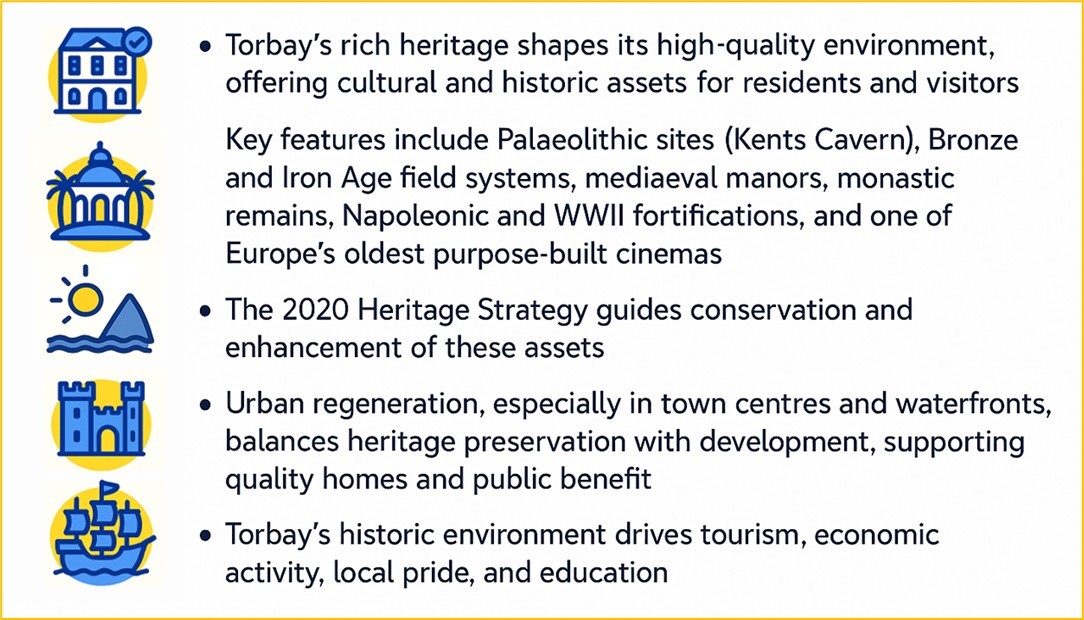
10.1 Torbay has a rich and varied history, which has helped create a high-quality built environment in which to live, work and visit. The Community and Corporate Plan aims to maximise heritage and cultural opportunities for the enjoyment and benefit of residents and visitors.
10.2 The current Torbay Heritage Strategy was adopted in November 2020. It describes Torbay's rich heritage and sets out objectives to conserve, manage and enhance Proposals should have regard to this document or any update.
10.3 Torbay's relationship with the sea has helped shape Torbay's built form. Its history is evidenced by a wide range of historic features, including Palaeolithic sites and finds of international importance (e.g. Kents Cavern), Bronze and Iron Age field systems in St. Marychurch, mediaeval manors that remain the basis of settlement patterns, the best preserved monastic remains in Devon, and Napoleonic and Second World War fortifications in Brixham. Paignton boasts one of the oldest purpose built cinemas in Europe. During the 19th Century, the main settlements in Torbay expanded in a very different way from previously. The arrival of the railway and development of tourism, combined with the close relationship with the coastal strip, the sea and buildings, resulted in the creation of the English Riviera. This was and remains strongly influenced by an Italianate aesthetic, especially characterised by large ornamented villas set in landscaped grounds:
10.4 The integration of Torbay's heritage assets with modern development forms an important part of the conservation and development of Torbay's unique character.
10.5 The Local Plan places great emphasis in regenerating urban areas, many of which contain both designated and un-designated heritage assets. Regenerating urban areas, particularly in town centres and harbourside and Waterfront Areas is one of the few options Torbay has to provide high quality homes, and the public benefit that development achieves must be recognised in the planning balance. Urban renewal, regeneration, and preservation of the historic environment can give rise to competing pressures. Careful development management is essential to ensure heritage assets and key features are conserved or enhanced through heritage-led regeneration while ensuring good quality development which contributes to the community good.
10.6 The historic environment adds value to regeneration and has been a major draw in attracting visitors to the Bay and acting as a stimulus to economic and tourist activities. It is also a source of demonstrable local pride as well as a valuable educational and aesthetic resource.
Strategic Policy HES: Historic environment strategy View representations
Development will be required to sustain and enhance monuments, buildings, areas, street furniture, walls and other features which make an important contribution to Torbay's built and natural setting and heritage, for their own merits and their wider role in the character and setting of the Bay. This includes all designated and undesignated heritage assets, including scheduled monuments, historic buildings (both nationally listed and of local importance), registered historic parks and gardens, conservation areas, and archaeological remains; and their settings.
All heritage assets and their settings will be conserved, proportionate to their significance.
Proposals which affect heritage assets will be assessed on the following criteria:
- The impact on the significance heritage assets, and their settings;
- The need to encourage appropriate adaptations and new uses and to support appropriate urban regeneration;
- The importance of protecting and promoting the assessment and evaluation of Torbay's scheduled monuments and archaeological remains and their settings, including the interpretation and publication of archaeological investigations within the Historic Environment Record;
- The impact on vistas and views of Torbay's historic built environment.
- Whether the impact of development, alteration or loss is necessary in order to deliver demonstrable public benefits taking into account the significance of the heritage asset; and
- Whether new development contributes to the local character and distinctiveness of the area, particularly through a high quality of design, use of appropriate materials, or removal of deleterious features.
- Proposals that enhance heritage assets or their setting will be supported, subject to other Local Plan policies.
Community and Corporate Plan – Conserving and Enhancing our Shared Heritage
Explanation
10.7 Policy HES seeks to ensure that heritage assets are safeguarded for the future, and where possible enhanced both for their own merits and as part of regeneration projects. It is also sufficiently flexible to ensure that any harm to the significance of a historic asset can be weighed against the wider benefits of an application, e.g. Social, economic and environmental enhancement. An Independent Statement of Heritage Significance will be required in support of an application that has a potential impact on heritage assets, and their settings. This should be proportionate to the scale of the proposal, and will be particularly relevant to proposals affecting listed buildings and key buildings within conservation areas.
10.8 Once heritage assets have been lost, they cannot be replaced, while their significance can be eroded through unsympathetic alteration or development within their setting. The council will expect all reasonable efforts to be made to find a viable use for a heritage asset in order to conserve its significance. Where there is evidence of deliberate neglect or damage to a heritage asset, the deteriorated state of the asset will not be taken into account in decision making.
10.9 Historic Landscape Characterisation, Conservation Area Appraisals and Management Plans, the Historic Environment Record (HER), and the Torbay Heritage Strategy will be used to further inform and understand the contribution that designated and undesignated heritage assets make to Torbay's history, character and communities.
10.10 Adapting historic buildings to improve energy efficiency and resilience to climate change is an important consideration. Historic England provides guidance on improving energy efficiency as well as installing heat pumps. Where adaptations are carried out, they should be reversable wherever possible.
10.11 Torbay also has a rich cultural, geological and social heritage, and is a global Geopark. Policies LS to L4, THS, TH1 and GIS are relevant to natural features and naturalised manmade features (such as hedgerows or historic ruins) of historic and landscape significance.
10.12 In determining planning proposals, the council will seek to achieve improvements to the built and historic environment, and will seek to support proposals that enhance these. Regard will be had to the need to find uses for historic buildings that may now be less suitable for their current purpose. The use of traditional local materials will be sought where it is appropriate to do so.
10.13 The removal of unsightly later additions to historic buildings will be sought when negotiating the change of use of buildings. Policies TO2 and TO3 set out criteria for considering proposed change of use of holiday accommodation, and seeks the removal of unsightly later C20th additions to historic buildings, which were only deemed acceptable to support tourism.
10.14 The council has a rolling programme to prepare and update Conservation Area Appraisals, which are available at www.torbay.gov.uk/conservation-area-appraisals.
Policy HE1: Designated Heritage Assets (CAs Listed Buildings Structures and Gardens, Scheduled Monuments) View representations
Development proposals should have special regard to the desirability of preserving any designated heritage asset including listed buildings, parks and gardens and scheduled monuments, and their setting. Special regard should be had to features of special architectural or historic interest which they possess.
In particular, proposals causing substantial harm to, or loss of, a Grade 2 listed building, park or garden will be refused other than exceptional circumstances. Proposals involving substantial harm to or loss of designated assets of the highest significance, notably scheduled monuments, Grade 1 and 2* listed buildings and Grade 1 and 2* registered parks and garden will be refused other than in wholly exceptional circumstances.
Where a proposal results in less than substantial harm to the significance of a designated heritage asset, permission will only be granted where both of the following are met:
- The harm is outweighed by the wider public benefit, and where appropriate securing a viable long term use for the asset; and
- It is robustly demonstrated that other options avoiding or minimising harm to the asset have been explored and are not reasonably viable.
Suitable uses for listed buildings will be supported where this would help to preserve or enhance their significance, with historic features being restored and deleterious additions being removed wherever possible. New development should respect the scale, form, orientation, purpose and architectural detailing of any designated heritage asset it affects.
Community and Corporate Plan – Pride in Place
Explanation
10.15 Policy HE1 deals with designated heritage assets, including listed buildings, Historic Parks and Gardens and scheduled monuments. Conservation areas are also designated heritage assets, Policy HE2 is also relevant to these.
10.16 Torbay has over 866 entries in the English Heritage National Heritage List, including 29 of Grade II*. Many are also within conservation areas. Historic buildings are an important part of the character and urban form of Torbay and as such it is important that they are maintained. Conservation is the positive management of change rather than simply preserving a heritage asset. This approach allows historic building to change and adapt to new uses and circumstances in a way that keeps their heritage value intact and ensures their long-term maintenance and viability.
10.17 The Planning (Listed Buildings and Conservation Areas) Act 1990 also provides special protection to listed buildings, and consent is required to make alterations or demolitions to the building, including internal features and features within the curtilage built before 1948.
10.18 Torbay also has six parks and gardens which are listed in the National Register of Parks and Gardens of Historic Interest. The Register is intended to ensure that their historic value is taken into account when considering development proposals. Torbay's parks and gardens listed in the national register are listed below. All are Grade II apart from Lupton, which is Grade II*.
-
Watcombe (Brunel) Park, Torquay
-
Barton Road Cemetery, Torquay
-
Castle Tor, Torquay
-
Princess Gardens and Royal Terrace Gardens, Torquay
-
Oldway Mansion, Paignton
-
Lupton Park, Brixham
10.19 A small number of historic buildings or sites have special protection as Scheduled Monuments, which are of national importance. They are protected under the Ancient Monuments and Archaeological Areas Act 1979. Historic England considers applications to schedule or de-schedule monuments on behalf of the Department for Culture, Media and Sport (DCMS). Torbay contains 13 Scheduled Monuments:
-
Ashole Cavern, Brixham
-
Berry Head Fort and Battery, Brixham
-
Hardy's Head Battery, Brixham
-
Chambered tomb, 630m north west of Elberry Farm Churston-with-Galmpton
-
Kent's Cavern, Wellswood, Torquay
-
Prehistoric field system, Walls Hill, Babbacombe
-
St Michael's Chapel, Chapel Hill, Torre
-
The Bishop's Palace, Tower Road, Paignton
-
The Old Redoubt and later Victorian Rifle Range Target, 540m south west of Berry Head Fort, Brixham
-
Torre Abbey, Torquay
-
Two prehistoric hilltop enclosures, a ditch system and four bowl barrows, 300m north of Barton Pines, Blatchcombe, Paignton
-
Windmill Hill Cave, Brixham
-
World War II Emergency Coastal Battery and remains of a Victorian practice battery, at Battery Gardens, Brixham.
Policy HE2: Conservation Area protection and enhancement View representations
Proposals within or affecting a Conservation Area should pay special attention to the desirability to preserve or enhance the character and appearance of Conservation Areas.
Proposals affecting Conservation Areas will be assessed on the basis of
- Significance of the asset;
- Level of harm;
- The public benefits arising from the proposal;
- The necessity of carrying out works to adapt or create resilience to climate change, providing the least intrusive method or technology has been adopted;
- The desirability of retaining key buildings and features within Conservation Areas.
- The benefits of identifying a long-term viable use of a heritage asset, particularly those identified as being at risk
Proposals involving demolition of buildings or structures of demonstrable significance within Conservation Areas or their setting must show that all options for retention have been assessed. This includes showing that all possible funding sources and other feasible options that would be less harmful, have been explored.
Community and Corporate Plan – Pride in Place
Explanation
10.20 Conservation Areas are designated under conservation legislation, currently the Planning (Listed Buildings and Conservation Areas) Act 1990. Torbay has 24 Conservation Areas indicated on the Policies Map. Section 72 of this legislation sets out a duty in conservation areas to pay "special attention to the desirability of preserving or enhancing the character or appearance of the area".
10.21 Key buildings and features within conservation areas are identified within the council's Conservation Area Appraisals. Conservation Area Appraisals and associated Management Plans for each conservation area will be prepared and periodically reviewed.
Demolition within Conservation Areas
10.22 Conservation Areas (and listed buildings) are protected by the Planning (Listed Buildings and Conservation Areas) Act 1990. This requires consent to be obtained for the demolition of buildings in Conservation Areas, in addition to planning permission for development. The demolition of buildings or boundary features within Conservation Areas can seriously harm the character and appearance of areas. Many buildings of quite modest architectural merit can still be of importance in Conservation Areas where they form part of a street façade or maintain a pattern of building and open space, or have historic significance.
10.23 Many Conservation Areas owe their character to a significant extent to the presence of boundary walls of local stone, which may also serve as retaining walls. Some are listed in their own right but others are protected by the fact that they form part of the curtilage of a listed building or because they are in Conservation Areas. The council aims to ensure that these walls are retained and that, where repair or reconstruction are required, this is carried out sympathetically.
Alterations in Conservation Areas
10.24 Roof materials and coverings, chimneys, cornices and mouldings, original windows and shopfronts, railings and boundary walls all make an important contribution to the character of a Conservation Area. Alterations and extensions of buildings in Conservation Areas can easily lead to their visual character being harmed by alterations or extensions which on houses (but not flats or commercial properties) can often be carried out as permitted development. Examples are porches, stone cladding, PVCu windows, dormer windows and satellite dish aerials. In appropriate situations the council will introduce Article 4(2) Directions to bring such items under normal development control
10.25 Policy HE2 seeks to balance the need to conserve the character and appearance of conservation areas, with the need to provide resilience to climate change and for buildings to remain suitable for modern occupation. However, proposals should utilise the least intrusive method, such as the use of traditional materials (e.g. wood rather than PVC-u) and locating equipment such as solar PVC-U out of public view where possible. They should take a whole house approach to consider improving energy efficiency of the entire building, rather than focussing just on individual features.
10.26 The council's officers and Design Review Panel, will advise applicants and, officers will encourage any alterations or adaptations to be carried out sensitively to the character and appearance of the host building. Additional guidance on adapting heritage assets in the face of the Climate Emergency will be published.
Development proposals in Conservation Areas
10.27 It is recommended that when submitting outline planning applications for development within Conservation Areas, details relating to elevations, height, massing and scale are considered. Inappropriate development just outside the boundary can be as damaging to the character of the area as if it were sited within the Conservation Area. Therefore, development on the fringes of Conservation Areas must be considered as carefully as those within the boundary
Conserving and enhancing Conservation Areas
10.28 Many of the proposed urban regeneration areas are within conservation areas. These offer opportunities for conservation area enhancement, for example through traffic management, street furniture and the promotion of enhancement schemes. The aim will be to ensure that changes are sympathetic and features that make a positive contribution to the character of the Conservation Area are not lost. The council will seek to ensure that paving, landscaping, road design and street furniture are appropriate and well designed.
10.29 The Planning (Listed Buildings and Conservation Areas) Act 1990 requires local planning authorities to determine which parts of their areas should be designated as Conservation Areas and to review their boundaries "from time to time". The council will consider designating conservation areas where locales have significant architectural or historic value. Similarly, where areas are not of significant historical or architectural value, a conservation area designation can devalue the concept, and the council will consider removing such areas once appropriately reviewed.
Policy HE3: Non-designated heritage assets View representations
Proposals involving the substantial or complete demolition of a designated or non-designated heritage asset, and those within conservation areas will only be permitted where they minimise the loss or harm to the asset, proportionate to its significance. Proposals should seek to conserve or enhance the architectural or historic value of non-designated assets and where possible provide a long-term viable use of a heritage asset.
Energy efficiency or climate resilience measures will be supported where possible and appropriate.
Community and Corporate Plan – Pride in Place
Explanation
10.30 Non-designated heritage assets do not enjoy specific planning protection (note that all buildings and structures within conservation areas are designated in relation to its contribution to the significance of the conservation area as a whole). Nevertheless, non-designated assets may be of individual architectural or historic value, and should be conserved where possible, taking into account the need to find viable uses for the assets, and having regard to the wider public value of development.
10.31 The council will consider seeking emergency listing of significant heritage assets that are at risk.
Policy HE4: Schedules of redevelopment of heritage assets View representations
Where Proposals involving demolition of all or part of designated heritage assets and within conservation areas, will only be permitted subject to an agreed schedule of redevelopment, and it is demonstrated to the Local Planning Authority's reasonable satisfaction that redevelopment will proceed.
Where proposals include the demolition of period features or materials, they shall be salvaged and reused as far as practicable.
Community and Corporate Plan – Pride in Place
Explanation
10.32 The starting point in planning is that buildings of significance to designated heritage assets should be retained, as noted in the above policies and the NPPF (Paragraphs 212-217). Designated heritage assets should be retained and retrofitted to adapt to modern use, where possible.
10.33 Where key or significant buildings are demolished, the result can be an unsightly gap which may remain undeveloped for years or decades if developments stall. Therefore, where redevelopment or demolition are granted it will be subject to an appropriate condition ensuring that demolition only takes place in conjunction with the redevelopment. Only in instances where the existing building is structurally unsafe, has no architectural, historic or townscape merit, where archaeological investigation necessitating demolition, of the site is required, will the council consider an earlier demolition, without a schedule for replacement.
Policy HE5: Investigation and preservation of archaeology and historic artefacts View representations
Archaeological and palaeontological remains and their settings should be preserved where the intrinsic and historic importance of these remains outweighs the need for the proposed development. There is a presumption that Scheduled Monuments will be preserved.
Where development proposals affect a site of archaeological potential, the applicant will be required to commission an archaeological assessment or field evaluation and submit the results of any assessment or evaluation to the local planning authority before the application is determined.
Where development has an effect on artefacts, but is assessed to be acceptable, the developer will be required to make provision for appropriate and proportionate archaeological recording, preservation, storage, publication and public curation.
Community and Corporate Plan – Pride in Place
Explanation
10.34 Policy HE5 requires that the impact of development on archaeological or palaeontological remains is taken into account in the development process. In most instances, artefacts will be the remains of human activity ("archaeological"). However, the policy also covers pre-human evidence (palaeontological).
10.35 Important archaeological remains and their settings should be preserved in situ as a first option, although each case will be taken on its merits. Where development may affect remains, developers should contact the DCC Council's Archaeology Team before submitting a planning application in order to find out at an early stage whether there are likely to be archaeological constraints. Archaeological appraisals (desk-top studies) and field evaluations may be required for applications where archaeological remains are thought to be present.
10.36 Building and landscape proposals should be designed to minimise the disturbance of archaeological remains as far as practicable. The council will encourage the sympathetic management of sites by planning conditions and legal agreements where appropriate.
10.37 In most cases archaeological remains will not require withholding planning permission. However, where appropriate the council will use planning conditions or obligations to ensure that the archaeological remains are adequately recorded. This will include analysis, interpretation, preservation and curation of the findings and the presentation of results to the public.
