Regulation 18 Draft Local Plan 2025 Online Version and Consultation
Other elements in this consultation
Chapter 11: Designed with quality - Taking pride in Torbay's place-making View representations
Strategic Policy DES: Design and placemaking View representations
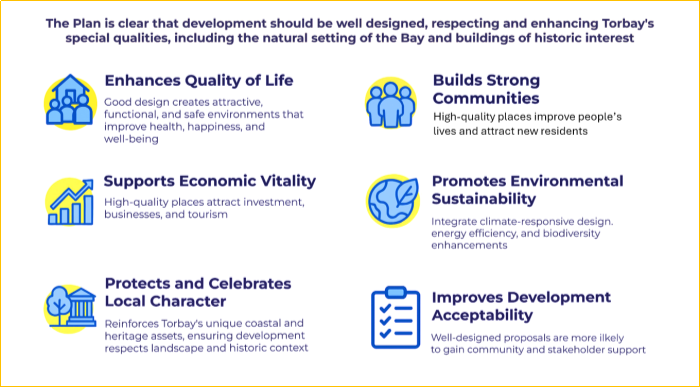
Development should be well designed to make best use of land and maximise the density of development, whilst protecting living conditions and amenity, respecting and enhancing Torbay's special qualities, including the natural and built environment including areas and buildings of historic interest.
Proposals that achieve a positive contribution to regenerating waterfront and harbourside areas will be supported subject to other planning considerations.
All development should design out opportunities for crime and disorder.
Community and Corporate Plan – Pride in Place
Explanation
11.1 The Local Plan seeks to maximise opportunities for urban development, especially through town centre regeneration. However, we need to create places that are a good living environment where people want to live, work and play. A high quality of design, that respects living conditions, scale, density, massing, height, material, landscaping, layout, accessibility, safety and security is key to this. Particular attention must be given to conserving or enhancing the character and appearance of conservation areas and other designated heritage assets.
Policy DE1: Design quality and assessment View representations
All development should be well designed, respecting and enhancing Torbay's special qualities, including the waterfront and natural setting of the Bay, and the character of the natural and built environment including areas and buildings of historic interest and the settlement pattern of the three towns, whilst designing out opportunities for crime and disorder.
Major development should be informed by a townscape and/or landscape assessment, including historical context of the site, existing and previous land uses (including agricultural land quality where appropriate) as well as movement patterns through and/or around the site.
All development proposals will be assessed against their ability to meet the design considerations set out below.
Table 16 Design Considerations for Development
|
DESIGN CONSIDERATIONS FOR DEVELOPMENT |
|
|
FUNCTION |
|
|
1. |
Be adaptable to future change and needs, including that of occupiers; |
|
2. |
Promote diversity through a balanced mix of uses that work together and encourage sustainable living; Resist low rise development and promote living accommodation above commercial uses where possible. |
|
3. |
Make the best use of space in terms of ground coverage and height, and achieve maximum density consistent with good design principles; |
|
4. |
Be designed to reduce crime and the fear of crime by the promotion of safety and security in the design of buildings and surrounding space whilst ensuring that amenities are not unduly affected. Design should also minimise opportunities for community conflict, anti-social behaviour and maximise safety for all; |
|
5. |
Be economically and socially viable in terms of density, mix, function and location; |
|
6. |
Where appropriate ensure equality of access and use for all sectors of the community; |
|
7. |
Integration of the development and surrounding green infrastructure, including sustainable drainage and water sensitive urban design; |
|
8. |
Achieve a net gain in biodiversity, including tree and hedgerow planting and habitat creation; |
|
9. |
Avoid noise and light pollution; and |
|
10. |
Promote tenure neutral design, materials and location of affordable housing; |
|
VISUAL APPEAL |
|
|
11. |
Be uncluttered and attractive; including, where appropriate the removal of unsightly additions when considering the conversion of existing buildings. |
|
12. |
Acknowledge local character and develop distinctive character in townscape and landscape terms, using existing landform, features; |
|
13. |
Have a clear urban structure and grain that integrates with the surrounding context; |
|
14. |
Relate to the surrounding built environment in terms of scale, height and massing; |
|
15. |
Make the most of opportunities to restore/ improve key gateways into the Bay and create a focal point |
|
16. |
Evolve high quality architectural detail with a distinctive and sensitive palette of materials; |
|
17. |
Protect important local and longer-distance views and impact on the skyline, especially from public vantage points, having regard to the location and prominence of the site, and |
|
18. |
Integrate with the existing street scene and features (such as trees) |
|
QUALITY OF PUBLIC SPACE |
|
|
19. |
Positively address the street with active frontages; |
|
20. |
Respect existing street frontages and built form; |
|
21. |
Ensure definition of space that clearly and coherently defines private and public areas; |
|
22. |
Be legible, permeable and accessible to all users; |
|
23. |
Provide opportunities for active lifestyles including walking and cycling ("Active Design") |
|
24. |
Provide public space and routes that are attractive, safe, uncluttered and work effectively, including a means of storing waste which minimises impact on the street scene; |
|
25. |
Positively enhance the built environment; |
|
26. |
Avoid creating gated communities; |
|
27. |
Incorporation of existing trees and native species, and |
|
28. |
Provision of high quality hard and soft landscaping. |
Community and Corporate Plan – Pride in Place
Explanation
11.2 The design of development has a vital role in the development of place and the evolution of the Bay. Torbay is blessed with a diverse range of historic architectural styles within its towns and some outstanding countryside. Some post-war development has nevertheless diluted the quality and character of their surroundings. Government guidance requires new development to be of a high standard of design The council will prepare an Urban Design Guide setting out local design codes supplementary planning document and have regard to the National Design Guide
11.3 Good design is not just about the architecture of a building. It is also about the spaces within which the development sits, and the quality of the relationships between the development and surrounding areas. Design and layout should take account of neighbouring buildings, uses and the wider area. The council considers that good design is about making places that are functional, visually appealing, with a high-quality public realm.
11.4 The Torbay Design Review Panel (DRP) assesses draft proposals to improve the quality of urban design and architecture through the planning process. The DRP acts as an advisory body, providing professional design advice on key development proposals. While it does not have statutory decision making powers, its guidance reports will be used as a material planning consideration when applications are taken to the council's Development Management Committee.
11.5 Section 17 of the Crime and Disorder Act makes a legal duty for planning to consider crime prevention. Consideration should be given in the location, design, and management of development to preventing crime, disorder, community conflict and antisocial behaviour. Such matters should be addressed in design and access statements. The council will work with the Police Architectural Liaison Officer (ALO) to minimise crime, disorder antisocial behaviour and conflict. Design should seek to promote healthy and active lifestyles . Guidance and a developer checklist on "Active Design" is available from Sport England and the Healthy Torbay SPD.
11.6 To ensure that development proposals meet the requirements of this Policy, a Design and Access Statement should accompany planning applications proportionate to the scale of the proposal. Such statements should provide a site analysis describing how the proposal has evolved, the philosophy behind the proposal, how the proposal responds to its context and how it connects with surrounding areas. They should be updated as the design process evolves.
11.7 Development likely to harm (directly or indirectly) existing trees or woodlands will only be permitted where appropriate measures are in place for the retention and management of existing trees and landscape features. The council will seek advance planting where practicable. Appropriate protection measures will include approved management programmes, planning conditions or s106 Planning Obligations, conservation area legislation or tree preservation orders (see also Policy THS).
Policy DE2: Building for a Healthy Life View representations
To demonstrate the delivery of high-quality urban design, major development proposals with a residential component will be assessed against 'Building for a Healthy Life' (BHL) criteria (or equivalent methodology).
Under the BHL12 'traffic light' system, a development proposal will be supported by the council when it secures as many 'green lights' as possible. When a development proposal has 'amber' and 'red lights' scored in the BHL assessment, it should be amended to improve the quality and design of development. Site and scheme specific constraints will be taken into account.
Community and Corporate Plan – Place and Community
Explanation
11.8 Torbay Council is committed to the principles of Building for a Healthy Life. It is a standard that can be used by local authorities to assess the design quality of new homes and neighbourhoods. . The current version, Building for a Healthy Life 12 (BHL12), Building for a Healthy Life | Other Manuals and Briefings | Urban Design Group , comprises 12 criteria, prompted by questions, which help achieve the delivery of functional, attractive and sustainable places. A well designed scheme will perform well against all 12 criteria and the performance is determined using a traffic light system of green, amber and red. The assessment supports the delivery of the aspirations of this Local Plan as well as government policy and guidance promoted through the National Planning Policy Framework.
11.9 Building for a Healthy Life provides a useful guide for developers on the standards that are now expected and what factors are considered when assessing design.
11.10 The BHL12 framework aims to form a collaborative dialogue with the 12 criteria being used at the start of and throughout the development and consultation process. It is important that BHL 12 is considered at the outset of design proposals and should therefore form an integral part of pre-application discussions. The purpose of BHL 12 is to enable a conversation about design in new schemes between local authority and applicant, thereby arriving at a mutually supported result. A properly evidenced, self-assessment of BHL 12 by the applicant will be required alongside a planning application, proportionate to the nature and scale of a proposal. The local authority may also choose to carry out its own assessment of a scheme using BHL12 criteria, and will also take the Design Review Panel's views into account.
Policy DE3: Development amenity and living standards View representations
All development should be designed to provide a good level of amenity for future residents or occupiers and should not unduly impact upon the amenity of neighbouring and surrounding uses, or place unreasonable restrictions on existing businesses and community facilities. This will be assessed using the following criteria:
- The impact of noise, nuisance, visual intrusion, overlooking and privacy, light and air pollution;
- Satisfactory provision for off-road motor vehicle parking, secure covered and safe parking for bicycles and electric-bicycles, and storage of containers for waste and recycling;
- Scale and nature of the use, specifically where this would be overbearing, or lead to an over-concentration of similar uses which would harm the amenity of the area;
- Impacts on existing living conditions and standards of accommodation of other uses;
- New dwellings should comprise self-contained accommodation with separate access;
- New residential development will need to have particular regard to outlook and light;
- Provision for useable amenity space, including gardens and outdoor amenity areas. Where possible a minimum of 10 sq m for apartments and 55 sq m for houses will be sought. Where individual provision is not possible, communal provision will be sought;
- New homes should be developed at a density which makes good use of land, whilst avoiding town cramming and the loss of open space;
- Adequate floorspace should be provided in residential development to achieve a pleasant and healthy living environment. Regard will be had to the Nationally Described Space Standards; and
- Where historic buildings are converted, incongruous later additions should be removed or replaced by more sympathetic additions, and attempts be made to restore the building's original character.
Where necessary, in order to limit the impact of new development, the council may seek to restrict the use of hours of operation, time and volume of deliveries, vehicular access, operation of machinery as well as other measures necessary to preserve amenity.
Community and Corporate Plan – Place and Community
Explanation
11.11 The council wishes to ensure that all new homes meet high standards of residential accommodation, both in terms of quality of life for residents, and the creation of liveable, safe neighbourhoods. All applications will be expected to contribute towards making Torbay a better place in which to live.
11.12 The council will consider the impact of the development in terms of the noise and disturbance it may generate or be subject to. Developments likely to affect amenity by virtue of noise or disturbance, traffic movements, fumes, dust, vibrations, light, heat and littering on a regular basis or into the evening and night-time will not be considered favourably, unless impacts can be mitigated and will be encouraged to locate away from residential areas to avoid harm.
11.13 The Local Plan seeks to achieve a significant increase in town centre living and therefore some homes will be located close to existing business, tourism and commercial uses. Care should be taken to provide users with reasonable level of privacy. The council's starting assumption is that tourism, leisure uses and residential accommodation can coexist in Harbourside and Waterfront, Core Tourism Investment Areas and other key tourism areas. Residents in these areas must expect that there will be a level of bustle and activity including late at night.
11.14 Residential developments should be designed to protect privacy in proposed and existing dwellings so that the outlook and quality of space provided will not be compromised. Window alignments should be designed to minimise overlooking other windows or garden areas as far as possible. As a guideline, layouts should seek to avoid directly facing windows less than 21m apart unless obscured, as far as this is consistent with other design principles and the need to make best use of land.
11.15 New dwellings should make provision for external amenity/garden space where possible. As well as providing amenity space, gardens can act as a sustainable urban drainage measure, assisting flood risk management and promote biodiversity. The council's greenspace requirements are set out in the Planning Contributions and Affordable Housing Supplementary Planning Document (2022) and will be updated through the healthy Torbay SPD and Local Design Codes. All dwellings should make provision for the storage of recycling bins/boxes and secure cycle parking (see Policies W1 and TA4). .
11.16 New dwellings should be self-contained as far as possible and of a reasonable size. All new homes, whether created by sub-division, redevelopment or new build should therefore provide a good standard of accommodation, having regard to safety, space, amenity, parking and design. Development should meet the government's Nationally Described Space Standard Technical housing standards – nationally described space standard - GOV.UK as far as possible. The standards are intended to be operated flexibly, especially when converting historic buildings. However, the creation of small apartments by subdivision/ conversion will be resisted where this would result in an unpleasant or unhealthy living environment or exacerbate concentrations of deprivation (see also Policy SCS).
Table 17
|
Dwelling Space Standards. |
|||||
|
This table reflects the Nationally Described Space Standard. |
|||||
|
Number of bed-rooms |
Number of bed spaces |
Minimum GIA (square metres) |
Built in storage (sq metres) |
||
|
1 storey dwelling |
2 storey dwelling |
3 storey dwelling |
|||
|
1b |
1p |
39 (37*) |
1 |
||
|
2p |
50 |
58 |
1.5 |
||
|
2b |
3p |
61 |
70 |
2 |
|
|
4p |
70 |
79 |
|||
|
3b |
4p |
74 |
84 |
90 |
2.5 |
|
5p |
86 |
93 |
99 |
||
|
6p |
95 |
102 |
108 |
||
|
4b |
5p |
90 |
97 |
103 |
3 |
|
6p |
99 |
106 |
112 |
||
|
7p |
108 |
115 |
121 |
||
|
8p |
117 |
124 |
130 |
||
|
5b |
6p |
103 |
110 |
116 |
3.5 |
|
7p |
112 |
119 |
125 |
||
|
8p |
121 |
128 |
134 |
||
|
6b |
7p |
116 |
123 |
129 |
4 |
|
8p |
125 |
132 |
138 |
||
|
*Where a studio has a shower room instead of a bathroom, the floor area may be reduced from 39 sq. metres to 37 sq. metres, as shown bracketed. |
|||||
|
The Gross Internal Area of a dwelling is defined as the total floorspace measured between the internal faces of perimeter walls that enclose a dwelling. This includes partitions, structural elements, cupboards, ducts, flights of stairs and voids above stairs. GIA should be measured and denoted in square metres. |
|||||
The above also applies to shared housing (HMOs) which are also covered by Policy H10. In the case of shared housing, some allowance may be made for communal areas that are available for residents. Regard will be had to creating a mix of accommodation types and sizes. Proposals that result in an over-emphasis of one accommodation type, such as such as small one-bedroom apartments, are likely to harm the living environment and intensify concentrations of deprivation, and will be resisted (See Policy SCS).
Support will be given to the provision of accessible and adaptable homes that are capable of adaptation to meet the changing needs of residents.
New homes often result from the conversion of existing buildings, many of which are in conservation areas. In such instances the council will seek the removal of incongruous features and, where feasible the restoration of a buildings' original character. Where the removal of such features is argued to make development unviable, the council will require an independent viability assessment and will require appropriate aesthetic improvements to render the development acceptable in design terms.
New dwellings will be expected to strike an appropriate balance between making good use of land, whilst avoiding town cramming or harm to neighbours' amenities. As a general guideline, a minimum density of 40 dwellings per hectare will be sought on greenfield sites. However, in some instances landscape or ecology considerations may dictate lower densities.
Policy DE4: Building heights and urban form View representations
The height of new buildings should be appropriate to the location, historic character and the setting of the development, whilst having regard to the need to make best use of urban sites.
New development should have regard to the prevailing height (the most commonly occurring height) within the character area in which it is located, unless there are sound urban design or socio-economic benefits to deviate from this approach.
The introduction of new tall buildings above the prevailing height will be supported where they:
- Achieve town centre regeneration or other socio-economic benefits. There is an expectation that tall buildings will be acceptable in town centre and harbourside/waterfront regeneration proposals, subject to historic environment and other considerations.
- Enhance the vitality of an area;
- Contribute to the regeneration of Torbay;
- Strengthen the character of the area;
- Are appropriate in terms of their visual impact;
- Provide wider urban design benefits;
- Make a positive addition to the built form, townscape and surrounding landscape; and
- Do not seriously harm long-distance views and key vistas.
Community and Corporate Plan – Pride in Place
Explanation
11.17 Tall buildings will not in themselves achieve Torbay's housing need targets. Regard will be had to the historic environment, street widths and creating liveable spaces. In practice, higher densities can often be achieved through terraced housing and residential blocks that avoid the need for excessive highway dominated schemes. Nevertheless, Torbay's built form is largely established and constrained by existing development and topography. A great deal of Torbay's built-up area is conservation area or contains listed buildings or other designated heritage assets. The Building Safety Act 2022 introduces additional fire and safety requirements for buildings taller than 18m or 7 storeys (in practice 18m usually equates to buildings of 4 to 5 storeys), including requiring an additional stairwell for residential buildings. Even before these regulations came into force, there had been concerns raised by the development industry about the viability of taller residential buildings in Torbay other than in key waterfront locations.
11.18 However, the Local Plan places a great emphasis on urban regeneration, especially in town centres, harbourside and waterfront areas. Given Torbay's shortage of developable land, taller buildings may play a role in helping boost numbers and achieving regeneration. There are areas of the Bay that may be suitable for tall buildings, such as town centres, regeneration areas and transport interchanges where they can support the vitality of these places and emphasise the importance of their role in the character and function of Torbay.
11.19 Torbay Council's Building Heights Strategy in 2010 provides guidance on the most appropriate locations for tall buildings and also the appropriate height for building throughout the Bay. This will be updated in the light of new guidance, including the NPPF, Historic England's Tall Buildings Advice Note: Tall Buildings: Historic England Advice Note 4 and findings of studies such as the Town Centre Regeneration Visions.
11.20 The term 'tall buildings' in the Torbay context is defined as buildings that are significantly higher than the prevailing height and/or have a significant impact on the skyline.
11.21 Tall buildings can deliver regenerative benefits, contribute to the reuse of brownfield land and reduce development pressure on greenfield sites. If well designed and built in suitable locations, tall buildings can form architectural and visual landmarks, create visually dynamic skylines and help define the area.
11.22 The 2010 Strategy identified that Torbay has a number of sensitivities to tall buildings, including conservation areas, special landscape character and prospect views which are important in defining the area's special qualities. In considering building heights, decision makers should balance the need to respect the character and urban form of the surroundings for new development, with the importance of urban regeneration or brownfield urban sites.
11.23 Where tall buildings are proposed, supporting evidence should be provided as part of a Design and Access Statement. For tall buildings, additional graphical illustration, and additional material such as 3D modelling and 'fly-throughs' should be provided to help assess their impact.
Policy DE5: Extensions and standalone additions to buildings View representations
Extensions, and standalone additions to buildings will be supported where:
-
the plot is large enough to accommodate the proposed extension or addition without resulting in a cramped or over-developed site, or the loss of important trees or hedgerows;
-
the extension or addition would not dominate or have other adverse effects on the character or appearance of the original property or any neighbouring properties, or on the street scene in general;
-
the extension or addition would not cause harm to the amenity of nearby properties, e.g. through overlooking, overbearing impact, loss of light or privacy or water run-off;
-
the extension would not result in the loss of parking, including garage space, where no suitable alternative exists to serve the property; and
-
highway safety would not be impaired.
-
All proposals should achieve a net reduction in water run-off to impermeable surfaces and shared sewers.
Community and Corporate Plan – Pride in Place
Explanation
11.24 The majority of extensions and additions are relatively small in scale, and many do not require planning permission. However, they can cause problems for adjoining properties due to loss of privacy or overbearing impact.
11.25 It is also important that extensions respect the character of the original building and the surrounding area and should therefore be of an appropriate scale or design. Resultant loss of off-street parking provision can also lead to loss of residential amenities for neighbouring properties.
11.26 Torbay is a Critical Drainage Area. The effect of urban creed is a major source of run-off into shared sewers and cause of Combined Sewer Outfalls. Cumulative increases in water run-off should be minimised as far as possible, for example by draining storm water into soakaways. The impact of "urban creep" (i.e. building over gardens etc) as identified by the Torbay Hydraulic Modelling of Sewer Capacity in Torbay study (AECOM 2014) and Water Cycle Study (2025 forthcoming) is identified as having a greater impact on sewer capacity than the effect of new greenfield development. Accordingly measures to minimise surface water running into shared sewers will be sought. This could include permeable surfaces, increased planting, water butts, as well as promoting water efficiency measures in the home. See also Policy ER3 Water Management.
11.27 Many house extensions or additions do not require planning permission; in many situations they may be permitted development under the Town and Country Planning General Development Order. However, permitted development rights are complicated and affected by many factors. In some cases normal permitted development rights have been taken away by planning condition or legal agreement. Permitted development rights relate largely to dwelling houses and therefore other types of property, such as flats and commercial properties, require planning permission for many alterations and extensions.
11.28 For the above reasons, it is usually advisable to contact the council before any work is undertaken.
Policy DE6: Advertisements View representations
Advertisements will not be permitted where:-
- they would harm visual or aural amenity; or
- they would undermine highway or public safety.
Community and Corporate Plan – Pride in Place
Explanation
11.29 Properly managed and well-designed advertising can add enormously to the colour and vitality of commercial areas, but in the wrong place it can appear out of place and distasteful or even offensive. The land use and visual character of an area are crucial in determining the appropriate level of advertising. Most advertisements appear in the context of buildings and it is important that they fit in with the character of any buildings to which they relate.
11.30 Large advertisement hoardings can have a powerful impact on the street scene. The council is concerned to control them carefully to ensure their effect is minimal and not detrimental to the surrounding area. In sensitive situations, hoardings may need to incorporate other design features to soften their impact. Smaller advertisement signs may be acceptable in appropriate situations subject to the criteria set out in this Policy.
11.31 Proposals for hoardings which contribute to the environmental improvement of unsightly sites will be supported in principle on a temporary basis, subject to the criteria set out above and to their removal when the site has been developed.
11.32 Applicants should have regard to the location of Areas of Special Control of Advertisements in Torbay.
