Regulation 18 Draft Local Plan 2025 Online Version and Consultation
Other elements in this consultation
Chapter 4: Building a prosperous and inclusive Torbay - Unlocking opportunity for all View representations
Introduction
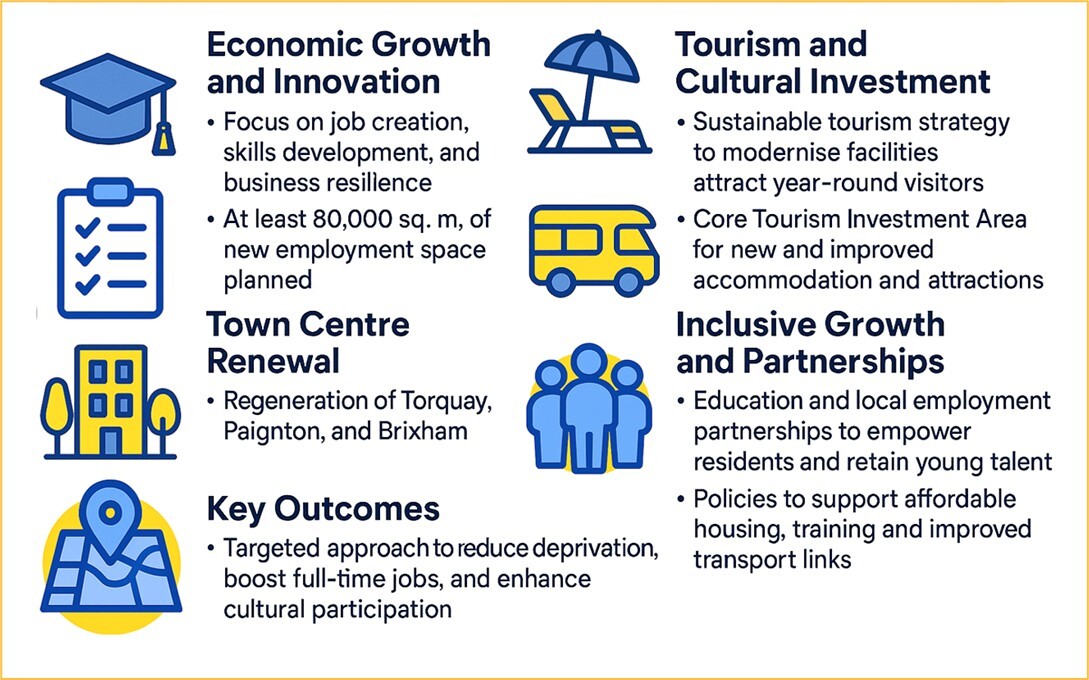
4.1 The Local Plan supports a step change in the economic performance of the Bay, building on the recent signs of recovery and maximising the opportunities for regeneration. The National Planning Policy Framework (paragraphs 18-22) supports economic growth. Plans and decisions should support growth and to plan proactively to meet development needs. At the same time, many employment and commercial activities are outside the control of planning, particularly with the creation of a wide Class E commercial use class, and permitted development rights to convert many commercial buildings to housing.
4.2 This chapter is divided into three sections:
-
Part 1: Economy and Employment Land
-
Part 2: Tourism
-
Part 3: Safe and Welcoming Town Centres for All (Town Centre and Retail policies)
Part 1 - Economy, Tourism and Town Centres
Economy and Employment Land
4.3 The Torbay Economic Growth Strategy was adopted by Torbay Council in 2023. This identifies a need to increase Torbay's productivity by broadening the economic base and reducing reliance on the service sector. The Economic Growth Strategy sets out how the council and its partners can improve economic conditions and help businesses to improve performance, create new opportunities for residents, tackle poverty and improve health outcomes.
4.4 The Local Plan recognises the importance of the hi-tech sector and knowledge-based economy. Torbay has specialisms in areas such as photonics, electronics, and medical technology. Many firms are reaching capacity and need grow-on space. There is a need to provide improved employment prospects and learning opportunities, and to provide better opportunities for younger people to stay in Torbay. This involves improving links with education providers such as South Devon College and providing improved prospects for local young people, especially those from care-experienced and other special education needs backgrounds. More details of the Economic Growth Strategy are available at: Economic Growth Strategy - Torbay Council and the Economy Topic Paper.
4.5 Torbay's Community and Corporate Plan prioritises inclusive economic growth, aiming to create opportunities for all residents. This section supports that ambition by focusing on job creation, skills development, and business resilience. The emphasis on high-tech industries and education partnerships reflects a commitment to long-term prosperity and social mobility. Investment in employment land and infrastructure is key to unlocking Torbay's potential and reducing deprivation.
Strategic Policy ES: Torbay employment and innovation strategy View representations
The Local Plan supports the regeneration of Torbay and improvement in its economic performance, with the aim of achieving a step-change in economic prosperity as set out in Torbay's Economic Growth Strategy. Proposals that create or improve employment or enable expansion will be supported subject to other policies in the Plan.
The Local Plan proposes the creation of at least 80,000 sq. m. of new industrial space within Use Class B2/B8/ E(g), equal to at least 20 hectares of employment land. Additional provision will be made for healthcare and education where there is an identified need.
Phased delivery of mixed-use development must include early provision of serviced employment space, unless there are compelling reasons to justify later delivery, and safeguards to provide compensation in the event of non-delivery. The provision of local training and employment schemes will be supported.
Where planning permission is granted for Class E(g) or B2/B8 space the council will use conditions or seek a s106 obligation to ensure that the space is retained for employment purposes.
Community and Corporate Plan – Economic Growth
Explanation
4.6 The Local Plan sets out a positive spatial framework to support the economic prosperity aspirations of the Community and Corporate Plan and Economic Growth Strategy. Central to increasing Torbay's productivity and employment prospects, the Local Plan seeks to create a land use framework to support the maintenance and expansion of hi-tech industries identified in the vision in the Torbay Economic Growth Strategy, Community and Corporate Plan and The Torbay Story.
4.7 Whilst not an exclusive list, the following sectors are particularly important in Torbay:
-
Tourism, hotel and catering
-
Manufacturing
-
Professional services
-
Financial services
-
Advanced electronics and photonics / hi-tech
-
Medical / Healthcare
-
Education and training
-
Business Process Outsourcing and
-
Food production and processing.
4.8 Policies ES and E1 set targets for the provision of employment land in Torbay. This is informed by the Torbay Economic Development Needs Assessment (EDNA) (DLP 2024) https://www.torbay.gov.uk/council/policies/planning-policies/local-plan-update/economic-development-needs-assessment/as well as the Torbay Economic Growth Strategy (2023). Based on the 2024 EDNA, the Local Plan seeks to allocate at least 20ha of employment land that should achieve at least 80,000sq m of net additional employment floorspace within Class E(g), B2 or B8 (i.e. traditional employment uses such as offices, light industry and high tech that would have fallen into Use Class B1 prior to 2021, Use Class B2 General industry and Use Class B8 Storage and Distribution). Policy E2 sets out site allocations. There is an emphasis on traditional former "Class B" jobs in these allocations due to the need to increase GVA and widen the areas industrial/high tech base. The Local Plan identified about 32ha of employment land in Policy E1, but makes an allowance for other uses including Class B8 and non-completions. This level of provision is more likely to deliver 80,000sq m of employment space rather than simply relying 20ha, which would be the requirement based on a typical 40% site coverage assumption (i.e. assuming that 1ha allocation yields 4000 sq. m. floorspace). The delivery of employment space will be kept under review in order to ensure that it delivers at least 80,000 sq. m. Class B2/B8/E(g) floorspace.
4.9 The 80,000 sq. m. employment space allocation does not include provision for education or healthcare jobs. Provision should be made for growth within these sectors, particularly at Torbay Hospital, South Devon College and other strategically important institutions. Development in Future Growth Areas should make provision for education and healthcare facilities in line with Policies SCS and SC1
4.10 Home working has become increasingly important, both because of flexible working arrangements, improvements to ICT and AI. This usually takes place as ancillary to the domestic use of properties, and there has not been an upsurge in demand for live-work units. However, the Local Plan seeks to accommodate the rise in home working through policies supporting to the door fibre (Policy IN2) and provision for vans as part of residential layouts (See Policy TA4). The Local Plan also supports the provision of work hubs or start up units are part of the Class E(g) employment space offer.
Strategic Policy E1: Strategic employment land allocation View representations
The following sites are proposed for employment use within Class B2, B8 or E(g), to meet the needs of existing, growing and new businesses.
Within these areas, a minimum of 50% (or 2000 sq. m. per hectare) will be provided as Class B2 or E(g) employment, subject to other policies in this Plan. Early delivery of serviced units of Class E(g) or B2 space will be sought. Where later delivery of B2 /E(g) units is proposed, a S106 phasing agreement will be required setting out safeguards including compensation for non-delivery of employment units.
Table 8 Local Plan Employment Allocations.
|
Site |
Site Size |
Notes |
Status |
|
|
Torquay |
||||
|
E1T.1 |
Land at Orchard Way |
1.5ha |
||
|
E1T.2 |
Adj. Ridge Lane and Moles Lane, Edginswell |
3ha |
23T003- New allocation. Land to the West of the Ring Road. |
Proposed new allocation |
|
E1T.3 |
Kingsland, Torquay |
3.2ha |
Allocated as part of SDT2 and shown on the Adopted Masterplan (2015) as employment. HELAA site 21T125. Application P/2019/0710 for 90 houses and offices refused/appeal dismissed. |
Allocated in Local Plan 2012-30 |
|
E1T.4 |
Land adj. Kingsland Torquay |
1.2ha |
HELAA site 21T004 |
New proposed allocation |
|
E1T.5 |
Former Market Site, Stantor Barton |
1.3ha |
HELAA site 21T136 Promoted for housing in the HELAA). |
New proposed allocation |
|
E1T.6 |
Riviera Way adj. Magistrate's Court |
0.6ha |
The site has outline permission P/2024/0511 |
|
|
Paignton |
||||
|
E1P.1 |
Claylands Cross phase 2 |
2.4ha |
Allocated site in Local Plan 2012-30 (SDP1/SDP3) Permissions P/2016/1115, P/2016/1123, P/2018/0700, P/2020/0187 2022/0027 Hybrid permission 11,188 sqm B2/B8 floorspace (10,788 sq. m +400 sqm approved under P/2018/0700 in 2 units. Unit 1 built out (5,600sq m). Outline permission for phase 2. (Circa 5,600 sq. m). |
Allocated and committed site. 5,574sq m built; outline permission for phase 2 (circa 5,035sq m). |
|
E1P.2 |
Land at Yalberton Road/Berry Acres |
1.7ha |
Berry Acres Development allocated for business use, rear of Yannons Farm. Part of a mixed-use site approved as P/2014/0983. The housing has been built. P/2014/0983 and P/2018/0977, P/2019/0605, P/2019/0173. Circa 7,400sq. m of employment. S106 plan shows three fields at north of site for employment (0.68ha +0.98ha+ 0.431 ha). (Plus a separate plot at Wilkins Drive -see below). Part of the land used for sustainable drainage and access. So likely to be middle portion of land circa 1ha that is deliverable. The site is close to proposed waste operation at Yalberton, but is suitable for employment use. |
Allocated site with outline permission. 1ha likely to be deliverable. |
|
E1P.3 |
Wilkins Drive, Yannons Farm |
1.3 |
Standalone part of Berry Acres (Jackson Land). Access strip controlled by local housebuilder being. The site is being promoted for housing. Allocated site in Torbay Local Plan 2012-30 SDP3.4 If it comes forward as housing, there would need to be compensation for loss of employment land unless another social benefit is provided e.g. affordable housing in excess of policy requirement. |
Allocated site in Torbay Local Plan 2012-30. Outline permission – but being promoted for housing |
|
E1P.4 |
Land north of Wilkins Drive PMU |
1.5ha |
21P034 in HELAA |
New proposed allocation |
|
E1P.5 |
Land at Long Road/Lower Yalberton Farm Holiday Park . |
4.7ha |
21P012 (south of 21P067) -promoted to the HELAA as housing/mixed use development. |
New Proposed allocation |
|
E1P.6 |
Land at Devonshire Park Long Road |
(Circa 0.7ha) |
Allocated/ part of outline P/2014/0947. 5,547 sq. m of Class B1/B8. Retail Park built out (8,501sq m +139 sq. m of Class E). Housing and employment land not started. |
Existing allocation with permission. Not being actively promote for employment. |
|
E1P.7 |
Land at White Rock (South of Woodview Road) |
4.77ha |
Units C (12,000 sq. ft), G (930 sq. m. 10,000 sq. ft), F (1,120 sq. m/12,000 sq. ft) approved. Part of P/2011/0197 and subsequent RMs for 350 dwellings and 36,800 sq. m of employment floorspace plus 1652 sq. m retail and 392 sq. m A1/A3 units. Two sites to the south of approved units G and C. H 1400 sq. m./15,000 sq. ft. J 1,860 sq. m/ 20,000 sq. ft. |
Part existing allocation with Permission / Part new proposed allocation |
|
E1P.8 |
Land North of Peters Copse, Long Road (West of Graphics Contol, Western Bowl). |
1.7ha |
Part of HELAA site 21P060. Being promoted for residential use. |
New Proposed allocation |
|
E1P.9 |
Land South of Peters Copse, Long Road. (To the West of Graphic Controls). |
2.5ha |
Part of HELAA Site 21P060 Within White Rock Future Growth Area but not previously shown as development land. Three Units K 2,440 sq m./ 26,250 sq. f. L 1,770 sq m / 19,000 sq. f. M 1,120 sq.m. 12,000 sq ft) |
New Proposed allocation |
|
Brixham |
||||
|
E1B.1 |
Oxen/Freshwater Cove |
0.9ha |
Allocated in BPNP and Local Plan 2,000 sq. m (Policies J1 and J7) Total site is 1.8 but 0.9ha assumes retention of car park. |
Existing allocation with no permission |
|
E1B.2 |
Monksbridge (as part of a mixed use development) |
0.25ha |
Approx. 1000sq m of Class E(g) as part of mixed-use development |
New proposed allocation |
|
E1B.3 |
Northern Arm Breakwater |
Subject to Environmental Impact Assessment |
Existing allocation rolled forward. |
|
|
Total |
32.3ha |
Community and Corporate Plan – Economic Growth
Explanation
4.11 Policy E1 proposes employment allocations. The main focus of these should be on providing employment space within the "industrial" use classes which are needed to support Torbay's key employment sectors such as photonics and MedTech, as well as the Bay's Marine economy. There is an emphasis on the following use classes to support these sectors:
-
B2 General Industry
-
E(g)(i) Office
-
E(g)(ii) research and development
-
E(g)(iii) any industrial process which can be carried out in a residential area.
-
Limited Class B8 Storage and distribution where necessary to support key industries or the wider economy.
4.12 The table above provides around 32 ha, but not all of the areas are likely to be suitable for employment development at 40% site coverage and some are subject to alternative proposals. Delivery of employment land will be kept under review to ensure that at least 80,000 sq. m. of B2/E(g) floorspace is delivered early in the Plan period.
4.13 Where proposals are part of wider mixed-use areas, such as Future Growth Areas, there should be a value-equalisation agreement over the site where practicable to assist with the delivery of employment areas. Development should be phased to ensure early delivery of employment areas.
4.14 Proposals for non-employment use of these allocations will be resisted, subject to the considerations in Policy E4 below. The council recognises that there is likely to be limited demand for new office space, and proposals should avoid this as an element of mixed-use developments, unless supported by clear evidence that it is deliverable.
4.15 Employment sites should be suitable for modern users and not unduly constrained by operational requirements. Care will need to be taken when locating employment next to residential development, and areas should be master planned to accommodate employment use. Advice on the needs for employment space, layout etc. is available from the Economy Team.
Policy E2: Employment area renewal and modernisation View representations
The refurbishment and improvement of the existing employment estates will be supported subject to other policies in this Plan. Development should not result in a net loss of Class B2/E(g) floorspace, unless the quality of employment space is significantly improved. A proactive approach will be taken to bringing underutilised space into productive use.
Other uses, including residential development will be supported where it achieves an overall improvement in the provision of high quality employment space or substantial public benefits, and does not sterilise the area from employment or undermine existing industrial uses.
Table 9 Existing Employment Areas
|
Site |
Notes |
|
Torquay |
|
|
Edginswell Business Park (Torquay) |
Partly built out |
|
Woodlands Trading Estate (Torquay) |
Refurbishment and environmental improvements to existing employment area. Qualitative improvements to upgrade existing provision. |
|
Lymington Road/Teignmouth Corridor |
|
|
Broomhill Way, Torquay |
|
|
Paignton |
|
|
Claylands Phase 1 |
|
|
Yalberton Industrial Estate (Paignton) |
Refurbishment and environmental improvements to existing employment area. Qualitative improvements to upgrade existing provision. |
|
Brixham |
|
|
New Road Trading Estate, Brixham |
|
|
Northfields Trading Estate (Brixham) |
Refurbishment and environmental improvements to existing employment area. Qualitative improvements to upgrade existing provision. |
Community and Corporate Plan – Pride in Place
Explanation
4.16 Policy E2 proposes the refurbishment and improvement of existing employment areas. The Local Plan recognises that there is scope to make better use of land in some of these locations, including the introduction of some other employment or residential uses. However, the policy seeks to improve the quality of employment space and achieve no net loss of Class E(g), B2 or B8 space, unless there is a clear improvement in the quality of space provided or other public benefit. Nor should new uses sterilise existing industrial uses.
4.17 Whilst the emphasis is on the retention of industrial and hi-tech uses, it is recognised that some uses such as "trade counters" and car showrooms already operate in these areas, and that other non-industrial (i.e. outside of former Class B) uses may be appropriate in these areas, subject to Policies TCS and TC5 dealing with the town-centre first approach for main town centre uses.
4.18 Further Masterplans will assist the regeneration of industrial land and identify opportunities for mixed use development. Where mixed use developments are approved, the delivery or enhancement of employment space will be required through phasing agreements and land equalisation measures.
Strategic Policy E3: Supporting a sustainable marine and coastal economy View representations
The council will support investment in marine-related development where this produces economic, social or environmental benefits to the area. Proposals should be consistent with wider natural and historic environmental, including marine environment, and coastal defence objectives. Sites of importance to marine-based activities will be protected for such use, subject to the other Policies in the Local Plan.
The following schemes are proposed:
- An extension to Torquay Harbour
- Improvements to Paignton Harbour
- Construction of Brixham Northern Arm Breakwater
Proposals must demonstrate that there would be no adverse effect on the integrity of any European site through a Habitat Regulations Assessment (see also Policy NCS2).
Proposals should be consistent with South West Marine Plan to ensure integrated marine and terrestrial planning is delivered for Torbay.
Community and Corporate Plan – Economic Growth
Explanation
4.19 The Local Plan places very great emphasis on achieving urban regeneration to support economic growth and provide housing opportunities. Policy E3 sets out a supportive framework for employment uses that require a maritime location, particularly those related to harbourside and waterfront improvements and the fishing, tourism, and related marine industries.
4.20 Tor Bay is a beautiful natural harbour which provides a protected area of water for leisure, recreational, tourism and commercial use. The coastline and the harbours are a vitally important resource for the community and economy. Torquay, Paignton and Brixham each have working harbours, with Brixham Harbour being the largest fishing port in England and Wales, in terms of the value of catch.
4.21 The Bay is part of the Lyme Bay and Tor Bay Special Area of Conservation (SAC). Tor Bay is also designated as a Marine Conservation Zone (MCZ) and contains several geological Sites of Special Scientific Interest (SSSIs). The coastline provides a flood defence for low lying coastal areas.
4.22 Torbay's unique coastal setting offers potential to support economic regeneration through investment in marine-related development. A number of such projects are identified in the Tor Bay Harbour Authority Port Masterplan Addendum (2019). Accordingly, sites that are of importance to the marine economy will be safeguarded for such use.
4.23 All marine-related development must avoid harm to marine biodiversity, geodiversity, human health and the wider environment.
4.24 Proposals must demonstrate that air quality, noise, vibration and water quality impacts have been taken into account and that any such impacts are minimised and mitigated sufficiently. This includes physical impacts such as, contamination and non-toxic changes (for example to salinity, turbulence nutrients and organic matter), as well as minimising the impacts on wildlife through piling, noise or other disturbance. Many marine species are protected by wildlife legislation, and a licence may be required to carry out works affecting marine species or their habitats.
4.25 Marine related developments are likely to require an Environmental Impact Assessment (EIA) and Habitats Regulation Assessment (HRA) or screenings to be carried out at the application stage. Development that is likely to have a significant effect on the Lyme Bay and Torbay Marine SAC can not be permitted unless an Appropriate Assessment has ascertained that following mitigation, there is no adverse effect on the integrity of the site, taking a precautionary approach (see also Policies NCS1 and NCS2). Only as a last resort, in highly exceptional cases where there are no less harmful solutions, and the development is required for Imperative Reasons of Overriding Public Interest, will compensation for adverse impacts be permitted. Proposals likely to impact the protected features of the Torbay Marine Conservation Zone will require an MCZ assessment.
4.26 The council will work with the Marine Management Organisation when considering marine development, especially where developments may also require a Marine Licence.
4.27 Visual, cultural, historical and archaeological impacts should also be considered. Torbay has an important maritime history; all three harbours are recognised as designated heritage assets and form the focal point of their surrounding conservation areas. Policies HES and HE1 are relevant when considering historic assets.
4.28 Marine activities and development should not prejudice the interest of defence and national security, and the MoD should be consulted accordingly. Development will need to be safe over its planned lifetime and not cause or exacerbate flood and coastal erosion risk elsewhere.
Policy E4: Safeguarding strategic employment land (proposals involving the loss of employment land) View representations
Proposals for the loss of existing or allocated employment space will be considered on the basis of the impact on the economic prosperity of Torbay, the appropriate mix of uses within a locality, and on the amenity of people in the area.
The loss of sites that provide employment of strategic importance to the Bay's key economic sectors will be resisted.
Within allocated sites in Policy E1, Proposals that result in the net loss of employment space will be refused unless it is demonstrated that the proposal results in a significant public benefit that cannot be achieved elsewhere in Torbay, and that there would be no adverse effect on the retention of existing employers in the Bay.
Where it is demonstrated that there is no reasonable prospect of a site being used for other (Class B2, B8 or E(g))employment purposes, or such a use would conflict with the Local Plan, alternative uses that provide wider sustainable local communities will be supported.
Where the proposed loss of employment space is agreed, the council will seek financial contributions to compensate for the loss of employment.
If planning permission is granted for E(g) space the council may restrict permitted development rights for change of use to residential, in order to protect key economic sectors.
Community and Corporate Plan – Pride in Place
Explanation
4.29 The Community and Corporate Plan and Economic Growth Strategy do not wish Torbay to become a commuting or retirement resort. It is therefore important that opportunities for employment are protected, and sufficient land retained to meet the demand of existing and new companies.
4.30 Whilst the number of people in Torbay with jobs has increased since 2001, the number of Torbay based workplace jobs has remained relatively static.
4.31 Torbay's high levels of deprivation stem primarily from low wages and poor employment prospects, rather than abnormally high property prices per se. The hi-tech elements of the local economy are identified by the Economic Growth Strategy as key to raising GVA. There is also a national dimension that such industries are important to the economic prosperity of the country especially in the face on uncertain global events.
4.32 Accordingly, Policy E4 seeks to retain employment space for employment purposes, subject to a "reasonable prospects" test. Applications for non-employment use must be supported by proportionate evidence that there is no reasonable prospect of employment use. This may include details of marketing including to the council, or seeking funding support for matters such servicing and infrastructure provision.
4.33 Where loss of employment is deemed acceptable in principle, a S106 obligation will be sought to compensate for the loss of employment and will be used to support the delivery of jobs, infrastructure or local training facilities elsewhere in Torbay.
4.34 Note that Policy E4 relates to a net loss of jobs. It will not be applied where proposals are likely to modernise or make better use of employment space, and are thereby likely to improve employment opportunities; although the council will still seek local skills and training agreements in line with Policy E5.
4.35 Policy E4 seeks to protect a stock of employment space broadly within the hi-tech and industrial uses. Proposals for the loss of employment within town centres, holiday accommodation or retail will be considered on the basis of policies in those sections of the Local Plan (see Policy TC7). However, where a non B2/B8/E(g) building located within an industrial area/trading estate becomes available, the council will seek to retain/revert its use for industrial on the basis of the above policy tests.
4.36 The council recognise that employment land enjoys a range of permitted development rights and that some changes of use fall outside of planning control.
Policy E5: Education and Local Employment Partnerships View representations
The council will support initiatives and development that improve skills and links between work and education, particularly through South Devon College and the Torbay and Southern Devon Health and Care Trust.
Applications for major development should be accompanied by an Employment and Skills Plan, proportionate to the scale of the development. The council will promote and encourage links to local education providers, apprenticeships and other measures to support people into work from the local area.
Community and Corporate Plan – Community and People
Explanation
4.37 Policy E5 promotes local training arrangements, placements and apprenticeships, to maximise the benefits of development to the local economy. It is important that measures are put in place to support people in Torbay to learn and retain the skills needed by growing and new businesses.
4.38 The council recognise the role of key worker and self-build housing to strengthening links between work and skills, and housing. Policy H7 seeks a proportion of affordable housing to be provided on larger development sites.
4.39 The council is unable to require the use of local labour. However, it will encourage developers to employ local people where it is practical to do so. This is particularly the case in schemes where an element of 'exception' to planning policies is made in order to permit development. For example, developers will be encouraged to use employment and skills plans to better establish links between education and employment. Advice on the content and scope of Employment and Skills Plans is available from the Economy Team.
Part 2 - Tourism
Introduction
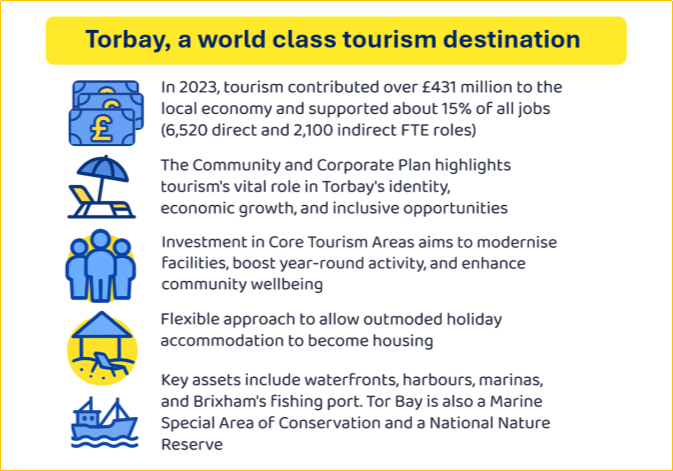
4.40 Torbay has a fantastic brand – the English Riviera – and is a world class tourism destination. In 2023, Tourism contributed over £431 million to Torbay's economy. Tourism accounts for about 15% of all employment in Torbay: about 6,520 full time equivalent jobs directly and a further 2100 FTE jobs indirectly. There are some very positive signs of a changing tide for tourism. The need to modernise the tourism sector and "Turn the Tide" on the decline that has beset may coastal resorts has been part of planning policy for several years. The tourism economy has been hit hard by the early 2020s and cost of living challenges. Despite this, there have been several hotels opened in Torbay over the last decade, which is likely to have led to a small increase serviced bedspaces (i.e. hotels and guesthouses) from around 13,300 in 2012 to 14,300 in 2023 (South West Research Company).
4.41 The Torbay Community and Corporate Plan notes that Tourism is a vital part of Torbay's identity and economy, and the Community and Corporate Plan recognises its role in creating inclusive opportunities. This section supports the Plan's ambition to make Torbay a premier destination while ensuring that all residents benefit from its success. By focusing on modernisation and investment in Core Tourism Investment Areas, the Local Plan aims to deliver high-quality experiences and facilities. This approach also supports year-round economic activity and community wellbeing.
4.42 Tourist accommodation is key to the success of tourist resorts. The English Riviera Destination Management Plan updates this strategy for 2022-30 and is part of the wider Torbay Economic Growth strategy. The Management Plan recommended a bedspace reduction of about 2% between 2022-27. This is currently being refreshed. However, the general approach of encouraging modern accommodation including hotels in prime locations whilst allowing change of use of less well located or outdated accommodation to residential use is likely to continue.
4.43 All three towns contain important Waterfront and harbourside areas. Brixham and Torquay also contain marinas. These are within the Core Tourism Investment Areas (CTIAs), and tourism, leisure maritime investment in these areas is supported. Brixham is a major fishing port and supporting the fishing industry is important to the Bay's economy, and relevant to its seafood specialism. Tor Bay is environmentally very important, being designated as a Marine Special Area of Conservation and National Nature Reserve. The Local Plan seeks to balance the internationally important environment with the area's economic needs.
4.44 The definition of "tourist" is not always straightforward. For the purpose of this chapter a tourist is defined as person or group visiting on a temporary basis and not staying in their sole place of abode. It can include domestic and international holiday makers, language students, business travellers and travelling workers (who have another home). It does not include people who have no other home. Accommodation for such people is likely to fall into Class C2 (if its purpose is to provide care), C3 dwelling house, C4 Small HMO, or Sui Generis (HMOs, hostels and other accommodation within its own class). Such uses are not tourist accommodation.
Strategic Policy TOS: Sustainable tourism and cultural investment strategy View representations
Torbay's tourism offer will be developed in a sustainable manner to enhance its role as a premier tourism destination. Tourist facilities and accommodation will be improved and modernised, and new tourism facilities provided. Sustainable tourism will be actively encouraged.
The quality of accommodation will be improved with a wider range of new and refurbished facilities and services. This will be achieved through the following measures:
- Supporting the improvement of existing and provision of new tourist accommodation, attractions and facilities, subject to other policies in this Plan. In particular proposals that make positive use of Torbay's marine environment, culture, heritage, biodiversity and Geopark will be encouraged.
- The retention, improvement and creation of new, high quality tourism and leisure attractions, facilities, and accommodation in Waterfront areas and Core Tourism Investment Areas (CTIAs), as key focal points for investment in tourism:
- Babbacombe Downs
- Torquay Harbourside, waterfront and Belgrave Road, Torquay
- Seafront, harbourside and Green Coastal Park, Paignton
- Goodrington, Paignton
- Harbourside and waterfront, Brixham
- Allowing poorly located and outmoded accommodation located outside of CTIAs to revert to decent self-contained dwellings, subject to the holiday character of the area and range of facilities offered not being undermined; and there being tangible regeneration and improvement to the fabric of the built environment and character of the area.
- Resisting the provision of small apartments, hostels, houses in multiple occupation (HMOs) or other incompatible uses in tourism areas.
Community and Corporate Plan – Pride in Place
Explanation
4.45 Policy TOS provides a spatial context for the tourist economy. The Policy seeks to maintain and enhance the most important tourism areas as Core Tourism Investment Areas (CTIAs),which are shown on the Policies Map.
Policy TOS provides a supportive framework to tourism in general, particular within the designated Core Tourism Investment Areas. Tourism and leisure investment will be given substantial weight in CTIAs. Torbay's marinas are also included within the CTIAs. The Policy also recognises the need to focus on modernising the key areas, and the role that more marginal areas can play in providing a source of brownfield housing. Although it goes further than land use planning, CTIAs should be protected for tourism use by council wide decisions, including interdepartmental enforcement action on problem uses.
4.46 Torbay's tourism strategy is closely aligned with the Community and Corporate Plan's vision for a vibrant, inclusive and sustainable economy. By focusing investment in key waterfront and cultural areas, the Plan aims to enhance the visitor experience and support local businesses. It also recognises the importance of protecting the character of tourism areas while enabling regeneration. This balanced approach ensures long-term benefits for residents and visitors alike.
4.47 Not all areas within CTIAs are suitable or proposed for development. For example, they contain areas of significant natural or historic environment importance. This will need to be taken into account when considering proposals, particularly where they affect the Marine or South Hams Special Area of Conservation.
Policy TO1: Supporting tourism and leisure infrastructure (Proposals for new and safeguarding of existing tourism and leisure facilities). View representations
Improvement of existing and the development of new tourist/leisure facilities and attractions, particularly all-weather facilities, will be supported subject to other local plan considerations.
Tourism and leisure facilities will be protected for tourism purposes, proportionate to their economic, social and cultural value to their tourism economy. Where an element of non-tourism or leisure development is allowed, it should contribute significantly to the viability of the area or regeneration of the resort.
The tourism and leisure value of country parks should be conserved and enhanced
The provision of enhanced tourism and recreation facilities at Broadsands are proposed, respecting the important environmental assets of the area, to serve as a suitable alternative natural greenspace to relieve recreational pressure on Berry Head.
Community and Corporate Plan – Community and Place
Explanation
4.48 Supporting existing facilities such as theatres, music venues, attractions etc, and promoting high quality all year round new facilities is vital to ensure a successful tourist economy. Policy TO1 provides an overarching policy to protect tourism and leisure facilities. Many tourism and leisure uses, including eating and drinking are "main town centre uses". Policy TO1 encourages the improvement and provision of such facilities in CTIAs. When considering proposals for such facilities, their value for the tourist economy will be an important material consideration.
4.49 However, policy TO2 recognises that some important leisure facilities are located outside of CTIAs and town centres, and sets a framework to protect them proportionate to their economic, environmental and cultural value. Areas such as Cockington, Occombe and Berry Head Country Parks are not designated as CTIAs, but have significant value for tourism because of their focus for rural crafts and green infrastructure. Policy GIS deals with policy in Country Parks. Significant attractions such as Kents Cavern and Babbacombe Model Village fall outside the boundaries of CTIAs.
4.50 Whilst the list is not exhaustive, the following attractions are considered to be of significant importance to Torbay's tourism offer:
-
All of Torbay's beaches and waterfronts
-
Babbacombe Model Village
-
Babbacombe Cliff Railway
-
Bygones, Babbacombe
-
Cockington Manor, Crafts Centre and Country Park
-
Kents Cavern, Torquay
-
Torre Abbey
-
Torquay Museum
-
Hollywood Bowl
-
Music venues in the harbourside and waterfront area (including but not limited to The Arena and The Foundry)
-
Beacon Cove (former Living Coasts)
-
Paignton Zoo
-
Occombe Farm and valley
-
Splashdown, Quaywest.
-
Babbacombe, Princes, Little Palace Theatres
-
UNESCO Geopark
-
Dartmouth Steam Railway
-
Golden Hinde replica, Brixham
-
Battery Gardens and WW2 coastal defences
-
Berry Head
4.51 It is noted that many of these attractions are also covered by other designations, in particular Kents Cavern, Torre Abbey, Battery Gardens and Berry Head fortifications are Scheduled Monuments. Berry Head is also particularly environmentally important as a Special Area of Conservation designated for its Greater Horseshoe Bat colony and calcareous grassland. The Local Plan proposes several Suitable Alternative Natural Greenspace to reduce recreational pressure on Berry Head. It is noted that Torbay's waters have important environmental constraints including the Marine SAC and important seagrass beds. Proposal must enhance and improve protection and interpretation of these assets. Where development in Torbay is likely to generate recreation pressure on Berry Head, developer contributions will be sought to provide mitigation, including to help fund suitable alternative natural greenspace (SANGs).
Strategic Policy TO2: Core Tourism Investment Areas (as shown on the Policies Map): View representations
There is a presumption that the tourism role of Core Tourism Investment Areas (CTIAs) will be retained and enhanced. The development of tourism accommodation and facilities in CTIAs will be supported, subject to other local Plan considerations.
The change of use of accommodation or facilities to non holiday uses within CTIAs will only be supported where:
- The holiday character of the area and range of facilities and accommodation offered in the CTIA are not undermined; and
- It lacks an appropriate range of facilities and scope for improvement to meet modern standards; and
- It is demonstrated that there is no reasonable prospect of the site being used or redeveloped for tourism or tourism related purposes, taking into account historic and built environment, amenity and other material considerations.
Non-tourism development or uses will only be permitted in CTIAs where they are compatible with the tourism character of the area. They will not be supported where they would introduce incompatible uses or accommodation that would detract from the holiday character or place pressure on nearby holiday business to curtail their operation.
Where a change of use away from tourism is permitted, there will be a requirement to restore or enhance buildings or land by the removal of unsightly features, signage, clutter and extensions relating to the holiday accommodation use. Where appropriate there will be a requirement to reinstate amenity space, and permeable surfaces. A high priority will be given to restoring the character and appearance of buildings within conservation areas.
Community and Corporate Plan – Pride in Place
Explanation
4.52 Policy TO2 deals with proposals affecting Core Tourism Investment Areas. It reinforces the intention of Policy TO1 to retain CTIAs as the heart of Torbay's tourism offer. CTIAs were reviewed as part of the current Local Plan Update, but only small adjustments to the previous Local Plan 2012-30 were identified as being required at this time. A much more drastic reduction of CTIA boundaries took place as part of the preparation of the previous Torbay Local Plan 2012-30, (which also rebadged them from their former Principal Holiday Accommodation Areas). CTIAs account for less than 20% of Torbay's serviced accommodation, but do contain most of the key hotels.
4.53 It is noted that some parts of the CTIAs are in need of investment and regeneration. However, CTIAs are focussed upon Waterfront and key tourism locations whose success is critical to Torbay's tourism economy. Neglect or underinvestment will not be treated as a reason for granting permission for non-tourism uses. The prevailing use in these areas should be for tourism or leisure. Change of use or redevelopment for non-tourism purposes is likely to significantly and demonstrably conflict with the Local Plan unless it achieves substantial regeneration or other benefits. The council will support regeneration and tourism promotion in CTIAs. It will also target enforcement at unauthorised uses and development which detract from the character of these areas.
Strategic Policy TO3: Redevelopment and reuse of holiday accommodation outside Core Tourism Investment Areas (as shown on the Policies Map) View representations
The change of use or redevelopment of holiday accommodation or facilities outside Core Tourism Investment Areas will be supported where:
- The holiday character of the area and range of facilities and accommodation offered in Torbay are not significantly undermined, and
- The redevelopment or change of use achieves regeneration, improvement to the built environment, and the provision of self-contained housing that meets space standards set out in Policy DE3
Proposals for small apartments, hostels, and houses in multiple occupation (HMOs) or other incompatible uses will not be permitted where they would conflict with the tourism character and offer of the Bay or increase concentrations of deprivation or introduce other incompatible uses (see also Policies H10 HMOs and SCS).
Where a change of use away from tourism is permitted, there will be a requirement to restore or enhance buildings or land by the removal of unsightly features, signage, clutter and poor quality extensions relating to the holiday accommodation use. Where appropriate there will be a requirement to reinstate amenity space and sustainable drainage features. A high priority will be given to restoring the character and appearance of buildings within conservation areas.
Community and Corporate Plan – Community and Place
Explanation
4.54 The English Riviera Destination Management Plan recognises a continued need to reduce and modernise the stock of holiday accommodation, whilst retaining good quality accommodation and protecting the area's status as a premier resort. Whilst there remains a demand for a broad range of accommodation, evidence of occupancy suggests that there is scope to reduce the number of traditional guest house and small hotel type accommodation.
4.55 Policy TO3 deals with proposals outside designated CTIAs. It sets a much more relaxed approach to allowing change of use or redevelopment of holiday accommodation outside of CTIAs. However, where holiday accommodation offers a range of facilities not available elsewhere in the area, or is within a key tourist setting, Policy TO3 seeks to retain the holiday use. Instances where this is the case re likely to be relatively rare, but are likely to include the Former Palace Hotel, Babbacombe, where redevelopment of the Victorian Bishop's Palace and enabling residential development has been approved specifically to support retained tourism use.
4.56 Policy TO3 does not require proposals to show that they are not viable for tourism use (unlike in CTIAs, where a "reasonable prospects test remains in place). However, neglect or underinvestment will not on their own be sufficient reasons to grant planning permission away from tourism use. Conversely, outside of CTIAs, the council will consider the intrinsic merits of the property and location and will not penalise past investment in otherwise unexceptional accommodation.
4.57 Residential use of holiday apartments must provide an acceptable standard of accommodation, having regard to Policy SCS and DE3, and not introduce discordant uses into areas that retain a holiday function. The council's starting assumption is that residential uses and holiday uses can coexist, but Torbay's key industry is tourism and the introduction of residential uses into tourism areas should not place undue pressure on remaining tourism or leisure facing businesses to curtail their use.
4.58 Where a change of use results in the loss of employment, the council will seek s106 Planning Contributions to mitigate this impact, as set out in Policy TO7. This will be focussed on improving the tourism economy, and the character and appearance of the area.
4.59 Some hotels and guesthouses have accrued unsightly clutter, signage or extensions that would not be currently permitted. The removal of such features will be sought as a condition of granting planning permission for a change of use. This will be particularly relevant for proposals affecting conservation areas and listed buildings. Proposals for redevelopment should also take into account the historic environment policies in Chapter 10 of this Plan.
4.60 As a minimum, in all areas, cosmetic features such as signage and awnings should be removed when conversion to residential use takes place. Many hotels/holiday flats comprise Victorian buildings with large C20th extensions which were permitted because of their contribution to tourism rather than their design. Where feasible the council will seek to remove unsightly features such as flat roof extensions, box dormers etc, particularly in conservation areas. In many cases their replacement by more in-keeping buildings will be appropriate. However, it cannot be assumed that like-for-like replacement will be acceptable if the site has been over-developed when judged against modern standards. If the removal of unsightly features is considered to undermine the viability of development, an independent assessment of viability may be sought. The council will seek to negotiate an acceptable design solution that improves the visual appearance of the building, and may agree to relax other s106 Planning Obligations to assist viability.
Policy TO4: Flexible use of holiday apartments and accommodation (excluding holiday parks) View representations
Within Core Tourism Investment Areas, self-contained holiday accommodation will be restricted to tourism use. Change to non-tourism occupancy will not be supported unless such a change achieves significant regeneration, built environment or tourism improvements.
Outside Core Tourism Investment Areas, the council will not seek to restrict the use of self-contained holiday apartments to tourism use, unless there are strong tourism related reasons for doing so. Where holiday occupancy conditions are removed, the council will seek development contributions to address the net additional impact arising from residential use.
Community and Corporate Plan – Pride in Place
Explanation
4.61 Some of Torbay's holiday accommodation is self-contained holiday apartments. South West Research Company figures suggest around 1130 units of self-catering accommodation, although this does not include Airbnb, second homes and other temporary use of residential accommodation for holiday use. The main approach of Policy TO4 is to allow greater flexibility of use outside CTIAs to use holiday apartments and accommodation either for residential or holiday use. Within CTIAs their holiday use will be regulated more closely.
4.62 Planning law on the status of holiday apartments is not entirely clear, and depends on a range of factors such as the range of facilities offered, degree of holiday use etc. Suites of rooms and even self-contained flatlets within hotels – often called "Apart hotels"- will fall within Class C1. However, holiday flats and dwellings used for holiday purposes typically fall within Use Class C3 "Dwellinghouses" in England. The government has proposed to introduce a new use class C5 for short term lets that are not used as a sole or main home, with likely permitted development rights for use of a dwelling (class C3) for limited short-term occupation. However, these changes have not (at November 2025) come into force.
4.63 Policy TO4 sets out criteria relating to proposals for holiday apartments, or for the removal of occupancy conditions/ change of use to allow holiday apartments to be used for full time occupancy.
4.64 Within Core Tourism Investment Areas, the starting point is that holiday accommodation should be conditioned for holiday occupancy (tourism) usually through planning condition or by making it clear that accommodation falls within Use Class C1 (and not C3 or sui generis). Unfettered occupancy within CTIAs will only be allowed where the relaxation would facilitate significant regeneration or other public benefits and unlock investment into the area. In such instances, regard will be had to possible "agent of change" issues and full residential use will not be approved where there this is likely to sterilise tourism use e.g. through noise complaints or objections to the operation of nearby tourism attractions, music or facilities. The council will need reasonable reassurance that it will not be called upon to pursue action that would undermine the reasonable tourism operations of tourism within CTIAs when considering proposals for residential use in CTIAs.
4.65 Outside of CTIAs, the council will not usually impose holiday occupancy restrictions on holiday apartments, other than in special circumstances: for example, where residential accommodation would not be otherwise approved. Such accommodation is likely to be liable for affordable housing and other residential S106 requirements and these will only be relaxed where a S106 is entered into undertaking to provide them in the event that holiday use ceases.
4.66 Where occupancy is restricted to tourism use, the council will require a monitoring contribution to ensure its occupation for tourism purposes.
Holiday Centres and Parks
Policy TO5: New holiday parks and extensions to existing facilities View representations
Proposals for new holiday parks, including chalet, caravan and camping sites, or schemes for the extension, refurbishment and upgrading of existing facilities will be supported, provided that the following criteria are met:
- It contributes to the modernisation and improvement to the tourist economy; and
- The development does not have an adverse impact on the landscape conservation, nature conservation and agricultural characteristics of the area or involve the loss of best and most versatile agricultural land; and
- The development is acceptable in terms of transport, access and safety considerations; and
- The proposal does not adversely affect the amenities of any adjoining residential areas.
- The use will be restricted to holiday use and a monitoring contribution sought to monitor the ongoing tourism operation, to prevent residential occupancy.
- Where other uses would not be appropriate, a site restoration condition or obligation will be applied requiring the site to be restored to its original condition and use should tourism use cease.
Community and Corporate Plan – Community and Place
Explanation
4.67 South West Tourism Company data indicates that in 2023 there were about 1740 static caravans or chalets in holiday parks, and 1290 touring pitches in Torbay. The facilities provided by holiday centres and parks offer an important source of holiday accommodation, particularly in Paignton and Brixham. As with serviced accommodation, there has been a general move to provide more modern facilities and accommodation in holiday parks. Holiday Parks fall outside of CTIA designations but are still important to the tourism industry. Policies TO5 and T06 set out considerations for proposals affecting holiday parks. They seek to support investment in existing parks, subject to landscape, ecological and other considerations.
4.68 Holiday parks tend to be located in countryside areas and other environmentally sensitive locations. The Local Plan recognises the need to modernise and upgrade facilities so that holiday parks continue to meet modern requirements. Accordingly, it seeks to support the investment in holiday parks subject to other environmental considerations. Brixham remains a popular destination for holiday parks. However, development in this area is already close to the boundary of the South Hams Special Area of Conservation and within the South Devon National Landscape. Accordingly, new uses or buildings will only be permitted where proposals have demonstrated that they would have no likely significant impact, alone or in combination on the South Hams SAC. This will also require mitigations of additional recreational pressure on Berry Head or the marine environment.
Policy TO6: Change of use or redevelopment of existing holiday parks to non-tourism uses View representations
Unless proposed for alternative development in the Local Plan or other development plan document, the change of use or redevelopment of existing holiday centres, chalets, caravans and camping sites to non-tourism uses only be supported where;
- the site is not in a prime location for holiday use (i.e. coastal, rural or close to major tourist attractions);
- the proposals would not result in the loss of a site which offers a good range of facilities or makes a significant contribution to the stock of holiday accommodation;
- the proposal does not conflict with countryside, landscape, coastal management, or ecology policies set out in the Local Plan.
- The new use, including residential accommodation, would be accessible by active travel and public transport.
Where holiday parks and chalets are located within the South Devon National Landscape or its setting, or within 0.5KM of the South Hams SAC, there is an expectation that they will revert to nature if tourism use ceases.
Community and Corporate Plan – Pride in Place
Explanation
4.69 It is noted that there has already been a significant fall in holiday park bedspaces over the last two decades, particularly in Brixham. It is anticipated that improvements in the quality and modernisation of chalets will result in the bulk of any further reduction in bedspaces, whilst improving the range of facilities offered. Policy TO6 deals with proposals to change the use, or redevelop, holiday parks to non-tourism uses.
4.70 Holiday parks have often been allowed in coastal and National Landscape (formerly AONB) locations particularly because they cater to the tourism economy. They have also evolved over many years, and their original planning status may be unclear. Accordingly, where development away from tourism is considered, the starting point should be that all, or the major part of such sites should revert back to open countryside or provide other landscape or ecological benefits.
4.71 The Local Plan also seeks to retain holiday parks in prime tourism locations or where the loss of facilities or tourism location would be harmful to Torbay's tourism offer.
4.72 This policy does not seek to resist the redevelopment of holiday parks that are allocated for residential use in the development plan (i.e. Kingskerswell Road, Torquay, H3T5 and H3T6).
Policy TO7: Tourism investment and monitoring contributions View representations
Where change of use or redevelopment of tourism and leisure facilities or accommodation is approved, the council will seek contributions to mitigate the impact of loss of tourism facilities and employment, proportionate to the scale and nature of the proposal and its net impact.
Where development generates a monitoring cost to ensure compliance with tourism occupancy or other requirements, the council will seek a contribution towards monitoring.
Community and Corporate Plan – Economic Growth
Explanation
4.73 Policy TO7 recognises that tourism development can impact upon the need for infrastructure or create a monitoring need. Policy TO7 identified that S106 contributions will be sought to address this, where necessary to make development acceptable in planning terms. Particular regard needs to be given to mitigating the recreational impact on the South Hams Special Area of Conservation and the effect of marine tourist development on the Marine SA (see Policies NCS1 and NCS2).
4.74 Proposals involving the loss of tourism may result in a negative economic impact. In such instances a contribution may be sought to mitigate the loss of employment. This will be based on the net impact of proposals, and other public benefits such as improvements to the built or natural environment, or the creation of affordable housing will be taken into account in calculating the net impact of a proposal.
Part 3 - Economy, Tourism and Retail
Safe and Welcoming Town Centres for All (Town Centres and Retail Policies)
Introduction
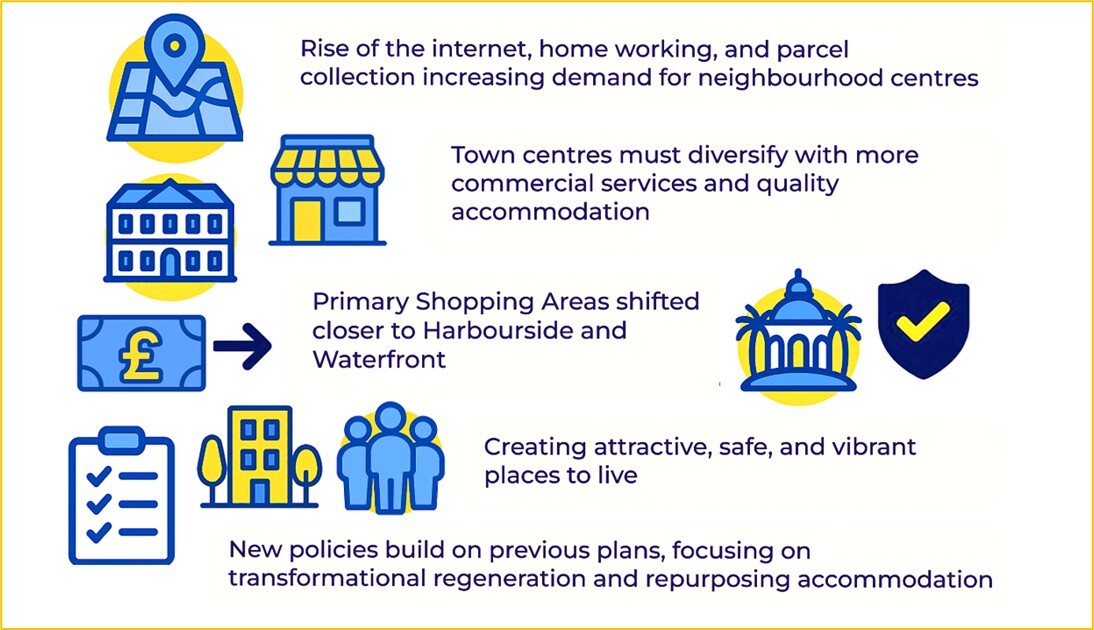
4.75 The role of retailing and the town centres is rapidly changing, although the changes hitting town centres have been clear for some time. The rise of the internet has profoundly affected every aspect of town centres. Linked to this the rise in home working and parcel collection has increased the demand for neighbourhood centres. There is a need for town centres to adapt and diversity towards providing a range of commercial services and good quality accommodation.
4.76 In the context of the Local Plan and the Town Centre Regeneration Visions, there is a policy shift of moving the Primary Shopping Areas closer to the Harbourside and Waterfront areas. There is a need to make town centres places where people want to live, and providing a high-quality built environment, realising the potential of heritage assets, and reducing crime and the fear of crime are a key part of this strategy.
4.77 Many of these trends were apparent when the former Torbay Local Plan 2012-30 was being prepared, and therefore the Policies set out in this chapter represent an evolution in the previous plan's approach. A significant change is the council's transformational regeneration vision and programme, as well as the ambitious accommodation repurposing proposals. These provide a better chance of significant changes in the town centres being achieved in the Plan period.
The NPPF, Class E and Permitted Development Rights
4.78 Chapter 7 (paragraphs 90-95) of the NPPF (2024) reflects the changing role of town centres and promotes a much more flexible approach overall. Planning policies should continue to support the role of town centres and take a positive approach to their growth, management and adaptation. Plans should identify a hierarchy of town centres and promote their long-term viability, including allowing them to grow and diversity.
4.79 The NPPF defines town centres to mean city and town centres, district and local centres but excludes small parades of shops of purely neighbourhood significance. The NPPF defines Main Town Centre Uses as: Retail development (including warehouse clubs and factory outlet centres); leisure, entertainment and more intensive sport and recreation uses (including cinemas, restaurants, drive-through restaurants, bars and pubs, nightclubs, casinos, health and fitness centres, indoor bowling centres and bingo halls); offices; and arts, culture and tourism development (including theatres, museums, galleries and concert halls, hotels and conference facilities). Some, but not all, of these are in the wide-ranging commercial Use Class E. Some other main town centre uses may be in Class F1 Learning and non-residential institutions, F2 "Local Community Uses or Sui generis (within a class of their own).
4.80 Planning for town centres (and employment land) has undergone a major change through the introduction of a wide-ranging commercial Use Class E in August 2021. Class E covers a range of former "Class A" retail uses, as well as other leisure and entertainment uses. The government has also extended permitted development rights to convert commercial property into residential use, subject to a slimmed down "prior approval" mechanism. These changes reflect the changing nature of town centres away from being limited to retail shops, towards needing to embrace a much wider range of uses and housing. It heralds a less restrictive approach to town centre planning through the removal of many former traditional planning controls.
4.81 The NPPF requires Local Plans to designate "primary shopping areas" where a range of main town centre uses are supported. However, the concept of "primary shopping frontages" which should be reserved for retail shops along is no longer required by the NPPF.
The Community and Corporate Plan and Town Centre Regeneration Visions
4.82 The Torbay Community and Corporate Plan recognises that town centres are at the heart of Torbay's communities, and their regeneration is a key priority in the Community and Corporate Plan. This section outlines how the Local Plan supports safe, welcoming and economically vibrant centres through investment, diversification and improved public spaces. It reflects a shift towards mixed-use neighbourhoods and a more compact retail core. These changes aim to make town centres places where people want to live, work and visit.
4.83 The Community and Corporate Plan 2023-43 contains several priorities relevant to town centre regeneration and relevant to retail policy, including drawing investment into our town centres, partnering with the private sector to deliver major projects. These are set out in more detail in Chapter 1 of the Local Plan.
4.84 The regeneration visions for Torquay, Paignton and Brixham are central to delivering the Community and Corporate Plan's goals for inclusive growth and community wellbeing. These visions focus on improving housing, reducing deprivation, and enhancing the built environment. By drawing investment and creating safer, more attractive spaces, the Local Plan supports long-term transformation. It also promotes heritage, culture and public realm improvements as drivers of economic and social renewal.
4.85 The regeneration and improvement of town centres is central to the Local Plan. More details are available at: Growth and Regeneration - Torbay Council . Town Centre Place Visions. At the time of writing (September 2025) the Torquay Regeneration Vision (by Millican and Leonard Design) is the most advanced. It identifies the need to reduce the size of the retail core and strengthen the retail offer south of the GPO Roundabout (i.e. Strand and Fleet Street). Improvements to the public realm, reducing and anti-social behaviour around Castle Circus and changing the perception of the town away from a "Seaside Destination" towards being a vibrant coastal Town".
4.86 Key to the current Town Centres Chapter of the Local Plan is the consolidation to the retail core of the town towards the harbour area, and introducing more mixed-use neighbourhoods elsewhere in the town centre, with a substantial uptick in good quality housing. The need to reduce crime and the fear of crime in this town centre will be an important element of making the town centres safe and welcoming for all.
4.87 The Local Plan is supported by a detailed Retail Study carried out by Avison Young (2022). This replaces the former Study carried out in 2013. This contains a detailed assessment of Torbay's town centres, retail trends and policy implications. It makes detailed recommendations for each of the three town centres, and the district and Local Centres, which are reflected in the Plan.
Structure of this Chapter
4.88 Policy TCS sets out a town centres and regeneration strategy, which seeks to support the regeneration and renewal of town centres and to focus retail and commercial activity closer to harbourside and waterfront areas.
4.89 Policy TC1 sets a retail hierarchy. Torquay is proposed to remain the principal town centre and largest retail, and leisure centre in the Bay, as well as being a sub-regional retail and leisure destination. Paignton's role will support its key tourism role, Brixham will primarily support local needs as well as the town's food and leisure specialisms. The Plan also identifies District Centres at Preston, St Marychurch, The Willows and a new District Centre at Devonshire Park. It is recognised that The Willows and Devonshire Park have characteristics of an out of town retail parks and should accordingly be regulated. Nevertheless, they serve a retail role for nearby housing. Policy TC1 also sets out a network of local centres with more limited range of facilities than town and district centres. Some of Torbay's former Local Centres are of only neighbourhood significance and have therefore been reclassified as Neighbourhood Centres. Policies TC2-TC7 deal with proposals for main town centre uses.
4.90 Policy TC8 deals with S106 contributions to support town centre regeneration. These will be sought to mitigate the impacts of development that have an impact upon the three main town centres and are similar to loss of employment contributions.
4.91 Policy TC9 deals with crime and anti-social behaviour issues, especially relating to the evening and night-time economy.
Strategic Policy TCS: Town centre renewal and retail strategy View representations
The primary locations for retail and other main town centre uses in Torbay will be the town centres of Torquay, Paignton and Brixham, as defined in the Policies Map. The vitality and viability of these town centres will be enhanced through the regeneration of key sites.
Future growth of main town centre uses should follow a town centre first approach, which prioritises the three defined main Town Centres as a location for retail, leisure and other "main town centre" uses.
The Local Plan supports the following:
- Working with the private sector to draw in investment in town centres and support the delivery of major projects
- The delivery of regeneration visions for Torquay, Paignton and Brixham town centres;
- Mixed use regeneration of key sites in town centres as identified in the Strategic Development policies and Policy H1, and regeneration visions. These swill include the provision of major residential, retail, leisure, cultural, healthcare, recreational and event space, and the comprehensive redevelopment of parts of the town centres;
- Significant increase in the number of dwellings in the three town centres, particularly within peripheral parts of the designated town centre and on upper floors.
- Maintaining and enhancing a reduced and more focussed Primary Shopping Area, shown on the Policies Map, where active ground floor retail, leisure or commercial frontages will be maintained.
- Allocating a medium sized food store (1500sq m-2000 sq m) within a town centre or edge of town centre site in Torquay and Paignton town Centres.
- In all three towns, shifting the retail core towards the Harbourside and Waterfront areas.
- Greater flexibility for a range of commercial, and particularly residential schemes outside the primary shopping area, to achieve more balanced communities by delivering a mix of housing, employment, tourism, leisure, retail, family, healthcare, education and other commercial facilities.
- The use of heritage assets, public art and public space, events, exhibitions and festivals to provide a more enjoyable, creative environment in town centres;
- Maintaining a network of district and local centres to provide a range of goods and services that meet the day to day needs of local communities, including the provision of healthcare facilities, skills training, employment and local food outlets.
- The retention of neighbourhood centres and small "corner shops" which serve a more localised function such as providing access to fresh food and top-up items.
- Investment in CCTV and policing to ensure that town centres are safe and welcoming for all.
Community and Corporate Plan – Community and Place
Explanation
4.92 This Plan promotes a range of town centre redevelopments to provide new retail, leisure, residential and cultural facilities as part of mixed-use developments. There is an urgent need to regenerate the town centre and make them attractive living and commercial environments. Masterplans and Regeneration Visions commissioned by the council will have a key role in 'place shaping' within each of the three town centres.
4.93 The town centres, harbourside and waterfront areas are likely to be suitable for a range of commercial and residential uses to support a prosperous Torbay. Regard will had to "agent of change issues" and the avoidance of incompatible developments that could undermine existing uses.
4.94 The Local Plan proposes a significant uptick in town centre housing, and the Retail Study indicates a shortfall in large town centre foodstores. There is a need to improve convenience provision, especially fresh food, in all three town centres, particularly Torquay and Paignton. In Brixham, the need is more "qualitative" in terms of reducing the need to travel though Windy Corner.
4.95 Accordingly, the Local Plan allocates sites for in-town convenience stores in the three towns. The need, size and location of these will be kept under review as part of the town centre regeneration visions. A medium size supermarket is generally between about 1500-2000 sq. m trading floorspace.
4.96 The three town centres are geographically spread out and there are opportunities to focus key town centre activities into a more compact and vibrant heart. In light of the need for town centres to take on a wider role, the "primary retail areas" have been reduced in size and shifted closer to the Waterfront and Harbourside areas. A partial exception to this is the lower part of Union Street Torquay (up to Market Street) where there is a concentration of larger retail units.
4.97 The NPPF simplifies the number of town centre designations by removing the requirement to designate primary and secondary frontages. Based on the Retail Study, the Local Plan has retained the previous town centre boundaries but amended "primary shopping areas" to reflect the areas of town centres that should be the focus of retail and commercial activity at ground floor.
4.98 All town centres contain historic elements, and regard needs to be had to conservation or enhancement of heritage assets and achieving a high-quality living environment.
4.99 Torbay Community and Corporate Plan – This strategy directly supports the Community and Corporate Plan's ambition to revitalise town centres and promote inclusive economic growth. By consolidating retail areas and encouraging mixed-use development, the Plan aims to create vibrant, resilient communities. Investment in public realm, housing and cultural assets will help make town centres more attractive and accessible. The strategy also supports safer environments and better access to essential services.
Strategic Policy TC1: Town centre hierarchy View representations
Retail, leisure and other main town centre use development will be supported within the following centres, where it is appropriate to the role, function and scale of those centres. This will have regard to the shopping hierarchy below. The first choice for retail and related development will be town centres, followed by district centres, then local centres in sequential order and in relation to local needs and function.
The following Centres (and associated primary shopping areas for the three main Town Centres) are defined in accordance with the town centre hierarchy below and are shown on the Policies Map:
Table 10 Town Centre Hierarchy
|
Shopping centre hierarchy |
Torquay area |
Paignton area |
Brixham area |
|
1. Town Centres |
1. Torquay |
2. Paignton |
3. Brixham |
|
2. District Centres |
1. The Willows; |
3. Preston 4. Devonshire Park & White Rock |
|
|
3. Local Centres |
1. Hele Road, Hele; 3. Plainmoor; |
4. Winner Street (removed from Town Centre) 5. Great Parks 6. Yannons & Yalberton (Sainsburys and Aldi (subject to improved walking and cycling links) |
Community and Corporate Plan – Pride in Place
Explanation
4.100 The Torbay Retail Study (2022) contains a detailed heath assessment of Torbay's town centres. Uses within all Torbay's centres are monitored annually.
4.101 Town centres are the most significant centres within the retail hierarchy in Torbay with large trade catchment areas. They will remain the focus for retail, commercial and other typical town centre-related activities. Torquay is the key town centre in terms of size and range of facilities, levels of investment etc. Paignton and Brixham are of a smaller scale and trading influence. A significant focus of the plan is to regenerate the town centres and increase the amount of high quality residential accommodation within them. The Local Plan seeks to locate major proposals for main town centre uses in the Town Centres where possible.
4.102 District centres offer a good range of retail facilities and related services but to a more localised catchment area. Whilst Preston and St Marychurch are traditional district centres, with significant numbers of local traders; the Willows and Devonshire Park have characteristics of out-of- centre retail locations.
4.103 A fresh review of Torbay's existing local centres has been undertaken in the light of advice in the NPPF that "small parades of shops of purely neighbourhood significance" are unlikely to constitute "town centres". Accordingly, the number of local centres has been reduced and the number designated as neighbourhood centres increased. Local Centres are the smallest designated centre (referred to as a "town centre" in the NPPF) with a position in the retail hierarchy. As a general rule, stores of no more than about 1600 sq m (net) floor area are likely to be the maximum that is appropriate to a local centre.
4.104 Neighbourhood Centres are the most localised designation, and contain shops and other facilities of purely neighbourhood significance. They serve an important role in providing access to neighbourhood services and top-up items. They are outside of the retail hierarchy for major retail or other main town centre uses. As a general rule, proposals of more than 280 sq m (net) will be treated as being of more than local significance.
Policy TC2: Development in Town Centres View representations
A new food store (convenience retail) should be provided in Torquay and Paignton Town Centres as an element of regeneration proposals.
New retail and other main town centre use development within Torquay, Paignton and Brixham Town Centres will be supported where they:
- Are of a scale appropriate to the nature and size of the Centre and complement its role and character; and
- Sustain the shopping, leisure, tourism and commercial role of the Centre and contributes to improving its vitality and viability;
- Protect or enhance cultural or tourism appeal;
- Enhance the overall attractiveness of the Centre for its users through environmental improvements, better pedestrian permeability, improvements to vehicular access and parking arrangements, and other town centre management measures;
- Retain active ground floor frontages such as shopfronts within Primary Shopping Areas.
- Contribute to reducing crime and the fear of crime.
Community and Corporate Plan – Community and Place
Explanation
4.105 Policy TC 2 supports the roles of the three town centres as key parts of Torbay's town centre hierarchy. Torquay will remain the main town centre and heart of the English Riviera. Paignton's role as the leading family tourism destination, and Brixham's specialist role as food and maritime port will be supported and enhanced. Town Centre Regeneration Visions will be key to bringing forward proposals in these areas.
4.106 The Local Plan identifies a need to improve foodstore provision in town centres. They should be brought forward in conjunction with the Town Centre Regeneration Visions and have regard for the complex infrastructure, viability and competing uses within these areas. The following guidelines will apply to the location of convenience stores:
-
Torquay: 1500-2,000 sq. m (Lymington Road, former New Look or Fleet Walk).
-
Paignton: 1200-1,600sq. m (Victoria Centre)
-
Brixham: There is a qualitative need to reduce the need to travel out of Brixham. (Ideally in the town centre, although Monksbridge if suitable town centre mitigation is provided).
Policy TC3: District Centres View representations
The following District Centres are shown on the Policies Map:
- St Marychurch, Torquay (existing)
- Preston, Paignton (existing)
- The Willows, Torquay (existing)
- Devonshire Park and White Rock, Paignton (Proposed new designation and redesignation of existing local centre)
1. St Marychurch and Preston District Centres:
New retail and other main town centre uses within St Marychurch and Preston District Centres will be supported where:
- It is of a scale appropriate to the nature and size of the Centre and complements its role and character; and
- It provides for and sustains a range of services and facilities which contribute to the long-term vitality and viability of the Centre and the ability of people to meet their needs locally.
2. The Willows and Long Road/Devonshire Park:
Proposals for new retail and other main town centre uses within the Willows District Centre or Devonshire Park will be supported where all of the following criteria are met:
- Major development will only be permitted where it cannot reasonably be located within the three main Town Centres; and
- Proposal over 500 sq m should demonstrate that there is no significantly adverse impact on town centre investment or vitality and viability
- Development is of a scale appropriate to the nature and size of the Centre and complement its role and character; and
- It provides for and sustains a range of services and facilities which contribute to the long term vitality and viability of the District Centre and the ability of people to meet their needs.
- Development supports measures to improve accessibility by walking, cycling and public transport, and permeability between the Centre and adjoining residential and commercial areas.
- Where adverse impact on the Town Centres are identified but assessed to be less than significantly adverse, these should be mitigated or compensated in accordance with Policy TC9
Community and Corporate Plan – Community and Place
Explanation
4.107 District Centres are of town significance and intended to provide a range of retail and service facilities able to meet most needs. St Marychurch District Centre has a strong tourism and heritage role, being located close to several tourist facilities. Preston District Centre is located in an area where there is scope to densify the built-up area and contains several brownfield regeneration sites (See Policy SDP3). It will be important to maintain retail and other facilities serving those communities.
4.108 Both the Willows and the proposed new District Centre at Devonshire Park have characteristics of out-of-town retail parks. The Willows at Scotts Bridge Barton (and nearby out of centre retail stores) was developed in the early 1990s as part of the urban extension which is now Scotts Bridge/Barton. The centre (and nearby out of centre stores) serves a sub-regional role and has a significant trade draw from the town centre. It is proposed to make the recently developed Devonshire Park a District Centre. Although there is an element of reactive planning, the location serves an area of significant recent residential expansion and planned future growth. It has good links with South Devon College and other employment.
4.109 Accordingly, Policy TC3 recognises the potential impact that major development in these centres could have on the town centres and other District Centres, and therefore seeks to regulate growth in these areas to minimise adverse impacts. The threshold for determining a "significantly adverse "impact on town centres requires a planning judgement. In assessing this, the identified retail capacity, trade draw from the town centre, and qualitative factors such as the range of facilities available in the town centres will be considered.
4.110 It is recognised that the Internet is now also affecting out of town centre retail. As Class E uses the stores could become a range of other class E uses. However, this is likely to require planning permission due to conditions imposed on permitted use and nature of goods sold at The Willows and Devonshire Park.
Policy TC4: Supporting Local Centres View representations
Development of new retail and other main Town Centre uses within Local Centres will be supported where:
- It is of a scale appropriate to the nature and size of the Centre and complement its local role and character. There is a general expectation that major development should be located in the Town or District Centres in preference to local centres; and
- It provides for and sustains a range of services and facilities which contribute to the long-term role of the centre in assisting people to meet their needs locally.
- Unless allocated in a development plan, proposals for more than 500sq m of Main Town Centre use floorspace should be supported by a sequential and impact assessment to demonstrate their impact on Town and District Centres.
- Development should be designed to be easily accessible by active travel or public transport.
Community and Corporate Plan – Community and Place
Explanation
4.111 Local centres are the lowest tier of the retail hierarchy and the smallest centres that the NPPF refers to as "Town Centres". They are primarily intended to help serve day-to-day needs. As such the size of stores appropriate to these centres is likely to be limited. New major development (i.e. with a floorspace of 1,000 sq m or more) is likely to be more appropriately located in Town or District Centres.
4.112 Nationally the increase in home-working and "click and collect" locations has helped maintain the purpose of smaller centres and it is proposed to maintain Local Centres. However, more substantial growth should be directed to higher order centres where possible.
4.113 On that basis, and as advised by the Torbay retail study, proposals of more than 500 sq m of new Main Town Centre use floorspace should be supported by a sequential and impact test, to demonstrate that they would not have a significant adverse effect on town centre investment or vitality and viability.
Policy TC5: Managing retail outside designated centres View representations
Proposals for retail and main town centre uses of more than 280 sq m outside of town, district or local centres must meet the following criteria:
- No other town centre site, edge-of- town centre, district or local centre site is suitable or available (or expected to be available within a reasonable period)
- Proposals should not cause significant adverse impacts either individually or cumulatively on the vitality and viability of existing and planned town, district, local or neighbourhood centres in the catchment area of the proposal. Proposals for main town centre uses over 500 sq m gross must provide a retail impact assessment; and
- Should not adversely impact on proposed regeneration schemes in the three Town Centres. Where an impact on town centres is identified which can be satisfactorily mitigated, proposals should provide financial or other contributions to offset harmful impacts on designated Centres.
- Development would improve the spatial distribution of accessible facilities throughout the Bay and help to achieve greater social inclusion.
- Be easily accessible to active travel and public transport.
Proposals for tourism and leisure developments within Core Tourism Investment Areas will be supported subject to other policies in this Plan and will not be required to demonstrate a sequential or impacts test. In such cases it may be necessary to restrict uses to those appropriate to the tourism setting of the area.
Neighbourhood Centres are designated below;
Table 11 Neighbourhood Centres
| Category | Centres |
|---|---|
| Neighbourhood Centres (not part of the retail hierarchy) | 1. Maidencombe Cross (proposed) 2. Moor Lane, Watcombe 3. Fore Street, Barton 4. Upton Road, Upton 5. Sherwell Valley Road, Chelston 6. Ellacombe 7. Roundhill Road, Livermead |
| Former Local Centres redesignated as Neighbourhood Centres (not part of the retail hierarchy) |
8. Cadewell Lane, Shiphay 9. Babbacombe 10. Old Mill Road, Chelston 11. Walnut Road, Chelston 12. Lucius Street 13. Belgrave Road 14. Higher Union Street, Torre 15. Wellswood 16. Lisburne Square, Torwood 17. Barton Hill Road, Barton 18. Preston Down Road 19. Collaton St Mary (proposed) 20. Marldon Road 21. Foxhole 22. Cherrybrook Square 23. Churston Broadway 24. Three Beaches, Goodrington 25. Pillar Avenue 26. Summercourt Way |
Community and Corporate Plan – Community and Place
Explanation
4.114 Policy TC5 deals with proposals for retail and other main town centre uses outside of designated Town Centre, District Centre or Local Centres. (Collectively called town centres by the NPPF). Policy TC5 applies a sequential and impacts test for considering out of centre (and neighbourhood centre) proposals.
4.115 There are some local specific circumstances that justify a local bespoke policy beyond the NPPF. Firstly, the Retail Study identifies the town centres as being vulnerable to relatively modest out of town centre proposals, and therefore recommends a threshold of 500 sq. m. (rather than the NPPF default figure of 2,500 sq. m).
4.116 The NPPF indicated that "references to town centres or centres apply to city, town , district and local centres but excludes small parages of shops or purely neighbourhood significance. Torbay's centres have been reviewed, and those of "purely neighbourhood significance" have been redesignated as Neighbourhood Centres. These do not have a role in the retail hierarchy in relation to the sequential preference for main town centre uses. However, they still serve a localised role in meeting day to day needs, and policy TC5 seeks to support development that will help them meet that need (insofar as the matter falls within planning control).
4.117 As a major tourism resort some "Main Town Centre Uses" such as food and drink, hotels, cultural facilities etc.) will often be appropriate within Core Tourism Investment Areas even though these (partly) fall outside main town centres. In such instances proposals will not be required to demonstrate a sequential or impact test. However, it may be necessary to restrict use to a range of uses appropriate to CTIA locations rather than the full gamut of Class E uses.
Policy TC6: Supporting access to local retail and services View representations
The introduction of new corner shops, village shops or shops and facilities serving isolated communities will be supported in principle, where such provision enhances the sustainability of new or existing communities, and are of an appropriate scale to cater for local needs. Out of centre retail shop premises should be no more than 280 sq m.
Community and Corporate Plan – Community and People
Explanation
4.118 Policy TC6 provides support for small out of centre shops. Where more than 1km from other shops these fall within Use Class F2 where their premises is less than 280 sq. m. The Town and Country Planning Use Classes Order (1987) as amended in 2020 and 2021 limit the size of store by "premises" and not trading floor area. The council will take this to mean the gross internal area (also called "gross retail floorspace) which is the total built floor area occupied by a retailer or retailers, and excludes out door display, storage or sales areas).
Proposals involving the loss of retail or main town centre uses.
Policy TC7: Change of use away from main town centre uses in Town, District or Local Centres View representations
Proposals for changes of use or redevelopment from retail or other main town centre use in Town, District, Local Centres will be supported where all of the following apply:
- The vitality, viability or character of the Centre as a whole is not undermined, and the Centre retains sufficient main town centre uses to maintain its role and function;
- A viable concentration of commercial uses and frontages is retained.
- Proposals are appropriate to the scale and nature of the Centre and will not introduce conflicts that will undermine the continued operation of other businesses in the centre.
Within Town Centre primary shopping areas, as defined in the Policies Map, proposals should retain active shop frontages and main town centre uses at ground floor level.
Outside of the primary shopping area, the council will seek to maintain active frontages where their loss would lead to a fragmentation of the overall commercial character or coherence of the centre.
Residential use will be supported in principle on upper floors of the primary shopping area. Residential use will only be supported on ground floors outside of primary shopping areas, where this does not lead to fragmentation of the centre, for example by creating inactive frontages.
Proposals for residential use in the town centres should have regard to existing and proposed nearby commercial uses and the likely impact of them on the amenity of residents.
Where commercial buildings are converted to residential use, there will be a requirement to restore building to their original historic form by the removal of unsightly features such as build-outs and signage. Where historic shopfronts need to be retained, they should be incorporated into the design of dwellings.
Community and Corporate Plan – Community and Place
Explanation
4.119 Policy TC7 seeks to retain ground floor commercial uses in town district and local centres. The policy does not restrict residential or other uses on upper floors, subject to amenity considerations. The policy must operate within the scope of permitted development rights, but as a general rule, active commercial frontages should be maintained in town centre areas.
4.120 As noted, the introduction of Use Class E, changed to permitted development rights, amendments to national planning policy, and changing shopping patterns remove the traditional role of retail policies to keep town centre as the preserve of Class A1 shops. Nevertheless, town centres and particularly the primary shopping areas should remain and be enhanced as the focus of retail, leisure, commercial and cultural activity. This will also assist in their regeneration as vibrant places where people want to live. Policy TC7 seeks to provide a flexible framework that supports the retention of a range of retail and main town centre uses in the town centres, whilst also encouraging increased residential use.
4.121 Policy TC7 incorporates an "agent of change" principle that new development should not lead to a sterilisation of longstanding existing uses. This is particularly important in Waterfront and other areas where the night-time economy operates (see also paragraph 200 of the (2024) NPPF). Residential development should comply with other Policies in the Plan, particularly design and housing policies. Ground floor residential uses should not create 'dead frontages' in the street scene and are therefore more likely to be appropriate in the peripheral areas of town centres.
4.122 It is important that district, local centres retain a mix of uses that provide a useful service to local communities.
Policy TC8: Change of use away from main town centre uses outside Town, District or Local Centres View representations
Outside the designated Town, District or Local Centres, proposals for change of use of shops and other main Town Centre uses will be supported where this would not result in the significant loss of facilities serving the day-to-day needs of local communities.
The council will seek to retain a small convenience store and other facilities serving a local area in neighbourhood centres or isolated shops unless one of the following applies:
- There is an alternative shop or comparable facility within 400m of the shop; or
- It can be demonstrated that there is no realistic prospect of the building operating for retail or main town centre use
Where commercial buildings are converted to residential use, there will be a requirement to restore building to their original historic form by the removal of unsightly features such as build outs and signage. Where historic shopfronts need to be retained, they should be incorporated into the design of dwellings.
Community and Corporate Plan – Community and Place
Explanation
4.123 Policy TC8 seeks to retain local-food stores and other small scale facilities such as hair salons, pubs and cafes in neighbourhood centres and out of centre locations. However, it is recognised that these can also provide new homes. The Local Plan seeks to allow change of use or redevelopment of such areas, so long as alternative provision is available within moderate walking distance (400 m) in the case of shops meting local needs. It seeks to resist changes of use that would leave neighbourhood isolated or dependent upon car travel to meet "top up" needs. Policy TC8 does not refer to the Use Classes Order, but greatest attention will be given to protecting small shops selling essential items, particularly food (whether within Class E or Class F(2).
Policy TC9: Town Centre Regeneration Contributions (New Policy) View representations
Where proposals have an adverse impact on the vitality or viability of town centres which is assessed to be less than significantly adverse, or where other material considerations indicate that permission should be granted; a contribution will be sought to mitigate that impact by supporting town centre regeneration projects.
Community and Corporate Plan – Economic Growth
Explanation
4.124 The NPPF indicates that proposals that have a "significant adverse" impact on town centre investment, vitality and viability, choice and trade, should be refused. There is no hard and fast rule about the scale of trade-draw (i.e. the amount of retail spend diverted away from a centre by a new proposal) should be considered as "significant adverse" but the council considers that impacts of more than around 4% are likely to be "significant".
4.125 However, there will be instances where the Local Planning Authority is minded to approved proposals that have an impact on town centres: either because they consider the scale or nature of impact to be less than significantly adverse, or because of other material considerations. This could include matters such the improvement of residential amenity, reduction on deprivation or the provision of affordable housing.
4.126 In such instances, the council will seek planning contributions to mitigate the impact. The starting point for assessing these will be the scale of impact measured over five years. This will be used to support the Town Centre Vision or other regeneration proposals.
Policy TC10: Safe and welcoming town centres for all View representations
The Local Plan will support measures to make town centres, harbourside and waterfront safe and welcoming for all. In principle, development that helps create a vibrant, diverse daytime, evening and nighttime economy or would contribute positively to environmental improvements, lighting and safety measures within the town centres, seafront and harbour areas of the Bay will be supported.
Development proposals will be resisted where:
- Proposals likely to attract crime and anti-social behaviour unless it is demonstrated that they can be sufficiently controlled and a mechanism provided for so doing.
- Whilst there is an expectation that food and drink uses are a suitable use in Harbourside and waterfront Areas, the cumulative impact of licensed premises, and those providing late night entertainment and services will be resisted where this would create serious amenity, or crime or fear of crime issues.
- It would adversely impact on amenity or cause disturbance to nearby uses (including residential properties).
Uses or developments that have an impact upon town centre monitoring, maintenance or policing will be required to make appropriate contributions towards the costs of monitoring, maintenance or policing arising from the development.
Community and Corporate Plan – Community and People
Explanation
4.127 The evening and nighttime offer in Torbay is currently focused on the harbourside and waterfront areas of the three towns. There is a need to diversify the offer in these areas to create a more balanced range of facilities with a more family friendly appeal. There is also a need for the town centres to diversify their current day time offer, and to extend their times of patronage, creating a more vibrant environment, with a wider range of uses, including cultural and family based activities.
4.128 It is intended that future developments will create town centre, waterfront and harbour areas that can be accessed by all groups in the day and night without fear of intimidation or conflict.
4.129 While there are opportunities and benefits to expand the evening and nighttime economies, there are also associated potential problems including alcohol-related crime and disorder, and noise nuisance. Perceived risks may discourage other groups such as older people and families from entering these areas at night.
4.130 The Local Plan seeks to expand the number of homes in town centres, particularly in mixed use residential neighbourhoods. While town centre residents must accept, and may well welcome, the noise and bustle of town centre living, their residential amenity must be respected, particularly very late at night. This sector needs careful management. The award of the "Purple Flag" for the effective management of the nighttime economy is a significant accolade. This requires ongoing management to ensure it is retained, for example to keep public toilets open and clean, clear up litter, provide policing and pastoral support. Where planning applications come forward which could put demands on these matters they will be required to make appropriate contributions towards CCTV, town centre monitoring and policing, and engage with strategies and initiatives to mitigate the cumulative impact of venues.
4.131 Torquay and Paigton Town Centres in particular contain concentrations of deprivation, which is in part driven by a poor-quality accommodation. Improved safe and regulated accommodation is needed for homeless people on Factory Row, and some of the accommodation close to the town centre. The renovation of buildings, improved streetscape and community capacity building will be supported where this would help regenerate areas of deprivation.
Have your say on Chapter 4