Torbay Local Plan Regulation 19 Publication Version and Consultation
Other elements in this consultation
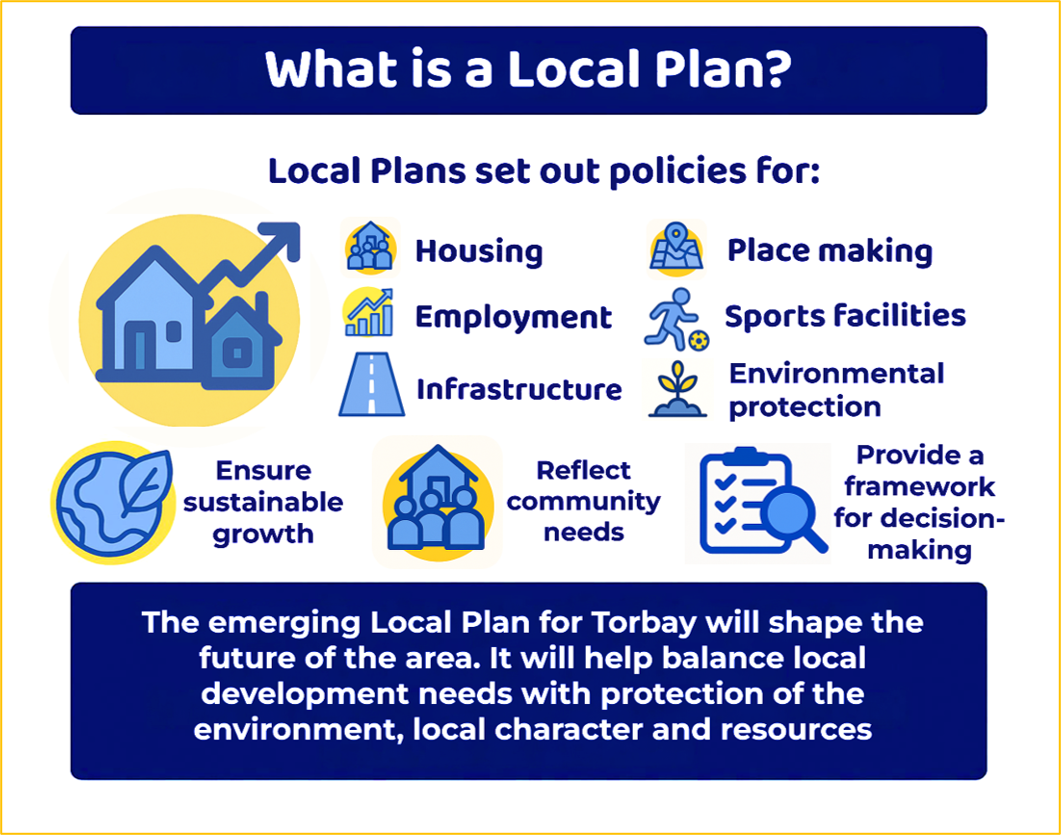
Chapter 1. Our shared vision - A healthy, happy and prosperous Torbay View representations
Introduction View representations
The scope of this Plan
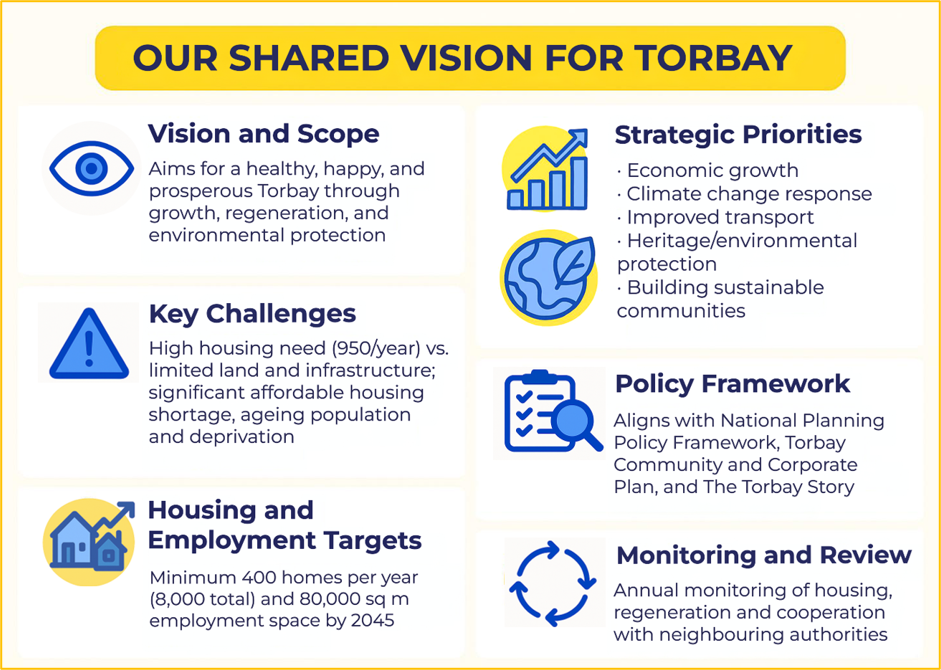
1.1This is the Regulation 19 Plan for Torbay which is published for consultation between 12th August and 23rd September 2026. It is a Plan for growth, within environmental limits, and strongly promotes regeneration and modernisation of the built-up area. It seeks to minimise damage to the natural environment and to provide resilience to the effects of Climate Change whilst reducing carbon emissions.
1.2The Plan contains a strong Presumption in Favour of Urban Regeneration and support for affordable housing. It seeks to achieve an average of 400 dwellings per year over the Plan period 2025-45. This is a minimum number and not a ceiling, should sustainable urban sites be available to exceed this figure. It is also proposed to deliver a minimum of 80,000 sq. m. (equivalent to around 20 hectares) of employment land. It will be important to provide sufficient affordable housing and family homes in order to reduce the risk of labour shortages. The plan also prioritises addressing Climate Change.
1.3The Plan is not intended to be a sales-pitch document. However, it seeks to implement and provide a positive planning framework to implement other key visions and strategies in particular:
-
The council’s Corporate and Community Plan 2023-43
-
The Torbay Story
-
The Housing Strategy
-
Regeneration and the Accommodation Repurposing Programme (also referred to as the “Hotels to Homes” initiative).
1.4. When adopted, the Plan will form the legal starting point for determining planning applications and related proposals in Torbay. Decisions are still subject to other material considerations, especially those set out in the government’s National Planning Policy Framework (NPPF, currently December 2024), Planning Practice Guidance (PPG) and National Development Management Policies.
1.5. This plan will replace the Torbay Local Plan 2012-30. It covers the period 1st April 2025- 31 March 2045. But realistically, the Plan will require a review five years from adoption. This version of the Plan is the “Regulation 19” publication plan. This means that it is at an advanced stage of consultation into the Plan’s soundness and legal compliance (see particularly Paragraph 36 of the (2024) National Planning Policy Framework (NPPF). The Local Plan is required by planning law to promote sustainable development. This means applying the Presumption in Favour of Sustainable Development in Paragraph 11 of the NPPF.
1.6. This version of the Local Plan is the result of previous consultations. We have carefully considered the feedback from these in drafting this version of the Plan. The previous consultations are: January 2022 Growth Options consultation, the October 2022 Housing Site Options, and the November 2025-February 2026 Full Draft Local Plan consultations.
1.7. Comments made on the Regulation 19 Local Plan will be carefully considered and reported to the Local Plan Working Party and Full Council in Autumn/ early Winter 2026. We will prepare a schedule of Main Modifications to the Local Plan (assuming these are needed). Following consideration by Full Council we intend to submit the Local Plan (along with any necessary Modifications to the Secretary of State by the Government’s deadline for submission of December 2026.
1.8. Members have been keen to ensure that the Regulation 19 Consultation is a genuine exercise that will be sedulously considered by the Council. The scope of the consultation is however more narrowly defined than at previous stages to matters of the Local Plan’s soundness and conformity to legal tests.
1.9. Further information can be set out in the council’s Local Development Scheme Local Development Scheme - Torbay Council.
Challenges for the Plan
1.10Torbay faces significant challenges but also opportunities. We need to be realistic and acknowledge that Torbay has a significant need for development, but limited space or environmental capacity to grow, and limited viability to support its infrastructure and other needs.
1.11Torbay has a significantly ageing population and needs to plan for the implications of this. It needs to encourage a younger demographic, particularly working age families, as well as provide for the needs of older people. This will be important to meet Torbay’s economic regeneration goals.
1.12Torbay’s fantastic environment is its unique selling point. It is justly branded the English Riviera, with a world class tourism offer. It has glamour, high-profile businesses, a beautiful marine setting and internationally important environmental assets. This is accompanied by a rich historic and prehistoric environment. Torbay faces challenges arising from Climate Change and a need to reduce carbon emission and provide resilience to the effects of a changing climate. Development is likely to impact upon the South Hams SAC and the Lyme Bay and Tor Bay Marine SAC, and this needs to be mitigated. Torbay’s best asset is its spectacular environment, and it is vital that development does not erode that. Hence the need to double down on urban regeneration and focus growth in the built-up area. Including building upwards where necessary and feasible.
1.13Like the previous Torbay Local Plan, this is a plan for growth within environmental limits, but the above seeks to be realistic about the scale of the challenges and the scope of a Local Plan to contribute to solutions. The solutions are wider than planning and it is critical that the land use framework supports the council’s wider regeneration programmes.
1.14The Local Plan is intended to be a strategic document. It interacts with and provides a land-use planning framework for other detailed visions, masterplans, and neighbourhood plans.
The National Planning Policy Framework (NPPF) View representations
1.15The NPPF has a legal weight in plan making. Councils are required by law to prepare a local plan and to seek to achieve sustainable development. Key to this are the Presumption in Favour of Sustainable development at paragraph 11 (a-b) of the NPPF and the Tests of Soundness (Paragraph 36). The NPPF sets out what Local Plans should include:
15. The planning system should be genuinely plan-led. Succinct and up-to-date plans should provide a positive vision for the future of each area; a framework for meeting housing needs and addressing other economic, social and environmental priorities; and a platform for local people to shape their surroundings.
16. Plans should:
- be prepared with the objective of contributing to the achievement of sustainable development (legally required under S39(2) of the Planning and Compulsory Purchase Act 2004).
- be prepared positively, in a way that is aspirational but deliverable;
- be shaped by early, proportionate and effective engagement between plan-makers and communities, local organisations, businesses, infrastructure providers and operators and statutory consultees;
- contain policies that are clearly written and unambiguous, so it is evident how a decision maker should react to development proposals;
- be accessible through the use of digital tools to assist public involvement and policy presentation; and
- serve a clear purpose, avoiding unnecessary duplication of policies that apply to a particular area (including policies in this Framework, where relevant).
17. The development plan must include strategic policies to address each local planning authority’s priorities for the development and use of land in its area.
There is an expectation that Local Plans should be strategic in nature and should set out an overall strategy for the pattern, scale and design quality of places and make sufficient provision for:
- homes (including affordable housing), employment, retail, leisure and other commercial development;
- infrastructure for transport, telecommunications, security, waste management, water supply, wastewater, flood risk and coastal change management, and the provision of minerals and energy (including heat);
- community facilities (such as health, education and cultural infrastructure); and d) conservation and enhancement of the natural, built and historic environment, including landscapes and green infrastructure, and planning measures to address climate change mitigation and adaptation.
1.16The NPPF is supported by online Planning Practice Guidance. The Levelling Up and Regeneration Act 2023 allows the Secretary of State to publish National Development Management Policies (NDMPs) which when published will take primacy over local plans where they are in conflict.
1.17Within these parameters, there are important local documents, visions and blueprints that the Local Plan seeks to support and ensure that land use decisions are aligned with meeting these community and corporate goals.
The Torbay Community and Corporate Plan 2023-43
1.18The Corporate and Community Plan sets out the council’s Vision, Objectives and Priorities, and to provides the strategically grounded foundation for everything the council does. This includes informing strategic, operational strategies, plans and policies including the Local Plan.
The Corporate and Community Plan perceptively states: “Despite everything that is fantastic about Torbay, we know that we face challenges and that some parts of the Bay suffer from nationally significant levels of poverty. There is huge potential, and this Plan brings together the interlinked priorities we need to address to make Torbay a happy, healthy and prosperous place for our whole community”.
The Plans’ Vision Statement is:
We want to see a healthy, happy and prosperous Torbay.
Torbay is a glorious part of Devon with an inspiring natural environment. We are a magnet for tourists and known as the English Riviera. We are home to globally significant technology businesses and have a rich leisure and cultural scene.
We want to deliver for our people and our place. We know we have challenges, but we have high aspirations. By continuing to work closely with our communities and partners and capitalising on our strengths, we want make Torbay a great place to do business – a place where everyone is able to live their best life.
A healthy, happy and prosperous Torbay for all.
To achieve this the Corporate and Community Plan identifies three strategic themes, all of which are relevant to the Local Plan:
- Community and People
- Pride in Place
- Economic Growth
Boxes like this feature after policies throughout the Plan. These indicate how the policy aligns with the visions and themes of the Community and Corporate Plan.
1.19Land use planning policies are integral to Pride in Place and play a substantial role in community and people and achieving economic growth. The Corporate and Community Plan objectives as follows:
People Priority
Support real, sustainable change for those in greatest need within our communities, to thriving communities where people can prosper. This should have regard to the following priorities:
- Ensure our town centres are safe and welcoming for all.
- Keep children safe in their communities and provide safe environments for our young people to thrive in.
- Ensure early intervention is effective and targeted.
- Provide the best care and support available so that residents are empowered to achieve what matters most to them.
- Provide clear signposting for those needing our help.
- Support and encourage community action.
- Improve wellbeing and reduce social isolation.
Pride in Place Priorities
Support investment in the three town centres to enable them to develop their own distinctive roles, including supporting the provision of affordable housing in town centres. Regeneration of brownfield urban sites will be supported in principle. Regard should be had to the following priorities:
- Draw investment into our towns and breathe life into our town centres, partnering with the private sector to deliver major projects.
- Maximise heritage and cultural opportunities for the enjoyment and benefit of residents and visitors.
- Ensure the effective operation of SWISCo to have resources to reinvest in Torbay.
- Deliver priority capital projects within the council’s Capital Programme.
- Improve the delivery, affordability and quality of housing (including housing standards) for residents in Torbay.
- Improve the delivery of our planning service.
- Protect and enhance our lived, built and natural environments, including our green spaces.
Economic Growth Priorities
To attract, retain and grow the economy to create good quality and learning opportunities, and to retain and attract the workforce that Torbay needs including the provision of affordable housing and opportunities for investment in employment. This should have regard to the following priorities:
- Encourage aspiration, providing opportunities for everyone to raise their skill level, particularly in high value careers.
- Drive training opportunities across all sectors to empower people to improve their skills.
- Improve transport links to and within Torbay.
- Develop a year-round economy.
- Increase the amount of full-time employment opportunities within Torbay.
- Focus on inclusive growth, with opportunities which benefit everyone.
The Torbay Story
1.20The Torbay Story is a strategic initiative aimed at transforming Torbay’s prospects whilst celebrating and enhancing its glorious natural assets and heritage. The Torbay Story is the Torbay Place Leadership Board’s springboard to promote investment, regeneration, and community development across Torbay. The initiative encourages collaboration between public and private sectors to unlock Torbay’s full potential.
1.21It aims to celebrate and realise the fantastic opportunities for Torbay to be:
- The Premier Marine and Natural Experience
- A hub for adventurers and tech innovation
- A place to invest, live, and thrive
1.22The Torbay Story promotes “tech by the bay” seeking to improve Torbay’s amazing knowledge based businesses scattered across the amazing environment. Whilst there is limited (but important) manufacturing; the Bay has a massive knowledge-based economy based on ideas, innovation thinking and ingenuity, with many globally significant companies in photonics (the science of light), environmental science, marine engineering, green technology, medical technology etc. The Torbay Story aims to grow relationships with regional universities and to encourage start-up business and benefit for the clusters of similar businesses. The spectacular environmental benefits of Torbay to live and work in are key to this.
1.23The Torbay Vision wants the area to be a Hub for Active Adventurers enabling people to better curate their health and especially mental health by providing a connection with nature, with endless recreation activities in Torbay’s globally important countryside and marine environments.
1.24The “Big idea” for Torbay is for an overall Torbay as The Premier Marine and Natural Experience. This idea is intended to help the public, private and voluntary sectors think differently to better utilise Torbay’s assets, radiate influence, cultivate and encourage strong leadership and developing new relationships to bring business and place together,
1.25 Within this “strategic signature” a vision for each town is set out, to develop their own distinct identities and roles to create a unified and complementary offer.
1.26Brixham is a centre for creative arts and industries, Food and Fishing Fusion. Paignton is Family Fun on the Foreshore offering traditional values to the best standard it can be with beautiful sandy beaches, nearby zoo, steam railway and oldest surviving cinema in Europe. Paignton is also home to clusters of “tech by the sea” high tech businesses. It is therefore also a centre for Enterprise, Electronics and Entrepreneurship. Torquay is the heart of the English Riviera and a premier holiday experience with the marina, waterfront, Agatha Christie Heritage, UNESCO Global Geopark, food and drink, leading on Leisure and Lifestyle by the Sea.
Town Regeneration Projects
1.27A range of transformative projects and opportunities aimed at revitalising key areas are proposed as part of the Torbay Story and the council’s wider regeneration programmes. Key to this is a range of ambitious urban regeneration projects, all of which are embraced and proposed for development in the Local Plan. These include:
-
Stand Torquay
-
Union Square Torquay
-
Crossways Centre Paignton
-
Victoria Centre, Paignton
-
Wider regeneration to create jobs, invest in key economic sectors such as “tech by the sea” knowledge-based industries and MedTech
-
Working with the Plan for Neighbourhoods to help realise a 10-year strategy to help those in most need in Torquay.
Other Visions and Strategies
1.28 The above documents set out a high-level vision for Torbay. The Local Plan lays out a land-use basis to realise those visions. Both the Local Plan and its supporting documents are informed by other Plans and Strategies. Where relevant, these will be referred to in the Policy Explanations and explained in more detail in background topic papers.
1.29Some of the key documents are:
-
English Riviera Destination Management Plan - Torbay Council
-
Greener Way for Our Bay Framework and Action Plan – Torbay Council
-
Joint Health and Wellbeing Strategy 2026-30 – Torbay Council
-
Devon and Torbay Local Transport Plan 4 2025 to 2040 – Devon and Torbay Combined Authority
Local Plan Key Objectives View representations
1.30. The Previous Torbay Local Plan 2012-30 sets out several key aspirations. These are still largely consistent with the objectives in the NPPF, Community and Corporate Plan and The Torbay Story. The proposed aspirations are set out below but have been amended to confirm that they are the Plan’s strategic priorities. They also take into account:
-
A higher priority to urban regeneration and the provision of affordable housing, and more established programmes for delivering these.
-
Responding to Climate Change being given a higher priority.
-
A focus on matters that land use planning is able to control (e.g. land use allocation) rather than things beyond the control of planning.
1.31. The Plan has five strategic priorities for the Bay:
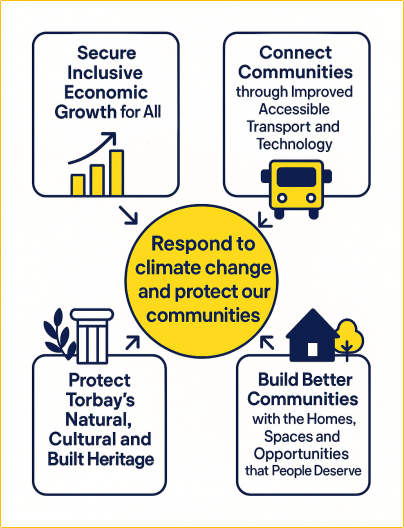
1.32These aspirations are interconnected, but at their heart is the need to focus development on urban renewal in order to protect the wider environment.
Strategic Priority 1: Secure Inclusive Economic Growth for All View representations
1.33To achieve economic growth and deliver new jobs and housing, in order to promote equality, reduce disadvantage and poverty and increase Torbay’s competitiveness. This will be achieved by meeting the following objectives:
- To strongly support town centre and other urban regeneration to provide more home, including affordable housing, jobs and commercial development. The Plan sets out a Presumption in Favour of Urban Regeneration.
- To drive forward regeneration schemes and provide sufficient land and co-ordinated infrastructure to achieve sustainable growth.
- To boost the supply of affordable housing.
- To provide sufficient, varied full-time employment and increase earning potential.
- To support existing employment sectors whilst providing land, training opportunities and a positive climate to encourage new employment, particularly in the knowledge based, high tech and medical technology sectors.
- To ensure the English Riviera achieves its potential as a premier tourist resort by continued investment in existing facilities, waterfront areas and marine environment, and the provision of new attractions.
- To cater for changing holiday demands and expectations to attract new visitors, investment in high quality facilities and accommodation, whilst releasing outdated accommodation and facilities for housing.
- To encourage a younger demographic in Torbay, including retaining college leavers by providing better job and training opportunities and better access to housing.
- To provide a range of goods, services, events and facilities that make Torbay a leading destination of choice for people with money to spend, particularly new and improved provision in the town centres.
- To strengthen Torquay town centre as the Heart of the English Riviera and a retail commercial, social and cultural focal point. Paignton and Brixham town centres to develop their role, on a proportionate basis, focused on meeting the needs of their own residents and tourists.
Strategic Priority 2: Respond to Climate Change and Protect our Communities View representations
1.34 To ensure the use of energy and natural resources, the sensitivity of the natural environment and public health needs are taken into consideration when planning new development. This will be achieved through meeting the following objectives:
- To promote the installation of low carbon and renewable technologies, particularly making better use of existing and new roof spaces for solar energy.
- To improve the energy efficiency of new developments, and existing buildings, to reduce the reliance on fossil fuels and the impact of rising utility bills on poverty.
- To roll out a network of electric charging for vehicles and other infrastructure needed to transition to a low-carbon economy.
- To become resilient and adaptable to climate change.
- To minimise flood risk to new and existing development by incorporating sustainable drainage and other measures to address run-off, sea level rise, increased storminess and unpredictable weather.
- To recognise the multiple benefits provided by open spaces, biodiversity, green infrastructure such as green corridors/wedges, rural landscapes, beaches and the Bay itself, having regard to their statutory significance and value to the community over the lifetime of development.
- To minimise the generation of household, business and construction waste and reduce its negative impacts upon the environment by focusing on the prevention, re-use and recycling of waste as set out in the waste hierarchy and prevent pollution.
- To support the growth of environmental technology and related businesses in Torbay.
- To resist the installation of fossil fuel dependent infrastructure or facilities.
Strategic Priority 3: Connect Communities through Improved Accessible Transport and Technology View representations
1.35 To ensure that Torbay has excellent accessibility and connectivity within the Bay and elsewhere. This will be achieved by meeting the following objectives:
- To increase accessibility throughout the Bay and beyond with fast, frequent, reliable and sustainable travel, giving people real choice as to how they make their journeys.
- To encourage active travel to promote health and environmental sustainability.
- To deliver an integrated transport system, providing a choice of transport and supporting walking, wheeling, cycling and public transport.
- To improve road, rail links, walking, wheeling and cycling routes, to reduce congestion and environmental impact.
- To promote water-based transport in the Bay, for both work and leisure.
- To ensure the safe and convenient movement of people and goods.
- To minimise the length of journeys for employment, shopping and other activities by the careful siting of development and through the detailed planning of the mix of uses in growth locations.
- To require the creation of permeability for active travel in all major development and to mandate interconnectivity between adjoining developments.
- To provide next generation broadband connections.
Strategic Priority 4: Protect Torbay’s Natural, Cultural and Built Heritage View representations
1.36To conserve and enhance the richness and diversity of the built, historic, marine and natural environments, which provide Torbay with its unique setting and important economic benefits. This will be achieved by meeting the following objectives:
- To safeguard existing and maximise opportunities for biodiversity enhancement in and around developments to deliver a net gain for biodiversity.
- To provide a network of recreation and Green Infrastructure including Suitable Alternative Natural Greenspace (SANG) to relieve recreational and other pressure on the South Hams Special Area of Conservation and other critical environmental assets.
- To ensure new development makes a positive contribution to local character and identity, including the wider landscape character river corridors, open spaces, country parks and natural areas and setting of proposals.
- The safeguard the Best and Most Versatile Agricultural Land to assist with food security in a changing environment.
- To preserve, safeguard and protect heritage assets from inappropriate development including those at risk in a manner proportionate to their significance, whilst supporting the need for regeneration and renewal of town centres and the built-up area. To have regard to the role of heritage assets in helping to deliver economic regeneration, express local identity, reveal social histories and narratives and increase the connection of communities with place.
- To avoid mediocre design by the application of clear design standards, including the use of Torbay’s Design Review Panel to maintain quality development that is well integrated in its surroundings and responds successfully to local character.
- To require conversions and extensions positively to enhance the existing building, especially in Conservation Areas, removing unsympathetic extensions and rectifying poor quality alterations where necessary.
- To encourage the re-use of empty homes and businesses, including bringing back historic buildings into beneficial use.
- To make the most of the English Riviera’s status as the world’s first internationally recognised Urban Geopark in recognition of its geological, historical and cultural heritage and sustainable tourism value.
Strategic Priority 5: Build Better Communities with the Homes, Spaces and Opportunities that People Deserve View representations
1.37To meet the needs of Torbay’s residents, including disadvantaged, care-experienced, and minority groups, and to provide everyone with a full range of opportunities in life. This will be achieved through meeting the following objectives:
- To build enough houses to give all Torbay residents a chance of a decent home.
- To end the cycle of deprivation linked to substandard accommodation and resist inappropriate conversions and poor design where this may exacerbate disadvantage and deprivation.
- To provide a range of supporting living opportunities to assist existing Torbay residents live independently in their own home for as long as possible, whilst providing and supporting facilities to minimise social isolation.
- To resist development that will create additional costs to the healthcare and social services, unless the impact of these is fully funded.
- To provide a full range of facilities and shops within town centres necessary to meet day to day needs, particularly the provision of fresh food.
- To resist inappropriate development that would harm the vitality and viability of town centres.
- To diversify the leisure and cultural offer in the town centres, particularly the nighttime economy in Torquay.
- To create a more enjoyable, creative built and natural environment using heritage assets, public art and revitalisation of the public spaces to attract events, exhibitions and festivals that celebrate and enhance the culture of Torbay.
- To allow tall buildings in appropriate locations where this secures wider regeneration benefits, particularly where informed by Town Centre masterplans and other design codes.
- To provide a suitable and sustainable range of physical and community infrastructure to promote economic prosperity and social cohesion, spiritual wellbeing and contribute towards higher aspirations and achievement, particularly amongst the young.
- To support the expansion and improvement of existing educational establishments, especially South Devon College, and plan positively for new education and lifelong learning, and links to employment especially in the knowledge based economy.
- To help tackle hotspots of child poverty, multiple deprivation, high levels of crime and unemployment wherever they arise.
- To support new and enhanced recreational, play and leisure facilities, to promote health and social wellbeing for all, including young people. To create sufficient burial and ceremonial spaces, as part of the green infrastructure offer to provide dignified resting, ceremonial and remembrance facilities.
Housing Numbers
1.38The Plan will support the delivery of a minimum of 8,000 homes over the Plan period 2025-45. This is around the long-term average achieved since 1980 and will require a significant uptick in urban regeneration and increased urban living. There is a particular need to boost the supply of affordable housing.
1.39Detailed assessment of spatial options for growth has shown town centres, Torquay Gateway and West Paignton as the most sustainable locations. Updated masterplans will be prepared to support and expedite delivery.
Natural and Historic Environmental Capacity
Crucially, the Plan recognises the unique quality of the Bay’s natural environment. This attracts people, investment, businesses and visitors. It is vital this Plan protects and enhances that quality, to bring more investment, more visitors and more people into the Bay. Torbay enjoys a significant historic environment, and there is a need to conserve and enhance the most important heritage assets and also improve the quality and perception of parts of the built up area, to assist urban renewal. As a UNESCO Geoparks Torbay also has internationally significant geological and palaeontological value.
Sustainability Appraisal
1.40The Local Plan is supported by a Sustainability Appraisal (SA). This assesses the environmental, social, and economic impacts of the Local Plan, and includes legal requirements from UK and European regulations. The SA helps make sure that the Local Plan:
- Promotes sustainable development
- Avoids harmful impacts on people and the environment
- Considers different policy options and chooses the most balanced and beneficial ones
- Includes ways to prevent or mitigate negative effects.
Land and Labour Supply
1.41The Local Plan, working alongside Torbay’s Economic Growth Strategy supports a step change in the economic fortunes of the Bay. The Plan seeks to provide a minimum of 80,000 sq. m of employment land over the Plan period. The Local Plan seeks to set out a positive land use framework to support businesses, and particularly urban regeneration.
1.42 A key economic threat is a shortage of working-age people due to Torbay’s ageing demographic. It will therefore be important to boost the supply of affordable housing and family homes to support economic recovery. It will also be critical to support the needs of young people, especially care-experienced, to enter the local jobs market, for example through local training agreements. There is a need to provide specialist accommodation for older people, but this must be focused on meeting the needs of existing residents and supporting people to downsize.
Infrastructure
1.43The Local Plan recognises the need to invest in infrastructure across the Bay – whether in green infrastructure or additional road capacity. Much is already being planned to improve infrastructure: a new rail halt at Edginswell; an enhanced ferry service across the Bay; increased capacity on the Western Corridor, and flood protection scheme at Paignton.
1.44At present, infrastructure ‘pinch points’, such as shared sewers in the town centres, the need for better resilience to climate change, and the need to improve the management of the South Hams Special Area of Conservation are potential constraints. The Plan sets out flood resilience, water management and Green Infrastructure proposals to address these issues.
1.45The Local Plan Regulation 18 Consultation and background evidence indicated that particular attention needs to be paid to Torbay’s water-cycle and municipal waste management infrastructure in addition to planning for the impacts of climate change and an ageing population.
1.46The level of environmental constraint and access difficulties get more significant in the south of Torbay, particularly south of Windy Corner. The Plan therefore seeks to focus more strategic development in Torquay and Paignton, with more localised development proposed in the Brixham Peninsula focussed at meeting the more localised needs and its fishing and food specialisms.
Monitoring
1.47The Local Plan will be monitored annually against the delivery of new homes, affordable housing and urban regeneration. The council will set these out in its Authorities Monitoring Report.
Duty to Cooperate
1.48The Planning and Infrastructure Bill 2025 introduces strategic plans know as Spatial Development Strategies. The council considers that wider strategic matters are best addressed through the forthcoming SDS. However effective cooperation between strategic policy making authorities and other bodies is an important part of the Local Plan’s test of soundness.
1.49Although Torbay is a largely self-contained housing market area (HMA) and Functional Economic market Area (FEMA), its population growth is entirely driven by inwards migration. This is largely from people moving from elsewhere in the UK. Whilst the closest neighbours are Teignbridge and South Hams, the council considers that unmet housing need, (as calculated by the Standard Method and demographic projections) is a sub-regional matter that needs to be resolved in cooperation with wider Devon Authorities through the Spatial Development Strategy.
Navigating the Local Plan
1.40The Local Plan is set out in theme-based chapters. The NPPF requires Plans to indicate where a policy is strategic. Each subject is prefixed with an overarching strategic policy (HS, ES etc.) however other policies in the Plan are strategic and these are indicated. The NPPF indicates that strategic policies are those that are necessary to address the strategic priorities for the area (including cross-boundary matters) but should not extend to more detailed matters.
- Chapter 1: Our shared vision - A healthy, happy and prosperous Torbay (this chapter)
- Chapter 2: Shaping our places - Local identity and community-led planning
- Chapter 3: Homes for all - Meeting Torbay’s housing needs
- Chapter 4: Building a prosperous and inclusive Torbay - Unlocking opportunity for all
- Chapter 5: Thriving communities - Wellbeing, safety and belonging
- Chapter 6: Moving Torbay: Sustainable travel and inclusive access
- Chapter 7: Building for the future: Resilient and smart infrastructure
- Chapter 8: Our changing climate: Protecting our Bay for future generations
- Chapter 9: Our natural places: Protecting and enhancing Torbay’s environment
- Chapter 10: Our shared history: Protecting and enhancing Torbay’s heritage and identity
- Chapter 11: Designed with quality: Taking pride in Torbay’s place-making
- Chapter 12: Responsible resource use: Minerals and waste
