Torbay Local Plan Regulation 19 Publication Version and Consultation
Other elements in this consultation
Chapter 7. Building for the future - Resilient and smart infrastructure and developer contributions View representations
Strategic Policy INS: Sustainable infrastructure View representations
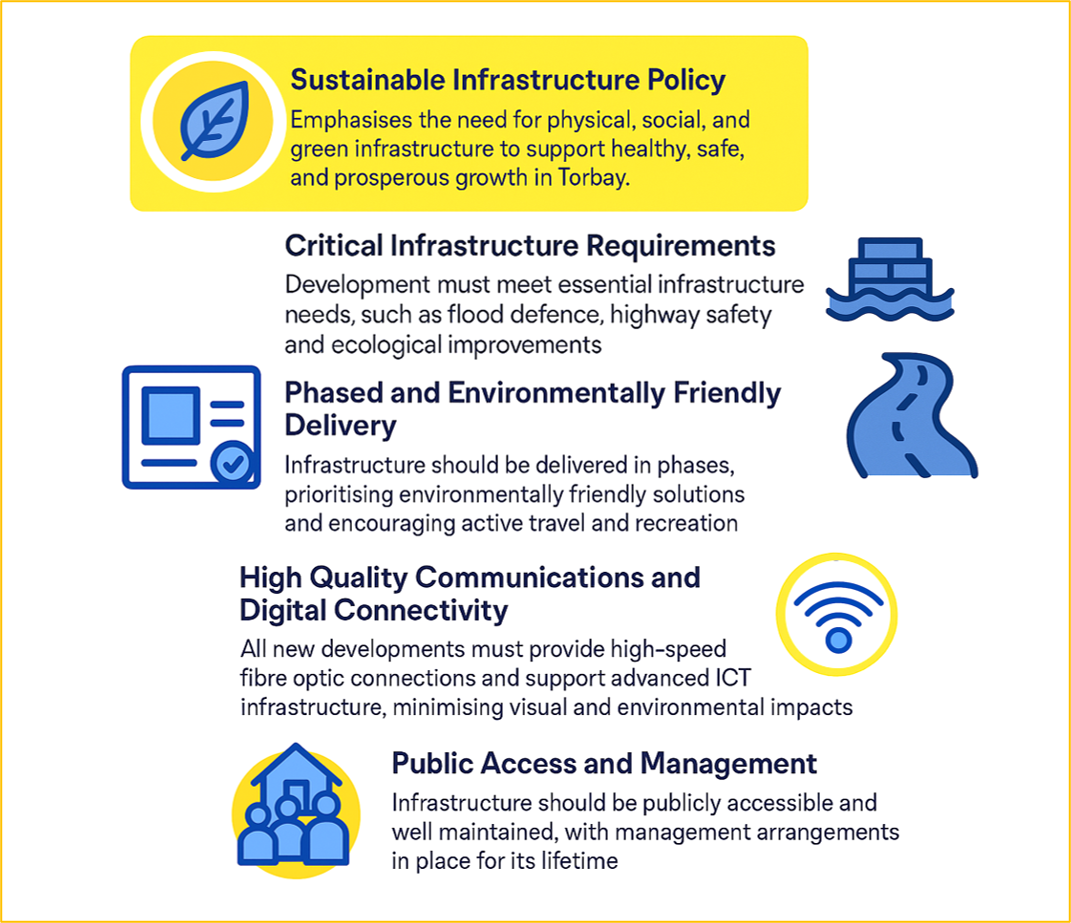
All development will be expected to provide the physical, social and environmental infrastructure needed to make it acceptable in planning terms. A range of physical, social, green and blue infrastructure will be sought in order to help Torbay grow in a sustainable, healthy, safe, and prosperous way.
Development must:
- Provide or contribute to the infrastructure required to meet the needs that development generates, having regard to its scale, type and location.
- Ensure timely delivery, including phasing where necessary, so that infrastructure is in place to support development.
- Prioritise sustainable delivery and outcomes, including climate resilience, biodiversity enhancement, sustainable transport and healthy, inclusive communities.
- Provide infrastructure on-site where possible and appropriate
Development that does not meet critical infrastructure requirements such as those including, but not limited to, flood defence works, highway safety, water and sewer capacity, waste, and/or ecological/environmental improvements to meet Habitats Regulations requirements will not be supported.
Where onsite provision of infrastructure is not possible or appropriate, developer contributions will be sought to achieve offsite provision in accordance with the hierarchy set out in Policy IN1. A planning obligation will be required to secure the infrastructure necessary to make development acceptable in planning terms.
New Infrastructure Projects
The council will take a supportive approach to the development of new or improved infrastructure meeting the needs of the Bay, particularly infrastructure that is of strategic importance, subject to an assessment of the proposal’s impacts including on amenity, the natural environment (including any European Wildlife Sites), landscape character, and the historic environment, and any necessary mitigation measures.
In the planning and design of infrastructure projects, opportunities to co-deliver environmental benefits (including habitat creation, ecosystem services (as defined in Glossary), and social benefits (including increased opportunities for social interaction, active travel and outdoor recreation), should be maximised.
Community and Corporate Plan – Pride in Place
Explanation
7.1The full range of physical, social and green and blue infrastructure projects needed over the plan period will be set out in an Infrastructure Delivery Plan, developed with input from infrastructure providers. The Local transport Plan, Local Cycling Walking Infrastructure Plan, Bus Service Investment Plan and The Torbay Green Infrastructure Delivery Plan also set out green and blue infrastructure needs.
7.2The Torbay Local Plan 2012-30 was supported by an Infrastructure Delivery Study (PBA 2013) that outlined Torbay’s infrastructure needs. This will be updated as part of the Local Plan preparation and a new Infrastructure Delivery Plan produced.
7.3Most of Torbay’s infrastructure requirements are likely to fall within Torbay Unitary Authority’s boundaries. Wider infrastructure such as water and electricity supply are covered by other regulatory and funding regimes. The need for cross-boundary infrastructure contributions will be kept under review, but are not currently proposed. The exception to this is likely to be where development affects Habitats Regulations matters.
7.4There are likely to be different ways in which infrastructure can be provided. The council will seek in particular the delivery of environmentally friendly infrastructure, such as sustainable drainage, water efficiency measures and renewable energy/micro generation solutions, so long as these have major biodiversity and recreation benefits and do not prejudice the effective operation of infrastructure or community safety. The infrastructure needs arising from a development will usually need to be met on-site through provisions made directly as an integral part of the development. Where appropriate, this will be regulated through planning condition or legal agreement. The council’s preferred means of achieving this will be for on-site infrastructure (notably including all internal roads and open spaces) to be transferred into the council’s ownership with financial contributions towards the council’s ongoing management and maintenance costs. Where safe and practical to do so, all infrastructure provided on-site will be publicly accessible, and will be supported by the necessary management arrangements to ensure that infrastructure is well maintained and fit for purpose for its lifetime. Where onsite provision of infrastructure is either not possible or not appropriate (such as sewage treatment or some nature based solutions), developer contributions will be sought to achieve offsite provision, in accordance with the hierarchy set out in Policy IN1.
7.5Infrastructure and service delivery should advance equity and should help close the gap between the most and least disadvantaged neighbourhoods and communities within the Bay. It is important that infrastructure facilities and services are well located in relation to need, and are accessible, useable and safe for all. It is important that, where negative impacts associated with new infrastructure are unavoidable, these impacts are fairly and equitably distributed, and that vulnerable or disadvantaged groups are not disproportionately burdened.
Strategic Policy IN1: Prioritisation of planning obligations View representations
Where possible and appropriate infrastructure will be provided onsite in accordance with Policy IN1. Developer Contributions will be sought for the provision of infrastructure, affordable housing and other matters required to make development sustainable in planning terms. Where S106 contributions are argued to make development unviable, an independent assessment of viability will be required, proportionate to the scale of the proposal before S106 requirements are relaxed. Where a reduction in contributions is agreed due to viability constraints, the following order of priority will be taken into account when reducing contributions.
Contributions will be sought on the basis of the impact of the specific development and needs arising from it. In seeking developer contributions, the following order of priority will apply:
- Site Deliverability Matters: The provision of critical infrastructure, e.g. flood defence works, highway safety, water and sewer capacity, and/or ecological/environmental improvements to meet Habitats Regulations requirements, and monitoring of obligations
- Healthy Environments including active travel and green and open space.
- Affordable housing
- Employment and Healthcare contributions
- Broader Sustainable Development Contributions (Public transport, Education, Lifelong learning, community facilities, Policing), offsite waste management, sports pitches and offsite open space
Where development pays CIL an equivalent reduction from Broader Sustainable Development Contributions will be granted.
Where policy requirements are not met due to an agreed viability reason, the s106 Agreement will include mechanisms for the deferred calculation of viability to ensure that developers meet their policy obligations where the viability of the development has improved at a later date.
Community and Corporate Plan – Pride in Place
Explanation
7.7Developer contributions towards infrastructure delivery will be sought in the form of the community infrastructure levy and/or section 106, as described in more detail in the council’s adopted CIL Charging Schedule, the Planning Contributions and Affordable Housing Supplementary Planning Document, and/or any subsequent local planning documents.
7.8Developer contributions may be pooled towards the delivery of strategic infrastructure elsewhere within the Bay where this would constitute the most effective and equitable means of meeting the infrastructure needs arising from the development.
7.9Policy IN1 seeks to set out the council’s priorities for S106 Contributions. More details are set out in the Planning Contributions and Affordable Housing Supplementary Planning Document (currently 2022, which will be updated as a supporting document to the Local Plan).
7.10Policy IN1 sets out the following priority order for Planning Contributions:
- Site Deliverability Matters. Critical infrastructure (also called “integral infrastructure”). This is physical and enabling infrastructure, which must be delivered on time to allow proposed development to proceed in narrow physical or safety terms (e.g. road access, flood defence works, sustainable drainage, sewerage capacity, water and electricity). Contributions for ecological mitigation etc. which are necessary to make development comply with Habitats Regulations requirements, particularly affecting the SAC, Marine SAC and Biodiversity Net Gain, will be treated as critical infrastructure. Where possible this will be delivered onsite although it may be covered by a S278 Highway Agreement or part of a S106 Agreement. The council’s preferred method of delivery is through transfer of open space, highways etc to the council for adoption, with a maintenance and monitoring fee.
- Healthy Environments. This includes the provision of accessible route for active travel, permeability between the site and nearby facilities, the provision of open space etc. Where possible this will be delivered onsite and should be integral to the design of development. although it may be covered by a S278 Highway Agreement or part of a S106 Agreement.
- Affordable Housing. This is covered in more detail in Policy H7
- Employment, Town Centre Regeneration. These will be sought to mitigate the impact of proposals that have an impact on town centres or result in the loss of employment See Policies E5, TO7 TC9 in Chapter 4.
- Wider sustainable development contributions. These are sought to support the infrastructure and other requirements that development generates a need for. Whilst not necessary to make development stand up or remain safe in narrow physical terms, such infrastructure is required to make development acceptable in planning terms. This covers public transport contributions, Education and Lifelong Learning, Health facilities, community wellbeing, spiritual and safety facilities, off-site provision of Playing pitches and strategic recreation facilities, offsite waste management facilities.
7.11The above priority list is a starting point only, and each application must be assessed on its merits to determine what obligations are necessary to make the proposal acceptable in planning terms, directly related to the proposal and fairly related to the scale and kind of development. For example, education contributions will not be sought from development of older peoples’ accommodation, although this may attract a higher level of healthcare contribution.
7.12Developer Contributions are usually provided through S106 Obligations, although conditions will be used where possible. The use of S106 Obligations is regulated by the Tests of Lawfulness set out in Regulation 122(2) of the Community Infrastructure Levy Regulations (2010 as amended) and the NPPF (paragraph 58 of the 2024 Framework). These require that obligations are:
- Necessary to make the development acceptable in planning terms;
- Directly related to the development; and
- Fairly and reasonably related in scale and kind to the development.
7.13 Mitigation will be provided from Sustainable Development Contributions for affordable housing provided through s106 Contributions or other mechanism that secure the housing as affordable in perpetuity.
7.14The council adopted a Community Infrastructure Levy (CIL) in 2017, and this will be updated as part of the Local Plan Update. Where development pays CIL the amount of CIL paid will be deducted from the Sustainable Development Contribution liability. However, Site deliverability matters must still be met irrespective of CIL. It is important that mandatory CIL relief for social housing and other matters is sought before development is commenced.
Viability Issues
7.15Whilst Torbay is a high-need area, it is not a particularly high value area, and the council recognise that development should be viable.
7.16A Whole Plan Viability Assessment is being prepared as part of the Plan preparation. Therefore, all developments are expected to meet policy requirements and developer contributions in full under normal market conditions. It is not possible for the Torbay Local Plan to anticipate extraordinary events that may occur during the plan period, and therefore it is accepted that abnormal costs or other circumstances may arise which impact upon viability to the extent that the full range of policy requirements and planning obligations set out in the local plan cannot be met.
7.17Where planning contributions are argued to render development unviable, a viability appraisal of the development proposal will need to be submitted by applicants. For major developments, the council will obtain an independent review of the submitted viability appraisal and will recover from the applicant its reasonable costs in doing so. The submitted viability appraisal and the independent review will be published by the local planning authority with the planning application documentation.
7.18The council will publish an updated Planning Contributions and Affordable Housing Supplementary Plan or guidance to support the Local Plan to expand upon the principles set out in Policy IN2. In the interim, the 2022 SPD will continue to apply. The council is entitled to charge a 5% administration fee for developer contributions and will update the figures for inflation.
Policy IN2: High quality communications and digital connectivity View representations
To the door fibre
All proposals for residential and commercial development should be designed to connect to high quality communications infrastructure including to the door fibre optic cabling. Where this is not possible, evidence will be required to show why the provision is not technically feasible.
Other ICT development
The introduction and installation of the most up to date and fastest telecom and other Information and Communications Technology (ICT) will be supported by the Local Plan. Applications for ICT developments will be supported where the following criteria are met:
- The opportunity to accommodate apparatus on an existing mast or structure in preference to new masts or structures has been fully explored;
- Telecommunication apparatus and associated structures have been sited and designed in order to seek to minimise impact on the visual amenity, townscape, character and appearance of the surrounding area;
- Development does not have an unacceptable impact, including cumulative impact, on residential amenity, landscape character or wildlife;
- Existing landscape features have been utilised and/or an appropriate landscaping scheme has been prepared to minimise the impact on the visual amenity, character or appearance of the surrounding area;
- If on a building, apparatus and associated structures should be sited and designed in order to minimise impact to the external appearance of the host building; and
- Underground facilities and ducts should be sited and laid to minimise harm to tree roots or areas of archaeological importance.
When considering proposals for telecommunications or other ICT equipment, the council will consider the operational requirements of telecommunications networks. It will be a condition of any approval given that any telecommunication apparatus and associated structures that subsequently become redundant will be permanently removed from the site and that land will be reinstated to its former condition or in accordance with details to be previously agreed with the council.
Community and Corporate Plan – Pride in Place
Explanation
7.19There has been a huge expansion in telecommunications and computing in recent years. Internet connectivity is now considered an integral part of everyday life and crucial to the success of most business operations. With the emergence of new services such as 5G services, streaming, the internet of things, home working and the expansion of internet capable devices, there is likely to be a continued very large increase in demand for bandwidth and persistent internet connection.
7.20The Plan cannot predict the future of technology although it is relatively certain that technological changes will happen quickly. It is important that the planning process is proactive in supporting and encouraging ICT networks to maximise their economic and social benefits.
7.21Policy IN2 sets out a supportive policy for Communications infrastructure, whilst seeking to minimise the impact of such equipment and making provision for sharing of masts etc. and the removal of redundant equipment.
