Torbay Local Plan Regulation 19 Publication Version and Consultation
Other elements in this consultation
Chapter 8. Climate Change - Our sustainable and resilient future View representations
Introduction
Strategic Policy CERS: Climate resilient, net zero carbon developments View representations
All development proposals will be required to be resilient to climate change and minimise carbon dioxide and wider greenhouse gas emissions.
Proportionate to their scale, they must minimise greenhouse gases, including carbon dioxide, and demonstrate how they:
- Apply a climate resilient approach to ensure the development is adapted to cope with a changing climate, including design to minimise overheating, use water efficiently and utilise green and blue infrastructure to help cool external spaces
- Minimise the risk and impact of flooding (including coastal where appropriate), through the location of development and including the use of nature-based solutions e.g. using sustainable drainage of surface water using features such as rainwater harvesting and reuse, infiltration areas, soakaways, porous pavements, attenuation wetlands and tree pits, green roofs/walls.
- Minimise heating and cooling energy demand and associated emissions of greenhouse gas emissions, using layout, orientation and built form
- Apply a fabric first approach to maximise energy efficiency
- Maximise renewable and low carbon energy generation[1]
- Maximise water efficiency and seek to achieve a water efficiency standard of no more than 100 litres per person per day
- Minimise the use of materials and creation of waste and promote opportunities for a circular economy
- Maximise opportunities to enable travel by sustainable means by prioritising integrated, accessible and inclusive development that reduces reliance on private motor vehicles, in accordance with Policies TAS and TA1.
- Achieve a minimum of 10% measurable biodiversity net gain and ensure that on-going management measures are in place
Proposals will be required to submit an Energy and Climate Change Statement, proportionate to the scale of the proposal indicating how the requirements listed above are to be met. As part of their wider Energy and Climate Change Statement, major developments will also need to include a climate resilience assessment and a transport assessment and travel plan.
Community and Corporate Plan – Climate Resilience
Explanation
8.1 A healthy, happy and prosperous Torbay for all is what Torbay Council’s Community and Corporate Plan aims to achieve by 2040. Ensuring that our residents and businesses are able to adapt to a changing climate is an important part of achieving this vision for Torbay. This is why our Corporate Plan commits the council to continue to tackle the climate emergency for a sustainable future.
8.2Beyond natural processes, humans have contributed to the release of more and more carbon dioxide emissions (and other greenhouse gases) into the air. This causes global temperatures to rise, resulting in long-term changes to the climate, known as climate change[2]. This means that our planet is facing huge environmental challenges. Our economy and society are also experiencing the impacts of a changing climate. Devon may face more river and surface water flooding, coastal flooding and erosion, reduced water availability, temperature change and extreme heat/cold and a range of negative impacts to key infrastructure, services and our wider economy and society (Devon Cornwall and Isles of Scilly Adaptation Strategy).
8.3To help play our part in reducing carbon dioxide emissions and to prepare Torbay for a changing climate, Torbay Council declared a climate emergency in 2019 and, with partners, will work towards creating a net zero carbon Torbay[3] by 2050.
8.4This target is in line with the current UK government’s net zero target by 2050. This is incredibly challenging. Success will only be achieved through all organisations, individuals and institutions playing their part. In 2024, The Torbay Climate Partnership approved the Greener Way For Our Bay Framework and Action Planhttps://www.torbay.gov.uk/council/greener-way-for-our-bay/ (GWFOB). This outlines a pathway to a net zero carbon Torbay by 2050 and a set of immediate actions to be carried by a range of partners across Torbay. This Local Plan needs to play a part in achieving a net zero carbon Torbay by 2050. A range of policies throughout the plan aim to reduce the amount of additional carbon emissions arising from new development and prepare and build climate resilient developments.
8.5Many actions that help tackle climate change and reduce energy use and carbon emissions will also have a number of other benefits, like helping create warm, healthier homes, free from damp and mould in winter, alleviating fuel poverty[4] by creating homes that use less energy and have lower energy bills and through renewable energy generation, homes that have their own resilient source of clean energy, with less reliance on imported energy.
8.6The National Planning Policy Framework 2025 outlines that the planning system should support the transition to net zero by 2050 and take full account of all climate impacts. It should also help to shape places in ways that contribute to radical reductions in greenhouse gas emissions.
8.7The following policy therefore plays a key role in ensuring that new developments make a full contribution towards meeting the GWFOB priority actions of making new buildings that are nice to live and work in, designed to limit the impact on the environment and help Torbay, and the wider UK, increase resilience to a changing climate and contribute towards the transition to net zero carbon by 2050. It also will help create future developments that are good for the occupants and are warm, healthy, developments that generate their own energy and have lower energy bills.
8.8The NPPF requires plans to take a proactive approach to mitigating and adapting to climate change (See NPPF 2025 paragraph 162). Plans should help to: shape places in ways that contribute to radical reductions in greenhouse gas emissions, minimise vulnerability and improve resilience; encourage the reuse of existing resources, including the conversion of existing buildings; and support renewable and low carbon energy and associated infrastructure.
8.9Making sure Torbay is healthy, happy and prosperous for all will require new development to be able to cope with a changing climate and minimise associated economic and social impacts, whilst working towards reducing area-wide carbon emissions.
8.10The GWFOB contains 10 priority actions and takes a long-term approach to mitigate emissions and adapt to climate change. In line with this framework’s priorities to make a) new buildings that are nice to live and work in, b) designed to limit the impact on the environment, c) promote and increase the uptake of renewable energy generation, d) provide a range of low carbon, affordable and accessible transport, e) make our naturally inspiring coast and countryside help tackle climate change, this policy brings together the NPPF’s and GWFOB’s key elements to ensure development prepares for local climate impacts and supports the transition to net zero carbon by 2050.
8.11New homes and commercial properties should be designed to adapt to a changing climate. They should be appropriately resilient to the impact of storm events including the effects of driving rain, high winds and surface water flooding and heat events. New buildings will need to also limit their propensity to overheat by optimising orientation, shading and layout.
8.12The provision of green and blue infrastructure can play an important part in helping to build climate resilience into developments. In the form of landscaped spaces, tree cover, green roofs and walls, all can be used to lessen overheating through shading, reduce storm water run-off, reduce external ambient temperatures and improve biodiversity. Major developments are required to submit a detailed Climate Resilience Assessment covering how the development has been assessed for a changing climate and measures to be introduced to increase climate resilience. As a minimum this must cover a, b, c and f of the GWFOB priority actions. The Met Office’s Local Authority Climate Service can assist developers understand how the local climate of Torbay will change up to 2100.
8.13Creating homes and buildings that use little to no energy, use energy efficiently and generate energy from low/renewable energy sources are vital to achieving net zero carbon by 2050. Locally, it will also help to create thermally comfortable homes, reduce cold-home related illness, reduce energy bills and reduce the numbers of homes in fuel poverty.
8.14Building Regulations have been improved to conserve energy and reduce carbon emissions. The government’s Future Homes Standard seeks to deliver homes that are zero carbon ready from 2025[5]. The government has also set out a new Future Buildings Standard which provides a pathway to deliver new non-domestic buildings that are zero carbon ready from 2025. At the time of writing, we are still awaiting the implementation of these new standards from 2027. The council will keep the government’s progress in achieving these standards under review.
8.15Maximising onsite renewable energy generation through technologies such as solar photovoltaic panels and air, water or ground source heat pumps will cut emissions through provision of low/zero carbon forms of energy generation and help the occupant to have lower electricity bills. Community-led renewable and low carbon energy schemes also have an important role to play in our net zero carbon transition and are encouraged to come forward.
8.16Water efficiency is about reducing our use of water and the effect our homes and buildings have on water resources. The effects of climate change may increase the pressure on water resources. Torbay already faces hose pipe bans during times of low water availability. Warmer summers are likely to increase water consumption and reduce available supply.
8.17Pressure on water supplies can be addressed in part by water efficiency measures to reduce consumption. Improving the efficiency of water use, has multiple benefits of reducing bills whilst also reducing the need to extract and treat water from the environment and reducing the amount of water flowing into the sewer system, thereby helping to protect the environment, reduce carbon production and reduce flood risk. Water efficiency measures may include dual flush toilets, low flow bathroom and kitchen fittings, low water consumption appliances, grey water and water recycling systems, water butts and other on-site water retention systems. All development will achieve a water efficiency standard of no more than 100 litres per person per day.
8.18Development should follow the waste hierarchy and reduce waste, reuse or recycle waste generated on site. Disposal of waste should be the last option.
8.19The circular economy, which involves sharing, leasing, reusing, repairing, refurbishing and recycling existing materials and products for as long as possible, is important. Developments should choose materials that can be used again and again, reduce waste and the associated manufacturing and transport-related carbon emissions. In accordance with the principles of the circular economy, any infrastructure and development should be underpinned by sustainable waste management, whether it be in relation to construction or ensuring that new homes have appropriate layouts for waste collection services.
8.20 Increased traffic volumes are likely to arise from new developments and if not managed effectively are likely to cause localised pollution and congestion, increase greenhouse gas emissions and reduce the attractiveness of an area for others. New developments must mitigate these traffic impacts. Measures designed to enable people to make sustainable travel choices, such as developments designed for pedestrians with provision of cycle lanes, access to and improved local buses, car clubs, car sharing and electric charging plug-in points can all assist with reducing transport impacts.
8.21In addition to the submission of an Energy and Climate Change Statement, Major developments will be required to demonstrate they have maximised opportunities for sustainable travel and will make adequate provision to mitigate the likely impacts of traffic through provision of a transport assessment and travel plan. All other developments generating new or additional journeys will be required to submit a transport statement unless there are significant transport implications arising. Particular attention should be had to Local Cycling & Walking Infrastructure Plan containing priority walking, wheeling and cycling routes, and the bus service improvement plan with network and infrastructure enhancements.
8.22New planning implementation guidance/ or similar will be developed to provide further guidance.
Policy CER1: Net zero carbon development standards View representations
From adoption of the Plan, all developments will have the following requirements:
- residential development, as a minimum, to achieve a 75% carbon dioxide emissions reduction from that required under Part L of the 2013 Building Regulations.
- non-domestic development, as a minimum, to achieve:
- A fabric standard at least as good as that required under the current Building Regulations;
- Heating using a heat pump or heat network (which does not utilise fossil fuel); and
- Solar PV panel coverage equivalent to 40% of the building's foundation area for both side-lit and top-lit zones
In addition, future growth areas and all major greenfield sites (10 dwellings or 1000 sqm) will be required to achieve net zero carbon emissions through solar PV or other measures. New development should connect to an energy network where there are existing proposals or schemes.
Any major, high-density future growth area or greenfield site (10 dwellings or 1000 sqm) with expected high heat demand must demonstrate that consideration has been given to whether it is feasible and viable to develop a local energy network. Given the scale of development likely to come forward, local energy network assessments are required in the Torquay Gateway and West Paignton SDT policies.
Major Non-Residential Development will be required to meet the most up to date BREEAM ‘Excellent’ standard. Where the ‘Excellent’ Standard cannot be achieved, evidence must be submitted with an application to the satisfaction of the council. The BREEAM ‘Very Good’ standard must be met as a minimum.
For all development (including hotels) proposals which involve the change of use or redevelopment of a building, or an extension to an existing building, resulting in a change in energy status[6] the proposal will be required to demonstrate in the Energy and Climate Change Statement how energy demand has been reduced to the lowest practical level using energy efficiency measures, heating/cooling systems have been selected for their energy performance and that on-site renewable energy will be installed unless evidenced to be unfeasible.
Significant weight will be given to the benefits of development resulting in considerable improvements in line with industry best practice approaches such as Net Zero Operational Carbon and to the energy efficiency and reduction in carbon emissions in existing buildings.
All development must submit an Energy and Climate Change Statement to the local planning authority for approval and implementation, demonstrating how they fulfil the above principles.
Community and Corporate Plan – Climate Resilience
Explanation
8.23 The GWFOB aims to create priorities to make new buildings that are: a) nice to live and work in b) designed to limit the impact on the environment and c) locally, increase the uptake of renewable energy generation. To achieve this The Torbay Local Plan is likely to be adopted around the introduction of the Future Homes Standard (FHS) and the Future Building Standard (FBS). These Standards are being introduced by the government to deliver highly efficient homes and buildings which are zero carbon ready, better for the environment and better for the occupants. For occupants, new developments will create warm, healthier homes, free from damp and mould in winter and help alleviate fuel poverty[7] by creating homes that use less energy and have lower energy bills. Through renewable energy generation, homes will also have their own resilient source of energy and be less reliant on imported energy.
8.24The FHS should ensure that all new homes built from 2027 produce at least 75% fewer carbon emissions than homes delivered under the Building Regulations Part L (Conservation of fuel and power in buildings) 2013. It is expected to be achieved by higher fabric and energy efficiency standards, as well as heating sources that do not utilise fossil fuels and the installation of solar PV panels.
8.25 The new FBS requirements for non-domestic buildings will also produce significantly fewer carbon emissions and will require heating sources that do not utilise fossil fuels and the installation of solar PV panels.
8.26This will significantly reduce the regulated[8] operational emissions for a typical building and make an important contribution to achieving net zero, whilst, for the occupant, increasing thermal comfort and reduce energy bills, fuel poverty and cold-home related illness.
8.27 In accordance with the government’s expressed intention to introduce the FHS and FBS in 2027, Policy CER1 seeks to ensure that the level of ambition is achieved. Should the introduction be delayed this policy provides a local back-up to the net zero national ambition. The council will keep the government’s progress in achieving these standards under review
8.28Torbay has limited potential for large-scale renewable energy generation like wind farms and district heat networks. This means that to reach net zero carbon by 2050 all homes need to play a part by generating their own clean energy. Therefore, the Local Plan needs to maximise small scale renewable energy generation wherever possible on new developments. It will also help reduce occupants’ energy bills. Therefore, this policy seeks to go beyond FHBS and require new developments to achieve net zero carbon and help create warm, healthier homes that use less energy and have lower energy bills.
8.29The FHS will lead to an increase in heat pumps across all new developments. Some heat pumps have permitted development rights. Those types that do not, and require planning permission, will be supported where proposals avoid unacceptable impacts upon amenity and the natural, historic and built environment.
8.30It is expected most buildings will achieve net zero carbon through achieving the Future Homes/Building Standard plus the installation of additional roof mounted solar PV panels, where appropriate, feasible and viable. Net zero refers to having zero regulated carbon dioxide (CO2) emissions associated with a building’s annual operational energy consumption. Achieving net zero will require the combination of constructing a highly energy efficient building using a fabric first approach, plus on-site or connection to off-site renewable electricity generation. It will require the annual generation of onsite zero carbon electricity to balance energy consumption from ‘regulated’ energy. Regulated emissions include CO2 emissions arising from energy use regulated by Part L of the Building regulations (e.g. space heating, domestic hot water, fixed lighting etc).
8.31Policy CER1b seeks to facilitate delivery of net zero carbon homes as soon as possible, prioritising fabric improvements which bring thermal comfort and lower energy bills, through for instance, high efficiency glazing and minimal heat loss from walls, ceilings and roofs. Where schemes cannot achieve all the requirements through fabric improvements, ‘top-up’ solutions are permissible such as Solar PV arrays to generate low carbon electricity, and finally payments to an approved carbon offsetting fund where necessary. Carbon offsetting should be considered only as a ‘last resort’. A Torbay fund will be established and administered by the council and will be collected via Section 106 agreements. Funds will be allocated to low carbon projects within Torbay, where additionality is clear, focussing on retrofitting existing housing stock, with a focus on lower income households and community energy projects. The council will prepare the terms for a carbon offsetting fund with external partners and further guidance will be published.
8.32Local energy networks[9] can play a role in helping an area to meet its net zero carbon ambitions. They use less energy and emit less carbon emissions by co-producing heat and power which is shared across a network to heat and power buildings. To date, Torbay does not have any large local energy networks. Major development should connect to such networks or communal heating networks where they arise in the future.
8.33Any large scale residential or non-residential development must demonstrate that consideration has been given to whether it is feasible and viable to develop, or be connected to, a local energy network.
8.34There is no exact formula for determining if a new development is suitable for the development of a new local energy network. However, major, high-density mixed development proposal with an anticipated high heat demand will lend themselves to such networks, especially if in close proximity to sites with excess waste heat or areas with known natural heat sources such as underground geothermal heat. Given the scale of development likely to come forward across Torbay, a site-specific local energy network assessment is required for development that comes forward within the Torquay Gateway and West Paignton areas (See policies SS1, SDT3, and SDP3) and all future growth areas or greenfield site (10 dwellings or 1000 sqm).
8.35All Major, non-domestic, developments are also required to meet BREEAM standards. This is a well-established and measurable means of delivering the policy outcomes above, and to achieve a sustainable development that minimises a range of other environmental impacts.
8.36 Energy and Climate Change Statements are also required for conversions and material change of use applications, where the conversion to a new use, will result in a change in energy status. Change to energy status is defined in regulation 2 (1) of the Building Regulations 2010 or most up to date version. A change to the energy status is when a building was previously exempt from the Building Regulations energy efficiency requirements but now is not. The change to energy status applies to the building as a whole or parts of the building that have been designed or altered to be used separately. For example, when a previously unheated space becomes part of the heated building.
8.37New planning implementation guidance/ or similar will be developed to provide further guidance.
Policy CER2: Embodied carbon reduction and assessment View representations
All new development will be expected to demonstrate how they will minimise embodied carbon emissions.
Proposals for major development will be required to include an embodied carbon assessment as part of the Energy and Climate Change Statement. This assessment must use a nationally recognised embodied carbon assessment methodology and demonstrate actions taken to reduce embodied carbon emissions.
All development, including demolition that involve one-for-one replacement of existing dwellings must demonstrate why it is not feasible or viable to refurbish existing dwelling(s).
All applications must demonstrate how these requirements are to be met in an Energy and Climate Change Statement
Community and Corporate Plan – Climate Resilience
Explanation
8.38Embodied carbon emissions are those typically associated with any processes, materials or products used to construct, maintain, repair, refurbish and repurpose a building and eventual material disposal.
8.39Embodied carbon from the construction and refurbishment of buildings currently makes up 20% of UK built environment emissions[10]. As operational emissions from buildings continue to reduce, embodied emissions will make up a greater proportion of a building’s total carbon emission. Work carried out for the Royal Institution of Chartered Surveyors suggests that embodied carbon currently makes up between 35% and 51% of a building’s total emissions, rising to 70% as operational energy decarbonises[11][11]. For this reason, the Local Plan seeks to start to address this increasing issue. Reducing embodied carbon emissions is extremely hard to achieve. This policy aims to introduce consideration of these emissions and actions to reduce them. No target is set through this policy but ensuring embodied carbon emissions are reduced as far as possible through good design and planning, will make a significant difference to reducing embodied carbon emissions and further support the transition to net zero by 2050.
8.40Developments should:
a) be encouraged to prioritise the renovation or retrofit of existing structures, as part of an efficient use of land, and subject to other local plan considerations
b) select highly efficient building design and quality materials and systems which:
- Have low embodied carbon, including transport emissions;
- Minimise the need for replacement over the lifetime of the development;
- Can be reused, recycled and disposed of sustainably at end of life;
c) Ensure that materials are reused and recycled whenever possible, and that waste is minimised in design. Ensure that this is designed in from project inception to completion.
d) Ensure that new buildings are flexible and adaptable to future uses, reducing the need for future redevelopment.
e) All development, including demolition that involve one-for-one replacement of existing dwellings must demonstrate why it is not feasible or viable to refurbish existing dwelling(s). Where it is not feasible or viable a clear plan must be in place to demonstrate that adequate steps have been taken in the design of the new development to reduce embodied carbon and impacts.
f) Demolition of historic buildings which are in a state of considerable disrepair will only be acceptable where robust evidence can be provided to the satisfaction of the local planning authority that the building has not suffered from neglect and that the repair and reuse of the building would not be viable or that significant public benefits, including a lower net-carbon solution for the site to outweigh the heritage harm caused, can be delivered.
8.41Given the impact a major development can have on embodied carbon emissions, they will also be required to include an embodied carbon assessment as part of the Energy and Climate Change Statement. To calculate embodied carbon emissions, a nationally recognised embodied carbon assessment methodology such as RICS and conform to BS EN 15978. All submissions should also demonstrate actions taken to reduce identified embodied carbon emissions. An Embodied Carbon Delivery Checklist will be developed to help all major developments meet this requirement.
Policy CER3: Heritage assets and climate adaptation
Proposals that help to increase resilience to climate change and secure a sustainable future for historic assets and non-designated heritage assets will be supported where they:
- preserve or enhance the significance of the asset
- facilitate their sensitive re-use where they have fallen into a state of disrepair or dereliction (subject to such a re-use being appropriate to the specific heritage asset)
Community and Corporate Plan – Protecting and enhancing Torbay’s heritage / Climate Resilience
Explanation
8.42Within Torbay there are 24 conservation areas, 13 scheduled monuments and approximately 865 listed buildings as well as numerous non-designated heritage assets, so it is vital that they play a role in contributing towards Torbay’s net zero carbon target by 2050 (and so buildings can become warm, healthy and with lower energy bills).
8.43To safeguard our heritage assets and to sustain our cultural heritage for future generations, our heritage assets need to be adaptable to, and protected from, the effects of climate change. Historic buildings can also positively contribute towards reducing carbon emissions through sensitive and sympathetic adaptations that secure their retention, repair, retrofit and reuse alongside the conservation of their significance. The embodied energy (the energy used within the materials and construction activities) in historic buildings means that their retention aligns with the ambition to reduce carbon emissions and the priority to conserve heritage assets.
8.44Sympathetic adaptation that preserves the building is required to improve energy efficiency, reduce emissions, enable renewable energy generation and/or enable the building to adapt to climate change. Adaptation may require alterations to heritage assets or development within their settings. A holistic view should be taken when considering such alterations. This should balance the need to safeguard the future of the asset and its conservation, and where appropriate, enhancement, of its significance.
8.45Historic England offers information and advice on many related topics including energy efficiency and historic buildings. Historic England Advice Note 18 sets out more detail regarding their requirements for adapting historic buildings for energy and carbon efficiency.
8.46New planning implementation guidance/ or similar will be developed to provide further guidance.
Policy CER4: Renewable and low carbon energy generation View representations
Renewable and low carbon energy-generating development[12], including energy networks and community projects and all related enabling infrastructure (including battery storage and other energy storage facilities or recovery of waste heat or cooling and proposals that support the transition to a smart, flexible, and zero carbon energy system) will be supported where proposals avoid unacceptable impacts upon amenity and the natural, historic and built environment. Clear evidence of local community involvement and leadership will be given substantial positive weight.
Energy-generating development that is neither renewable nor low carbon will not be permitted[13]
Community and Corporate Plan – Creating a Sustainable Future
Explanation
8.47 The Greener Way For Our Bay (GWFOB) aims to support the national decarbonisation plans for electricity and promote the uptake, locally, of renewable energy generation. In addition, the NPPF states the planning system should support the transition to net zero by 2050 and should increase the use and supply of renewable and low carbon energy and heat. The UK government's "Clean Power 2030" target aims for a clean power system by 2030, with at least 95% of our power coming from low-carbon sources. The use and supply of renewable and low carbon energy and heat will play a vital contribution towards local and national net zero carbon targets by 2050. By driving forward new low carbon technologies, we can cut the use of fossil fuels for heating our homes.
8.48Previous studies[14] carried out show a lack of abundant natural resources to supply clean energy in Torbay. The constrained nature of Torbay and proximity to nationally significant landscapes and marine designation, limits capacity for clean energy generation, through large, stand-alone, wind turbines, solar farms and low carbon heat networks. However, technologies are developing all the time and may give rise to new opportunities such geothermal heat. Therefore, this policy aims to be flexible and support the clean power transition where appropriate for Torbay. The Local Plan also aims to maximise smaller scale clean energy generation like roof top mounted solar. This is covered in more detail in Policies CERS and CER1.
8.49Major developments are encouraged to include land for larger scheme such as solar PV and wind turbines and be accompanied with some means of longer-term energy storage, to draw-down electricity when required.
8.50Communities are also encouraged to develop their own low carbon/renewable energy proposals, through neighbourhood plans. The benefits of which can include community ownership, revenue, and local jobs.
8.51Where renewable and low carbon energy-generating development comes forward, the council will not require applicants to demonstrate the overall need for renewable or low carbon energy. The approach set out in this policy aims to help increase the use and supply of renewable and low carbon energy and heat as it arises.
8.52Energy networks are vital to making net zero a reality in the UK. In high density urban areas, they are often the lowest cost, low carbon heating options. This is because they offer a communal solution that can provide heat to a range of homes and businesses by capturing or generating heat locally. By driving forward new low carbon technologies like heat networks, we can cut the use of fossil fuels for heating our homes and shield households from oil and gas price rises that are being pushed up by pressures on global energy markets. The Energy Act 2023 provides the powers for government to implement heat network zoning in England through regulations. These zones will be introduced from 2025. If a zone is highlighted in Torbay this policy will be updated to support the development of the zone.
Strategic Policy ER1: Flood Risk and Safe Development View representations
Proposals must demonstrate that all proposed development, including access and egress, is safe for its lifetime, taking into account all sources of flood risk (including ground water), future use, and the impacts of climate change. It must follow the sequential approach, prioritising sites with the lowest flood risk and ensuring land use vulnerability is appropriate to the location.
All proposals must be accompanied by a Flood Risk Assessment (FRA), proportionate to site size, location, and flood zone/critical drainage area. The FRA must demonstrate that:
- Development is located appropriately, guided by the sequential test where applicable, favouring areas at lowest flood risk.
- The development is safe for its entire lifetime, considering the latest Environment Agency climate change projections and future flood risk.
- The development does not increase risk as a consequence of flooding, including risk to life through higher occupancy levels or reduced ability of occupiers to respond safely.
- In higher-risk areas, where the development can be justified in principle, the development is designed and laid out to be resilient to flooding and to avoid harm to third parties.
- Mitigation measures are incorporated, including:
- Sustainable Drainage Systems (SuDS)
- Water Sensitive Urban Design (WSUD)
- On-site water storage.
- Mitigation measures must control runoff, reduce downstream flooding, and improve water quality, having regard to the sensitivity of receiving waters, including the Marine Special Area of Conservation (SAC). In addition, they must include provision for safe exceedance flow routing, ensuring that rainfall events exceeding the design capacity of drainage systems are managed without increasing risk to people or property.
- Proposals must comply with local and national strategies and guidance, including the Local Flood Risk Management Strategy, SuDS Design Guidance and the Strategic Flood Risk Assessment (SFRA).
- Where flood defences exist, development ensures long-term effectiveness and maintenance, potentially contributing financially toward upgrades.
- Development does not restrict access to watercourses or flood defence assets for maintenance or improvement.
Proposals that enhance floodplains, restore natural drainage, or open culverts are encouraged, particularly where they:
- Reduce flood risk
- Improve water quality
- Enhance biodiversity
- Provide amenity or recreational benefits
- Reduce flows to the combined sewer network or slow the movement of water through the catchment
Development of basement accommodation, including changes of use, conversions or basement parking, will not be permitted in flood zones 2 or 3 or areas identified in the SFRA at high risk of flooding (including climate change allowances).
Development must demonstrate that it will not contribute to cumulative increases in sewer loading or flood-related discharges that could increase pollutant inputs to the Marine SAC.
Development which contributes to downstream flooding or increases discharge from combined sewer overflows (CSOs) during flood events will not be permitted unless appropriate mitigation is secured and the necessary flood protection measures referred to above are in place and operational. Developers will be required to contribute to these works as appropriate (see Policies INS, IN1 and ER2).
Development will be resisted where maintaining flood defence infrastructure required to retain the existing level of protection would result in disproportionate costs or generate substantial obligations for the public sector.
Community and Corporate Plan – Climate Resilience
Explanation
8.53This policy seeks to ensure that development is located, designed and managed to minimise flood risk and remain safe for its lifetime, taking account of climate change and all sources of flooding.
8.54Given the constrained nature of Torbay’s catchments and the designation of the area as a Critical Drainage Area, Flood Risk Assessments are required for all development. These must take account of the latest evidence, including the Strategic Flood Risk Assessment (SFRA) and the latest Environment Agency climate change allowances for fluvial, tidal and surface water flooding relevant to the site location and lifetime of development. Relevant information sources include the SFRA, Environment Agency flood maps, surface water flood mapping, groundwater flood risk data and other locally available evidence. Site-specific assessments should be informed by the most up-to-date information available at the time of submission.
8.55All development is required to apply the sequential approach to direct growth to areas at lowest risk, having regard to the vulnerability of the proposed use. Where development is necessary in higher-risk areas, robust mitigation and careful design will be required to ensure safety and to avoid increasing flood risk elsewhere.
8.56Managing surface water is a key part of reducing flood risk. Development is expected to incorporate Sustainable Drainage Systems (SuDS), Water Sensitive Urban Design, and other measures that control runoff, reduce downstream impacts, and improve water quality. Further detail is set out in Policy ER2.
8.57 Flood risk in Torbay is closely linked to the performance of the combined sewer network. Increased surface water flows can lead to sewer surcharge and increased discharges from combined sewer overflows, with implications for water quality, including effects on bathing waters and the Marine Special Area of Conservation. Development must not increase these pressures and, where possible, contribute to their reduction.
8.58Further detail on flood risk, drainage constraints, and infrastructure requirements is set out in the Flood Risk and Water Management Topic Paper.
Strategic Policy ER2: Drainage Hierarchy View representations
All development, including changes of use, must minimise the generation of surface water run-off and improve surface water management on the site. Proposals must seek to reduce surface water discharge to the combined sewer network and will be supported where this is achieved.
Development must not discharge surface water in the combined sewer network. Where this is robustly demonstrated to be the only feasible option, appropriate mitigation must be secured to ensure no overall increase in the volume and rate of surface water discharge to the combined sewer network.
Prior to consideration of discharge options within the drainage hierarchy, drainage strategies should maximise opportunities for:
- The use of permeable surfaces, natural features and vegetation to maximise infiltration of surface water
- Water reuse and rainwater harvesting for re-use on the site
All development must adhere to the drainage hierarchy in the table below, prioritising infiltration and discharge to watercourses wherever feasible. Only where it is evidenced that ground infiltration is not possible can the next method of water disposal in the hierarchy be investigated.
Table 16 The drainage hierarchy, listed in order of priority:
|
Drainage Hierarchy: |
|
|
1. |
An adequate ground infiltration system (for example swales, soakaways, infiltration basins, filter drains, rain gardens). This option must be fully explored and only discounted where the Local Planning Authority (LPA) is satisfied that it is not feasible |
|
2. |
A main river or water course |
|
3. |
A surface water sewer or highway drain |
|
4. |
As a last resort, where the above drainage solutions have been fully investigated and robust evidence provided to justify why they cannot be utilised, development may be permitted to discharge surface water to a combined (foul and surface water) sewer, where: a) discharge rates are restricted to greenfield rates, and; b) the requirements of Table 14 and Policy NCS2 are met |
Table 17 Development requirements when disposing of surface water in the combined sewer
|
Where discharge of surface water to a combined sewer is proposed, it will be subject to Habitats Regulations Assessment (HRA) and must demonstrate that: |
|
|
a) |
there will be no adverse effect on the integrity of the Marine Special Area of Conservation (SAC), either alone or in combination with other plans or projects, as a result of increased pressure on the sewer system and the associated risk of sewer spills; |
|
b) |
appropriate mitigation measures are secured and delivered, such as a planning contribution towards strategic sustainable drainage improvements to reduce pressure on the sewer system and ensure there is no net increase in surface water discharge into the combined sewer network, and; |
|
c) |
there is a reduction in impermeable area of the site (with a minimum target of 20%) to enhance opportunities for rainwater absorption through permeable natural surfaces. Where this is not feasible the council may seek a planning contribution to deliver urban greening elsewhere within the catchment. |
All development proposals must provide robust evidence and information to enable the Local Planning Authority to assess potential effects on the Marine SAC.
Development will only be permitted where adequate wastewater and drainage infrastructure capacity exists or will be delivered in time to ensure no adverse effect on the Marine SAC. Financial contribution towards infrastructure improvement, or works in kind, may be required in order for development to proceed. Planning conditions or obligations will be used to prevent occupation until such infrastructure is in place.
Where necessary, planning obligations will be used to secure monitoring and management of drainage infrastructure and its impacts on the sewer network. Planning conditions to remove Permitted Development rights may be used to prevent cumulative impacts as a result of urban creep.
The Council will monitor the cumulative effects of development on the sewer network and the Marine SAC, including combined sewer overflow performance. Where monitoring indicates deterioration or risk to site integrity, additional mitigation will be required and development may be restricted.
Community and Corporate Plan – Climate Resilience
Explanation
8.59The primary objectives of Policy ER2 are to achieve a net reduction in surface water discharge to the combined sewer system and to manage surface water run-off sustainably.
8.60The Torbay Sewer Capacity Assessment (SCA) hydraulic modelling suggested that the sewer network will face substantial challenges due to the cumulative impacts of increased sea level rise and rainfall, urban creep and population growth. The assessment highlights that the cumulative impact of many small-scale changes across the urban area, including household development and the gradual loss of permeable surfaces, can significantly increase pressure on the sewer network over time. For this reason, opportunities to reduce surface water run-off should be maximised for all development proposals, regardless of scale.
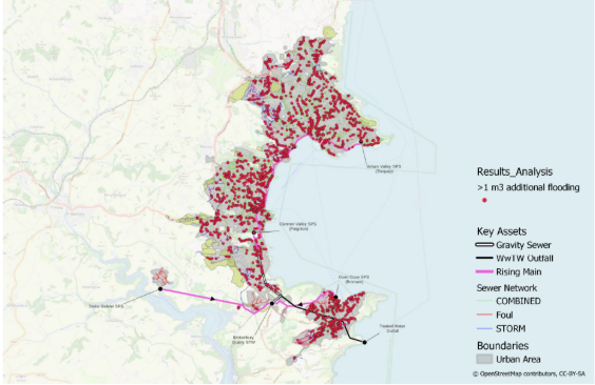
8.61Figure 19 illustrates flooding detriment due to development foul flows, urban creep across the whole catchment and 50% climate change allowance. This assumes a growth rate of 300 dwellings a year, but no mitigation works. For this assessment, the critical level has been taken as 0.5m below the manhole cover. This is the point where water level may impact upon low lying property by causing flooding or restricted sewer use. It should be noted that the results have been generated from a relatively extreme rainfall event and must be viewed as an indicator of modelled performance, rather than of the likelihood of actual sewer flooding occurring.
8.62The SCA predicts an 11% increase in combined sewer overspills (CSOs) by 2040 due to higher rainfall from climate change, population growth, and urban creep from the existing built areas. Increased CSOs would harm the features of the Lyme Bay and Torbay Marine SAC, reduce Torbay’s bathing water quality, and negatively impact tourism—all highly sensitive to water quality changes.
8.63 To avoid impacts on the Marine SAC the risk of increased CSO spills and sewer flooding must be prevented. All development must reduce the amount of rainfall that is discharged into the combined sewer system through adherence to the drainage hierarchy. Prior to considering discharge options within the drainage hierarchy, proposals should maximise opportunities for surface water infiltration, water reuse and rainwater harvesting on site. This may include measures such as green infrastructure, permeable surfaces, rainwater harvesting systems and SMART water butts. SMART water butts should not be relied upon within drainage calculations unless their performance and storage capacity can be robustly demonstrated.
8.64In accordance with advice from SWW, proposals seeking to discharge surface water into combined sewers will be subject to increased scrutiny. Developers must clearly justify why higher-priority disposal methods in the hierarchy cannot be used, to avoid adding stress to the network.
8.65Brownfield or town centre developments are not always able to meet steps i-iii of the drainage hierarchy and may seek to discharge surface water into the combined sewer system at a controlled rate. Natural England has expressed serious concerns about the effect of combined sewer overflows on the integrity of the marine reefs within the SAC. The cumulative impact of surface water and population increase is likely to result in increased CSOs, which has an adverse effect on the integrity of the Marine SAC.
8.66Development must demonstrate no likely significant effect (LSE) on the Marine SAC, including cumulative impacts. In order to achieve this, proposals will need to show that they avoid or cancel out the risk of increased run-off, and thereby an increased risk of spills.
8.67However, where proposals are reliant upon discharge to the combined sewer system, posing a risk of increased spills, it is likely that they will contribute to a likely significant effect on the Marine SAC and will require Appropriate Assessment, including an assessment of ‘in combination’ effects. In these instances, mitigation measures will be required and the council may require a planning contribution towards strategic sustainable drainage improvements to reduce surface water within the combined sewer system when development disposes of surface water in this way.
8.68 Where adverse impacts on a SAC may occur, there is a need for assessment of mitigation measures under the Habitat Regulations to determine the acceptability of proposals. As a result, development will be required to submit detailed drainage arrangements prior to determination so that the council can assess whether it can reasonably be achieved with no adverse impact on the SAC due to the cumulative effects.
8.69Minimisation of surface water run off can further be achieved using green infrastructure features which improve the potential for natural absorption of rainwater, such as soakaways, rainwater harvesting and reuse, green roofs, infiltration areas, porous pavements, attenuation wetlands and tree pits. All development should maximise these sustainable water management features.
Strategic Policy ER3: Water Management View representations
Proposals must not have an unacceptable impact upon the water environment. As such all development must submit a water management plan (proportionate to the scale of development) demonstrating how the below criteria have been satisfied:
- The design of buildings and the surrounding environment (including pavements, highways, parking areas, driveways, gardens, public green spaces, planting and drainage) maximises Water Sensitive Urban Design (WSUD) and the provision of natural flood management measures and is resilient to the ongoing and predicted impacts of climate change. The design of development must maximise natural and permeable surfaces (impermeable surfaces will only be permitted as the exception where it is demonstrated natural/permeable are not possible).
- All development must treat water as a valuable resource by minimising water consumption and optimising water efficiency:
- New homes (including conversions) will be expected to demonstrate how they will achieve an estimated water consumption of 100 litres or less, per person per day.
- Non-residential development will be required to achieve full credits for category Wat 01 of BREEAM unless demonstrated to be impracticable.
- Development must avoid harm to surface waters (including rivers and coastal waters), sensitive water-reliant habitats, species and sites protected under European legislation, and the quality and quantity of groundwater. Regard should be had to the cumulative effects of developments; (Refer to Policies ER2 and NCS2)
- Where development is located within Groundwater Source Protection Zones (SPZs) or where there is a risk of adverse effects on aquatic ecosystems from the development or its construction, Pollution Prevention Plans must be prepared and submitted as part of a planning application;
- Development must provide appropriate connection to the public sewer and complies with the requirements of Policy ER2.
- Development must deliver appropriate mitigation measures in accordance with the government’s current Water Framework Directive objectives.
Community and Corporate Plan – Creating a Sustainable Future
Explanation
8.70This Policy seeks to minimise the effect of development on water bodies, deliver Water Framework Directive objectives, support water resilience, reduce pressure on water supply and wastewater infrastructure, and implement mitigation measures set out in the South West River Basin Management Plan and Torbay Water Cycle Study.
8.71Under the Water Framework Directive, development must not cause deterioration in water quality status. The council will ensure compliance, and seek development to bring about improvements to bathing waters and marine habitats through its design and off-site contributions where appropriate.
8.72Evidence from the Environment Agency, South West Water, their joint position statement, and the Torbay Water Cycle Study (2026) supports the need for water resilience measures in all development. The Water Cycle Study identifies water supply and wastewater infrastructure constraints and a shortfall between planned growth and the housing assumptions within South West Water's Water Resources Management Plan. A water efficiency standard of 100 litres per person per day is therefore justified to reduce water demand and wastewater generation. Reducing wastewater flows will also help minimise pressure on the sewer network and wastewater treatment infrastructure, reducing the risk of combined sewer overflows that could adversely affect the integrity of the Lyme Bay and Torbay Marine SAC. Water consumption should be calculated using the methodology in Approved Document G of the Building Regulations.
8.73 The design of new developments should incorporate water efficiency and consumption measures, such as rainwater and greywater recycling, low flow taps and showers, low flush toilets, rain gardens and water butts in the construction of new buildings. These measures will help reduce potable water demand and wastewater generation, supporting the achievement of the policy’s water efficiency standard.
8.74Where development poses a significant risk to the water environment, either through the construction process or operation, a Pollution Prevention Plan (PPP) will be required. The PPP must identify how adverse effects on aquatic ecosystems, such as the marine SAC) and socio-economic assets (e.g., bathing waters) will be managed. Physical or chemical modification of water bodies will be resisted where it harms their function or damages habitats.
8.75Groundwater is an invaluable source of water for public supply, industry, agriculture and rivers but is vulnerable to a range of activities, such as pollution from industrial uses or infilling in the urban area. The council will refuse proposals that pose an unacceptable risk to groundwater and may require measures, such as Sustainable Drainage Systems (SuDS), to minimise or remove the risk. The use of natural SuDS such as swales, soakaways, infiltration basins, filter drains and rain gardens will be the preferred approach.
8.76The age and capacity of shared sewers, particularly in Paignton, and the limited baseline wastewater treatment capacity at Brokenbury Wastewater Treatment Works, are a major infrastructure constraint. Policy W5 and Policy ER2 address wastewater disposal and surface water discharge in more detail. Better use of existing infrastructure and water efficiency will be as important as new sewerage infrastructure in ensuring a sustainable future. Development must provide adequate sewerage infrastructure to cope with increased sewage and surface water, including the impact of extreme weather events. Foul and surface water drainage should be separated to reduce the likelihood of flooding and contamination downstream. Water conservation and reuse measures, such as rainwater harvesting and natural sewage treatment (e.g., reed beds), are encouraged. Development phasing may be required to align with critical water and drainage infrastructure improvements and Grampian conditions used to ensure phased and timely infrastructure development to serve growth.
Policy ER4: Sustainable Drainage Systems and Water Sensitive Urban Design View representations
Sustainable Drainage Systems (SuDS) must prioritise the use of above ground, biodiverse solutions and be incorporated into development proposals in a holistic and imaginative way so that they form an integral part of green and blue infrastructure, providing multi-functional benefits including amenity, water quality, recreation, flood management and biodiversity.
SuDS should be designed to provide a safe, naturalised, accessible system minimising the need for fencing or barriers. Consideration must be given to the vulnerability of existing site surroundings, including buildings, ground conditions, ecology, landscape, heritage, safety, and public health, in relation to the design, maintenance and management of surface water features.
Well-designed SuDS should deliver multiple benefits, contributing to biodiversity net gain, climate adaptation and high quality public space. All Sustainable Drainage Systems must incorporate appropriate treatment stages to remove pollutants prior to discharge.
Development incorporating Sustainable Drainage Systems (SuDS) must have regard to the most recently adopted Torbay Council SuDS Design Guide and the National Standards for Sustainable Drainage Systems.
Where necessary, development may be required to contribute to improvements to existing drainage infrastructure.
All development should treat rainwater as a valuable resource for the benefit of people and the environment and utilise a Water Sensitive Urban Design (WSUD) approach to delivery of water sensitive places. This should integrate the management of water within the design of buildings, public spaces and landscapes to reduce runoff, improve water quality, and enhance amenity. Where urban areas are being regenerated the retrofitting of water sensitive urban design is a high priority.
Community and Corporate Plan – Creating a Sustainable Future
Explanation
8.77At the top of the drainage hierarchy is infiltration to Sustainable Drainage Systems (SuDS). SUDS mimic nature and are designed to take account of water quantity (flooding), water quality (pollution) and amenity issues. They are more sustainable than traditional drainage methods because they:
- Reduce flooding by managing runoff volumes and flow rates from hard surfaces
- Protect or enhance water quality
- Protect natural flow regimes in watercourses
- Are sympathetic to the environment and the needs of the local community creating a better place to live and work
- Provide a natural habitat for wildlife
- Promote evapotranspiration from vegetation and surface water
- Recharge groundwater and natural aquifers
8.78Water Sensitive Urban Design (WSUD) integrates water cycle management with the built environment through the use of Sustainable drainage systems (SuDS) and by embedding water management within the design and layout of development, rather than treating it as a standalone drainage function.. In towns and cities, space for water can be created in areas that are not traditionally ‘designed’ to manage water. Blue corridors can be created in existing urban areas to channel and attenuate run off through a development whilst enhancing green infrastructure, biodiversity and public amenity. SuDS schemes should make provision for the maintenance and management of schemes so that they remain effective and safe.
Policy ER5: Contaminated Land and Site Remediation View representations
Development proposals must take the following environmental considerations into account:
- Where identified or suspected contamination presents a risk to public health and safety, buildings, structures or the natural environment, appropriate investigations and remedial or precautionary measures will need to be agreed with the council; and
- Developers will need to demonstrate that any identified or suspected contamination can be satisfactorily overcome without risk to health.
- The council will seek to support and subsidise the removal of contamination where it achieves wider public benefits including town centre regeneration, provision of employment or affordable housing.
Community and Corporate Plan – Pride in Place
Explanation
8.79Prioritising brownfield sites will often mean that contaminated land needs to be reused. Whilst contamination is not generally a significant issue in Torbay, there are several important sites where previous or current land uses suggest a remediation strategy will need to be agreed with the council before development commences.
8.80Whilst contamination needs to be removed and sites rendered safe, some such sites are often very sustainably located for brownfield regeneration, and the council will seek to support their regeneration, including through the flexible use of developer contributions, where this meets the legal tests.
8.81The council has prepared a Contaminated Land Strategy in accordance with the Environmental Protection Act 1990 – Part IIA.
8.82The council will request appropriate site investigations and reports to be undertaken to assess the ground conditions and to identify the remedial, preventative and precautionary measures that will be required. The examination of any development site may need to consider surrounding land and activities, including any pathways through which a pollutant could potentially transfer. The sensitivity of the proposed end use is especially relevant, particularly where residential development is proposed with gardens; sites with a history of contamination could present risks from growing vegetables or dermal contact with soils. The degree of exposure, in terms of the time users of a development spend staying in an area, will be taken into account. Site investigation reports and recommendations for remedial, preventative or precautionary measures must be submitted with major planning applications.
Policy ER6: Ground stability and risk management
Development proposals must take the following considerations into account:
- Appropriate investigations and remedial or precautionary measures will need to be agreed with the council where identified or suspected ground instability presents a risk to public health and safety, buildings, structures or the natural environment; and
- Developers will need to demonstrate that any identified or suspected ground instability can be satisfactorily managed throughout the lifetime of the development in order for development to proceed. This applies particularly, but not just to, land within the Coastal Change Management Zone and Coastal Vulnerability Zone.
Community and Corporate Plan – Creating a Sustainable Future
Explanation
8.83Ground stability is an issue in the immediate coastal area and inland due to the natural movement of the ground and underlying strata or bedrock. The impacts of climate change can also result in ground stability issues. Where land stability has been identified as a concern or is suspected, developers will be expected to undertake a geotechnical investigation in accordance with the council’s requirements. Conditions will be attached to planning permissions to ensure necessary procedures are followed. See also Policies ER7 ‘Coastal change management areas’ and Policy GE1 ‘Geodiversity’.
Policy ER7: Coastal Change Management Areas View representations
New residential development (including through change of use) will not be permitted within a Coastal Change Management Area (CCMA).
To reduce the impacts of physical changes to the coast and the impact of these changes on coastal communities, new development or the intensification of existing development in Coastal Change Management Areas will be limited to the following:
- Essential infrastructure[15] (including relocation) where there are clear, costed plans to manage the impacts of coastal change, and it will not have an adverse impact on rates of coastal change at the site or elsewhere;
- Changes of use to a use that would reduce the exposure of people, property and critical infrastructure to the impacts of coastal change, where the use requires a coastal location and would provide substantial economic or social benefits to the community;
- Key community infrastructure, requiring a coastal location to provide the intended benefits, where there are clear, costed plans to manage the impact of coastal change and the service it provides;
- Adaption measures to existing buildings, businesses and infrastructure, which increase resilience to flood risk and coastal change;
- Temporary siting of development directly linked to the coastal strip (such as beach huts, cafes/tea rooms, car parks and sites used for holiday or short-let caravans and camping);
- Water compatible development, where the CCMA risk is inundation;
- Minor extensions to established dwellings where the structural integrity of the shoreline would not be undermined.
All development must demonstrate:
- that it is consistent with policy statements for the local policy unit in the Shoreline Management Plan;
- that it will be safe over its planned lifetime, would not increase risk to life or property, and is designed, sited and securely fixed to minimise risks from coastal erosion, flooding and storm events, including ensuring that buildings and associated materials are not displaced or mobilised during extreme weather events;
- That it will not have an unacceptable impact on coastal change;
- that it conserves, or where appropriate enhances, landscape, seascape and townscape character, heritage significance and important coastal habitats, particularly where they are at risk from climate change impacts.
Where development is only appropriate for a limited period before the impacts of coastal change are expected to occur, planning permission may be granted on a temporary basis.
Within Coastal Vulnerability Zones, and in areas where there is uncertainty regarding the rate or extent of coastal change, development proposals must apply a precautionary approach and be supported by a site-specific assessment proportionate to the identified risks. The assessment must demonstrate that the development will remain safe throughout its planned lifetime and would not increase coastal erosion, instability or flood risk elsewhere.
The replacement, relocation or adaptation of essential infrastructure within a CCMA will be supported, where necessary to maintain the safe and effective operation of critical services, subject to compliance with the Plan as a whole.
Community and Corporate Plan – Creating a Sustainable Future
Explanation
8.84The National Planning Policy Framework (NPPF) requires plans to manage coastal change by avoiding inappropriate development in vulnerable areas and identifying Coastal Change Management Areas (CCMAs). These identify areas at risk from coastal erosion and, in some locations, inundation over the plan period. While much of Torbay’s coastline is currently defended, this does not remove long-term risks, particularly where there is uncertainty in the rate and extent of coastal change.
8.85Coastal change may affect land, property and key infrastructure. In Torbay, elements of essential infrastructure, including parts of the wastewater network such as rising mains, are located within CCMAs. Where there is uncertainty about the rate or extent of coastal change, risks to infrastructure and service continuity may increase. This may also add pressure to wider infrastructure constraints identified through the Water Cycle Study and Habitats Regulations Assessment.
8.86Within Coastal Change Management Areas, opportunities for development are necessarily limited by the need to manage long-term risks associated with coastal erosion, instability and inundation. The policy therefore takes a precautionary approach, seeking to minimise the future exposure of people, property and critical infrastructure to coastal change. Development should support adaptation to coastal change and avoid creating a reliance on future coastal protection measures that may not be sustainable or deliverable.
8.87This policy applies to both new development and the intensification of existing uses. Proposals that would materially increase the exposure of people, property, visitors, occupiers or critical infrastructure to coastal change will only be supported where they are consistent with the objectives of the policy and can demonstrate that risks can be appropriately managed throughout the lifetime of the development.
8.88Development within CCMAs should be resilient to coastal change over its lifetime. Proposals should consider site-specific risks, including erosion, inundation and storm events, and how these are addressed through design, siting and construction. This policy supports the replacement, relocation or adaptation of essential infrastructure where needed to maintain critical services, reflecting the need to respond to coastal change over time and ensure communities remain safe and functional.
8.89 The Coastal Vulnerability Zone identifies areas outside Coastal Change Management Areas where evidence indicates an elevated risk of coastal erosion, instability, inundation or other coastal change processes, including areas susceptible to cliff instability and ground movement. The designation is intended to ensure that development proposals are informed by proportionate site-specific assessment and apply a precautionary approach where necessary. Inclusion within a Coastal Vulnerability Zone does not mean that development is unacceptable in principle, but proposals will be expected to demonstrate that risks can be satisfactorily managed throughout the planned lifetime of the development and it would not increase risks elsewhere.
8.90Temporary planning permissions may be used where development can be accommodated safely for a defined period but is unlikely to remain appropriate over the longer term as coastal change progresses. This can help support coastal and marine businesses, tourism and community activities, while avoiding the establishment of permanent development in locations that may become vulnerable to erosion, instability or inundation during their anticipated lifetime. For the purposes of this policy, the planned lifetime of development should reflect the expected operational life of the proposed use, having regard to relevant national guidance and the anticipated effects of coastal change over that period.
[1] Use of appropriate technologies such as heat pumps, solar thermal / photovoltaic panels, wind turbines + others that are suitable to the location
[2] Climate change refers to a large-scale, long-term shift in the planet's weather patterns and average temperatures (MET Office). For more on climate change, what’s causing it and the evidence to support it please visit What is climate change? - Met Office
[3]Torbay will reduce its greenhouse gas emissions by 100% from 2008 levels by 2050
[4] With regards to a person in a fuel poverty, this is someone on a low income, that cannot keep their home warm at a reasonable cost.
[5]Expected Autumn 2025
[6] A change to the energy status is when a building was previously exempt from the Building Regulations energy efficiency requirements but now is not. The change to energy status applies to the building as a whole or parts of the building that have been designed or altered to be used separately. For example, when a previously unheated space becomes part of the heated building
[7] With regards to a person in a fuel poverty, this is someone on a low income, that cannot keep their home warm at a reasonable cost.
[9]Decentralised low carbon heat generation using district heating or communal heating networks to distribute heat locally.
[12] Includes a wide range of technologies that harness energy from water (hydro, wind, solar, clean hydrogen, geothermal, ground via bore holes, anaerobic digestion and new and emerging opportunities.
[13] With the exception of essential services and buildings, such as hospitals, that will still need backup power generation which are likely to be powered by fossil fuels.
[15] In the context of CCMAs, essential infrastructure is defined as: i. essential transport infrastructure (including mass evacuation routes) which must cross the area at risk; ii. essential utility infrastructure which must be located in a flood risk area or CCMA for operational reasons, including electricity generating power stations and grid and primary substations; and water treatment works that need to remain operational in times of flood; and iii. wind turbines.
